
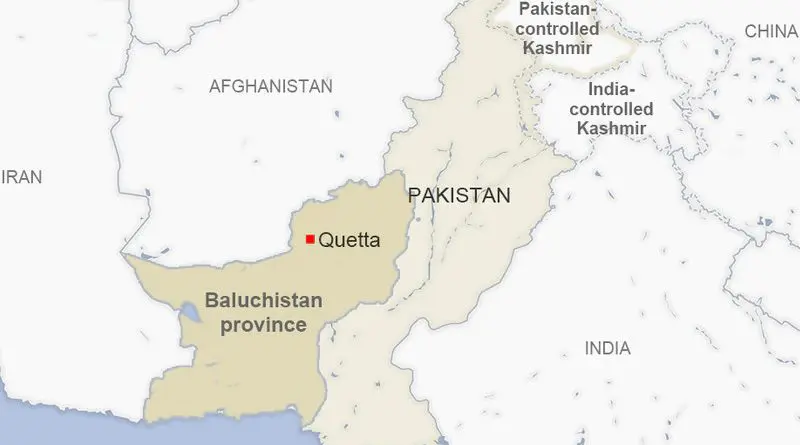
Balochistan And Mahrang Baloch – OpEd
In recent years, the narrative of “rights activism” in Balochistan has been increasingly manipulated by groups and individuals who claim to speak for the people, but whose actions expose direct affiliations with violent outfits. One such figure is Mahrang Baloch, leader of the so-called Baloch Yakjehti Committee (BYC). While Mahrang projects herself as a human rights activist, the facts point to a disturbing reality: BYC has repeatedly served as a proxy for terrorist organizations like the Balochistan Liberation Army (BLA) and the Balochistan Liberation Front (BLF).
Several incidents demonstrate BYC’s alignment with terrorist agendas. After the Jafar Express hijacking, Mahrang personally snatched the body of a BLA terrorist, attempting to portray him as a victim rather than a militant. In another case, she portrayed Wadood Satakzai—a suicide bomber glorified by BLA for the Mach attack—as a “missing person.” Similarly, she attempted to secure the bodies of terrorists involved in the Mach and Gwadar port attacks, incidents that caused immense loss of life and aimed to sabotage Pakistan’s economic future. The connection runs deeper. Her cousin and close bodyguard, Sohaib Langove, was killed in July 2025 as an active BLA saramchar in Turbat. Such personal and organizational ties reveal that BYC is far from a grassroots movement for rights; rather, it is interwoven with the very networks that destabilize Balochistan.
The BYC lacks any legal or constitutional standing in Pakistan. Yet, it deliberately mobilizes protests not for genuine grievances but to obstruct development and create instability. Its past gatherings in Gwadar were less about missing persons and more about blocking CPEC projects and disrupting Gwadar port operations—initiatives that promise jobs, infrastructure, and connectivity to the people of Balochistan. These protests became safe havens for militants, who mingled among the crowds under BYC’s cover. Such actions expose BYC as a calculated front, designed not for justice but to provide political space for terrorist actors.
Mahrang has gained international visibility by portraying herself as a human rights activist, but her contradictions expose her propaganda. She frequently claims to fight for “missing persons.” Yet, time and again, individuals presented by BYC as victims of enforced disappearances have later been identified by BLA and BLF as suicide bombers in attacks against Pakistani security forces and civilians.
Her admissions further discredit her stance. After Pakistan’s airstrikes on terrorist hideouts in Iran, Mahrang acknowledged that the families of those killed were present in her camps—proof that BYC provides political cover for militants and their families. Additionally, her foreign trips—to countries like Norway—have been less about advocacy and more about cultivating ties with handlers, raising funds, and securing international support for anti-Pakistan propaganda.
The symbiotic relationship between BYC and BLA cannot be ignored. BYC enjoys backing from Harbyar Marri, the absconded BLA leader based in London who lives in comfort while inciting bloodshed in Balochistan. Similarly, BYC openly campaigned for Zaheer Zeb, the brother of BLF leader Basher Zeb, further confirming its alignment with BLF, another RAW-backed militant group. This alignment shows that BYC’s agenda is not about securing justice but about offering political legitimacy to groups engaged in extortion, abduction, and mass killings in Balochistan.
If BYC were genuinely concerned about human rights, its leadership would condemn the atrocities committed by groups like BLA, BLF, and NLA. These groups extort poor citizens, abduct innocents, kill pilgrims in Nushki, and slaughter Punjabi laborers in cold blood. Yet, BYC remains conspicuously silent. It has never denounced the killings of barbers, children, or women—because doing so would contradict its alignment with militants. This silence is telling: BYC stands not with victims but with perpetrators, trading on human rights rhetoric while ignoring the suffering of ordinary Baloch at the hands of insurgent groups..
The tragic irony is that while BYC claims to represent Baloch interests, it is complicit in robbing the very youth it claims to serve of opportunities for education, prosperity, and peace. Instead of empowering them, it manipulates them into becoming pawns in a broader geopolitical game. The case of Mahrang Baloch and the BYC illustrates how the language of rights and activism can be hijacked to mask violence and terrorism. Far from being a genuine movement for justice, BYC functions as a political proxy for BLA and BLF, exploiting humanitarian concerns to provide cover for militancy.
Pakistan must remain vigilant against such fronts and continue exposing their connections to terrorist networks. Equally important, the people of Balochistan deserve genuine movements that prioritize education, economic opportunity, and peace—not the false promises of organizations that trade their future for the agendas of militants and foreign patrons.

Like what you read?
Please consider supporting Eurasia Review. Thank you for your consideration!
