

John W. Kiser: A Chronicler Of Arab Humanity And Spirit – Analysis
Introduction
John W. Kiser is a rare creature in the contemporary world of belles lettres and popular history, a serious reader, a serious thinker concerning Arab history and culture, a serious seeker of spiritual knowledge and enlightenment. His writing is an uncharacteristic junction in western literature and between the rigorousness of historical research and the empathy of narrative storytelling, so that readers are capable of entering into the social, religious and spiritual life of Arab societies.
Most Western writing on the Arab world is caught up in a politico-centrism and/or orientalist clichés, (Esposito, 1998, & Nasr, 1997), and Kiser’s stories stand out not just for an empathy for the individual subject, but for moral judgment and intelligently nuanced historical considerations.
His work is translated into Hungarian, Turkish, and Thai, and includes biography, history and narrative non-fiction. His powerful works—The Monks of Tibhirine, and Commander of the Faithful—demonstrate his sustained concern with the ethical, spiritual, and historical facets of Arab life. In his works, Kiser portrayed his characters not as “caricatures of the epoch”, but as individuals who made choices and adopted values and engaged in moral reasoning that served to shape the civilizational and spiritual geography of their respective worlds (Kiser, 2003, & Kiser, 2008). It is a conscious act of storytelling; in giving readers the people who lived and died through historical time, he allows a little space for empathy, curiosity and contemplation.
The implicit argument of this essay is that as a group, Kiser’s novels make the case in a multifaceted, empathetic and deeply implicated with a moral framing in a way that cuts across the grain of dominant stereotypes and narratives in favor of cross-cultural comprehension. The study resituates Kiser’s works historically as its makes Kiser himself part of the inheritors of a movement and in the contemporary landscape, and teases out the ways he reads events, ethics, spiritual practices that the contemporary world, too, does. This humble article demonstrates that Kiser’s interest in Arab culture is not purely academic, and is informed by firsthand experience, moral reflection, and actual involvement in inter-religious dialogue (Gant, 2017). Examining Kiser’s narrative strategy, preoccupation with themes, and readings of history, the study also works to highlight Kiser’s enduring legacy of interfaith communication and cultural understanding.
Early life, professional life and perspective
The US-born John W. Kiser discovered his interests in business, the sciences and world affairs at an early age. He grew up in a world of current events, of other peoples, that would inspire, eventually, his studies of Arab history and mysticism. Kiser served as the president of Kiser Research Inc., a Washington, D.C., based consulting and technology broker firm specializing in acquiring advanced technology from the former Soviet Union and Eastern Europe, from 1981 to 1994. It was during this time that he trained his mind to analyze and think strategically, a mental skill that he applied to his historical and literary analysis.
For Kiser, the mid-1990s brought a life altering turn. In 1994, he spent a year in France, to refresh himself intellectually and spiritually, during this sabbatical he was able to live with and study Europe’s view on culture, history and religion (Johnwkiser.com, 2025). What it was, more importantly, was a time that provided Kiser with a narrow window to begin embedding himself into the Arab world, no longer a detached chronicler of history and culture, but rather an explorer of them. In fact, his French colonial history of North Africa and his literal engagement with Algerian, Moroccan, and broader Arab narratives would contribute significantly to his future literary endeavors. Kiser describes this as a time of ‘’formation,’’ which involved much of the ethical perspective and the narrative approach characterizing later works starting to become established (Kiser, 2008).
Kiser’s shift from tech entrepreneurship to literary and historical analysis was gradual and deliberate. He was trying to bridge the gulf between the perception of the Arab world in the West and the experience of living there. This tendency stands out in his continuing interest in humanized narratives, ethical introspection, as well as his religious intuition. Thanks to his know-how in the Arab world history and culture, he was able to write about Emir Abd el-Kader (Chtatou, 2024, October 23, & Chtatou, 2024, November 5 & 8), the Cistercians monks of Tibhirine (Chtatou, 2024, December 2) and the Arab fighters of the past in this scientific preciseness and moral acumen (Kiser, 2008). So Kiser’s career move was not just professional, but ethical, even philosophical: an effort to translate lived experience, historical memory and moral reflection into accessible, empathetic narrative.
Literary Works and Themes
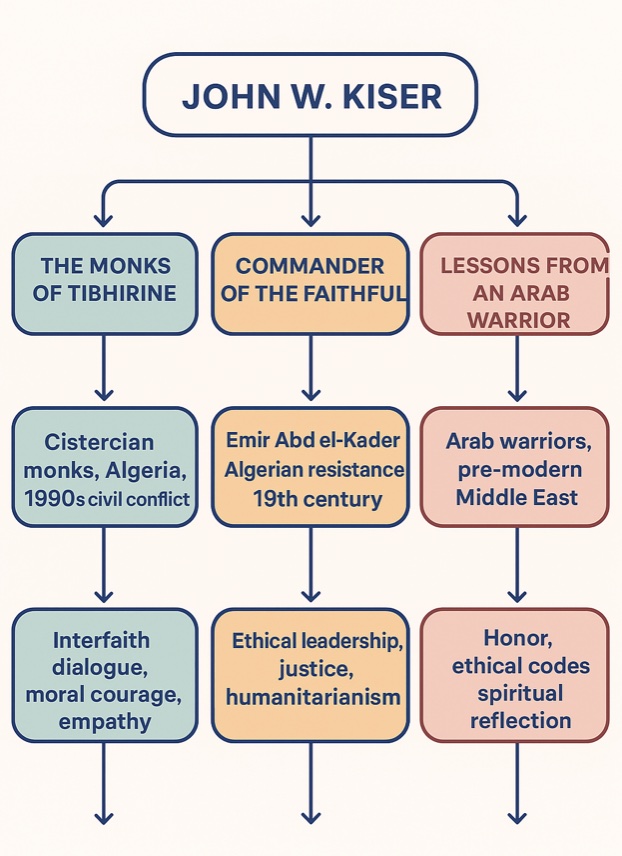
John W. Kiser works plunges the reader deep into an up-close-and-personal relationship with Arab religion, history and culture. They concern, that is to say, not only the play of history or a profile of a man, but as well an inquiry into the ethical, spiritual and cultural dimensions that must draw his reader toward an empathetic regard for the lives he is telling. With The Monks of Tibhirine (2003), and Commander of the Faithful (2008), the library now holds two of his most significant books, distilling his blend of historical research, narrative artistry and moral reflection.
The Monks of Tibhirine (2003)
The Monks of Tibhirine (Chtatou, 2024, December 2) recounts the fate of seven Trappist monks, kidnapped and eventually murdered during the 1990s Algerian Civil War. But at its heart, this is work is more than a story of events — it is an anatomy of interfaith encounter, moral courage and the human cost of conflict. Kiser embeds the story in Algeria’s overall politics and society, a country that is still struggling with the aftermath of French colonialism, an Islamic revival and political instability (Stora, 2001).
Central to Kiser’s narrative is the monks’ devotion to their Muslim neighbors in the region, and particularly their mission to bridge the two faiths, provide humanitarian service, and incarnate principles of compassion and humility. He reframes their choice to remain in danger within the categories of ethic and spirituality, placing their martyrdom in the context of both the Christian monastic tradition as well as of trans-religious moral norms (Kiser 2003). Kiser humanizes the monks and conveys their fears, doubts and relationships, allowing them to be not distant historical figures but humanized people with whom one can identify.
He depicts the monks’ honorable relationship with Muslim neighbors, as a tremendous human gesture for actual dialogue across religious and cultural divides. Kiser also explores the struggle between truth-telling and political brutality, rendering an ethical dilemma for people living in precarious times. As Kirkus Reviews notes, while it is a memoir of one man, Kiser’s story shines light on the bravery and moral decision making of those within times of societal tumult (Kirkus Reviews, 2000, December 15). In doing so, Kiser undermines our tendency to believe that history is simply what happens; it is instead the moral and ethical ground on which we stand or don’t on human values.
Commander of the Faithful (2008)

In Commander of the Faithful, Kiser adds a further chapter to the fraught history of Abd el-Kader, a 19th-century Algerian leader who resisted French imperial aggression. Kiser invites one to see Abd el-Kader not only as a political or military figure but also as a religious and moral leader whose model was that of a religiously-based just and compassionate rule (Kiser, 2008).
Kiser scrupulously meets the facts on the record as we currently know them, drawing on both archives, memoirs, and other secondary works, to locate the life of Abd el-Kader in the broader swerve of colonial militaries and local insurgents (McDougall, 2017). The book emphasizes the moral leadership as a leitmotif: Abd el-Kader always aimed to balance diplomacy, military strategy, and ethical accountability. Kiser is interested in the model that the Emir represented to the general public, and he points out the Emir’s protection of non-combatants, humane handling of prisoners, and a quest for balance between temporal and spiritual power, all of which provide contemporary ethical debate with a solid example of political values to which it can relate (Kiser, 2008).
Kiser makes the humane and genuine Abd el-Kader come alive, albeit a man who anguished himself over his choices and questioned the morality of his fight. In doing so he reduces what was an icon of history – God-like, unassailable – to someone whose humanity, whose sense of what is right, tell the reader what it is to be human today. The book’s opening sequences thwart facile binaries between colonizer and colonized, or Muslim vis-à-vis West, in favor of a delicate mapping of the possibilities of historical agency, cross-cultural engagement, ethical decision-making (Gant, 2017).
Overarching Themes Across Works
A couple of the themes run through these Two works:
- Humanising Arab and Muslim Subjects: Kiser humanizes Arab and Muslim figures, focusing on personal ethical decision, spiritual quest, and the frailty of humans with a flesh-and-bones approach ;
- Ethical and Spiritual Backgrounds: A constant factor in Kiser’s dramas is the representation of actions motivated by moral and spiritual principles, influenced by Sufi, monastic, and philosophical concepts ;
- Cross-Cultural Dialogue: Kiser promotes empathy and challenges Orientalist tropes with photos of interfaith collaboration and common value; and
- From history to histories: The telling of the subjects are situated within tension to its historical, political and social continuum, emphasizing its interplay of structure and agency (Esposito, 1998; McDougall, 2017).
Kiser’s literariness is not, therefore, biographical or historical, but moral, cultural, and pedagogical, by way of understanding, reflection, and ethical discernment. His work is a bridge between the Arab world and Western audiences, stories that are both educative humanizing and morally edifying.
Philosophical, Ethical, and Cultural Perspectives
There is a fundamental humanist ring of sound sense to the works of John W. Kiser. In all his works he is still plumbing the depths of the moral, spiritual and cultural aspects of his subjects, whether the otherworldly poverty of the Cistercian monks of Algeria, the principled leadership of Emir Abd el-Kader or the general moral legacies of Arabic warriors of yore. This narrative-philosophical approach to the issues of the ethical challenges in past history presents historical actors as reenacting acts of moral reasoning, of spiritual meditation, and of religious complexity (Kiser, 2003, Kiser 2008).
Humanism and Moral Philosophy
The core of Kiser’s view is that faith in human values is universal. His tales constantly remind readers of the need for understanding, integrity, courage, humility, and compassion, which he urges on us as universal values, pertinent even to multi-religious, multicultural, inter-temporal considerations. For instance, The Monks of Tibhirine (Chtatou, December 2) may be viewed as a portrayal of ethical courage: The monks exercise prophetic imagination by choosing to continue living in Algeria despite the imminent threat (Somner, 2012); put differently, the monks prefer human solidarity over individual safety and “are very well aware by being there that they will meet death” and “the monks display a noiseless moral duty to their neighborhood” (Kiser, 2003, p.314). In recognizing these alternatives, Kiser raises the question of the ethical responsibilities of communities and of events and meetings between cultures.
Similarly Kiser’s depiction of the personality of the Emir Abd eL-Kader is that of a moral and spiritual leadership, which encompasses more than just political expediency. Abd el-Kader’s championing of rules of treatment of prisoners or of the protection of non-combatants and his stance of principled struggle against colonial suffering all pointed to a picture of leaders whose inspirations were grounded in ethics and spiritual duty (Kiser 2008). Kiser’s attention to this moral dimension places the historiographical stories in the greater context of the meditation on morality; and the reader is invited to think about the relationship between virtue and action, between faith and responsibility.
By examining codes of ethics, principles of political leadership, and practices of ethical self-examination, Kiser gives evidence of an enduring line of moral thinking and decision-making in Arab civilization. By restaging ethical dilemmas and the appropriate action, Kiser promotes the construction of shared human values between cultures and within the historical period (Nasr, 1997). This kind of storytelling not only allows for a deeper exploration of the past but also fosters empathy and moral imagination among readers.
Sufi Influence and Spiritual engagement
The stories of Kiser expose a deep understanding of the psychological spiritual aspects of Arab history and culture and the influence of Sufism. Sufi ideas and, in particular, attitudes towards ethical self-examination, modesty, and moral education, inform much of Kiser’s work. For example, according to Chittick (1989), the moral deliberation of Abd el-Kader can be located in the Sufi-interdependent understanding of leadership wherein spiritual and moral growth is not antithetical to his military/political/social tasks.
Similarly, the monks’ interfaith work in Algeria echoes Sufi emphasis on acceptance, mercy and dialogue. The Kiser tales stress the role of spiritual comprehension in ethical living, and ethical behavior in the development of positive relationships among religious and cultural systems. In that respect he provides a history and biographical account where these appear in spiritual and moral transcendence – history, culture, faith and moral compound are with Kiser inseparable in what constitutes human deeds and human history (Stora 2001).
Western Attitude and Orientalism Rejected
What is significant in Kiser’s thinking is the manner in which his discourse counters the Occidental perception of the world of the Arabs. He dispels Orientalist clichés that all too often reduce Arab societies to a monolithic, irrational or intrinsically conflictual mass. By both compassionately seizing the truths of records and while simultaneously interrogating the minute offerings of the historical record, Kiser portrays Arabs as morally and intellectually complex actors confronting moral, political and spiritual challenges (Said, 1978, & Esposito, 1998).
Kiser sets out with this effort to address a twofold issue: the consistent shrinking of Arab peoples and culture to insistent stories of dispute and conflict and the fact that the eclipse instated the way in which ethical and contemplative aspects fashion social arrangements among Arabs. He also seeks to realize what he calls Arabness as a global moral-historical tradition to harmonize Westerners’ conceptions of humanity and cross-cultural harmony, a new world order.
Interfaith Dialogue and Cultural Literacy
Kiser’s writing is a tool of cultural literacy: He makes it possible for any thoughtful person who is totally ignorant of Arab civilization, spiritual sensibilities and ethical constructions to act as a diplomat among them. His emphasis on historical context, social proximity, and ethical argument supports interfaith empathy, and he argues that empathy and ethical reflection must come first before true dialogue can even begin (Nasr, 1997).
Moreover, the means Kiser uses to relate stories – the intertwinement of historical facts with imaginative heroics – enable the reader to inhabit persons of other faith traditions in their daily lives. It serves as a bridge of the mind and heart, a way to create understanding and compassion for unity and further intercultural conversation on a deeper level (Kirkus Reviews, 2008, & Chittick, 1989).
What we have, in short, in Kiser’s writings on the culture, ethics, and philosophy of the times finds a kind of synthesis when viewed in the closer light of his literary approach. His humanism, ethics, spirituality, critique of the prejudices of The West, and support of the dialogue among religions figure him as an enabler of dialogue among civilizations. In his writings, he demonstrates that both literature and history are not just collateral knowledge that serves as repository of events, but it constitutes moral, ethical resources, which can help in illuminating common values and fostering shared inter-cultural and inter-religious communication.
Arab History and Society in Kiser’s Narrative
The books written so far by John W. Kiser are a saga of personal lives, and a compelling peephole into Arab history, society and culture. If in too broad a sweep, Kiser situates the individual lives—the Cistercian monks and the Emir Abd el-Kader among them—within the social, political, and historical texture of the Arab world, with its complex and often contradictory set of social and gender practices in which Arab culture had been carried beneath the grip of an ancient system of religious power. His narratives, however, show how human agency and structural forces play with one another and offer readers an opportunity to judge Arab societies outside of the realm of Western clichés.
Algeria: Age-Old Grievances, an Intractable Conflict, a Legacy of Colonialism, and Ethical Leadership
Kiser’s works are largely set in Algeria, as in The Monks of Tibhirine and Commander of the Faithful. In The Monks of Tibhirine (Chtatou, 2 December), Kiser discusses Algeria during the civil war of the 1990s, a time that witnessed unprecedented brutal dynamics between the government and Islamist guerrillas (Stora 2001, & Esposito 1998). Instead, in the monks’ humanitarianism Kiser highlights the moral calculations that average people made as society disintegrated around them. He portrays “common” Algerians not simply as victims or perpetrators, but as ethically problematic actors buffeted by fear, survival and moral responsibility.
In Commander of the Faithful, Kiser returns to the 19th century Algerian anti-colonial struggle against the French, specifically concentrating on the Emir Abd el-Kader. Kiser here situates Abd eL-Kader’s personal piety and humanistic faith within a broader historical and social context. In juxtaposition with often brutal colonial policies of the French military, the humanity with which the Emir focused on the treatment of prisoners and of civilians demonstrates the complex moral leadership in a time of social and institutional change (McDougall, 2017, & Kiser, 2008). Kiser’s narrative brings out not only that Arabs had such high political value, but that, at the same time, they were ethically sensitive: their society was morally and spiritually meaningful.
In working over this Algerian material, Kiser breaks open simplistic histories of violence, fundamentalism, and abjection, demonstrating that ethical volition and spiritual insight can make history.
North African societies and inner moral code

Despite the continuing importance of Algeria in Kiser’s work, he engages also with wider North African cultural and spiritual geographies, including dimensions of Sufi life, forms of local governance in practice, and historical climates of social solidarity. By highlighting Sufism’s moral and spiritual efficacy, Kiser situates North African societies within a cultural logic of continuity, moral orientation, and social ethos (Chittick, 1989, & Nasr, 1997).
Kiser’s tales suggest that the religious traditions of the area engendered strength and moral obligation to combat colonial and post-colonial tribulations. The monastic and Sufi way of life, the adherence to inner moral and ethical codes in leadership, and the ties to a universal human values suggest an ethical, spiritual, and social responsible society. These portrayals challenge narratives that conceive North African societies as fixed, or uniform, and highlight the significance of the dynamic cultural and ethical conversations.
Case Studies: The Nuance of History and Culture
Kiser vividly portrays a three-dimensional life: though he is writing a biography, he does not construct Abd el-Kader as an ahistorical figure, but places him very much within a postcolonial memory of colonialism and national identity in Algeria. The moral leadership of the Emir is also an opening through which we can inquire about how postcolonial societies deal with historical trauma in natural and moral resource (Kiser, 2008, & Stora, 2001).
The Tibhirine Monks (Chtatou, 2024, December 2) illuminates the ethno-religious cohabitation. Kiser stresses that local Islamic groups and ‘’foreign’’ monks closely collaborated, respected and shared the same ethical and spiritual goals of each other also showing a ‘’correct’’ model of interfaith and of intercultural encounter (Kiser, 2003, & Chittick, 1989).
Synthesis: Arab History and Ethical and Human Narrative
Kiser’s representation of Arab history continually emphasizes that there’s no such thing as the merely political or military act, that everything is wrapped up in moral judgment, cultural intuitions and spiritual commitment. Exploring the relationship between agency, cognitive processes, and social institutions, Kiser presents an Arab history that is much like that of other humans and of humans in general.
Among his case studies of Algeria, Morocco, and the broader Middle East, Kiser’s account identifies persistent ethical structures, lively cultural forms, and deep spiritual questioning in Arab societies. This perspective challenges monolithic or skewed images, and brings to Western audiences more complex narratives of Arab history and periphery society (Esposito, 1998; Nasr, 1997, & McDougall, 2017).
Reception, Influence, and Critique
John W. Kiser’s works have been praised for opening the door so readers can walk into history, another culture, or a faith practice. Nevertheless, in the academic world and in civil society, his works have stimulated reflection on Arab history, spirituality, and ethics, as well as serious thinking on issues of narrative style, historical reading, and ethical argument.
Academic Reception
Biographies and historical accounts by Kiser are hotly recommended academic tools within the ethical leadership/cross-cultural engagement nexus. Specialists in North Africa and the Middle East, such as Stora (2001), appreciated the vast amount of archival work that went into Commander of the Faithful and The Monks of Tibhirine (Chtatou, 2024, December 2). By interplaying archival research, oral history and personal anecdotes, Kiser is able to create stories that work just as effectively as literary stories as they do informative historical documents (Kiser, 2003, & Kiser, 2008).
Academic reviewers also note Kiser’s focus on ethics and the spiritual, which they say is the result of a non-theological approach to political history. So if we reason according to that, Kiser argues that his portrayal of the Emir Abd el-Kader focusses on the Emir’s military and political strategy within an ethical and spirituel framework which in turn provides a more nuanced and mixed account of Algerian resistance and leadership (Gant, 2017, & Kiser, 2008). Again The Monks of Tibhirine (Chtatou, 2024, December 2) is highlighted for its interreligious mediating stances and moral conflicts in the Algerian civil war (Esposito 1998, & Stora 2001).
Still, some historians assert that Kiser’s creative reconstructions and narrative license can at times be hard to distinguish from historical record and empathetic imagination. While this device works to add depth and breadth to the story and to ignite interest, it has sparked conversations around the tension of historical accuracy and freedom to tap into the empathy of the reader (Kirkus Reviews, 2008, Gant, 2017). This makes Kiser’s books more, not less, valuable as tools of moral reflection, cross-cultural understanding, and historical encounter.
Public and Cultural Reception
As a gay Figaro, Kiser’s books have captured readers who seek multicultural understanding, interfaith dialogue, and historical biography. Reviews from major newspapers including Kirkus Reviews, Amazon and Barnes & Noble, raved about Kiser’s readability, moral wisdom and his ability to make history come alive (Kirkus Reviews, 2008).
Readers have frequently remarked on Kiser’s ability to reveal some of history’s most complicated and moral truths in the ordinary travails of human lives : The Monks of Tibhirine. In this context, we are challenged to read the lives of Tibhirine monks and many others as not glamorous figures or spiritual lives of those who have gone before us, but rather as emotional and ethical beings with which we are forced to reckon with to do real moral and historical thinking in thick, very subjective terms (Chtatou, 2024, December 2, Kiser, 2003, & Kiser, 2008).
Furthermore, Kiser’s efforts have been committed to encouraging interfaith understanding and dialogue where (Western constructs of) Islam and the Arab world (plagued by violence) are circulated in popular media. In humanizing this community, grounding ethical nourishment, and spiritual enrichment, Kiser fosters empathy, understanding, and efficacious interaction with religious and cultural difference (Nasr, 1997, & Chittick, 1989).
Critical Appraisal
There has also been criticism of Kiser’s writing, but he has also received considerable praise for his work. Some discussion points that have been as hot as could be for academics and reviewers include:
– Historical Re-creationism vs. Literary License: A few critical remarks on Kiser’s work note the way in which certain vignettes occur as a result of imagined conversation or a speculative re-creation of the historical past, thereby blurring the distinction between historical facticity and the literary imagination. (Kirkus Reviews, 2008, & Gant, 2017) This technique undoubtedly raises reader engagement and encourages moral reflection, but it comes at the expense of a certain kind of historial objectivity.
- Moral Exemplars: Kiser’s emphasis on moral\spiritual exemplars of should abstain from violence like Abd el-Kader or the monks of Tibhirine (Chtatou, 2024, December 2) in itself is not an idealizing one; at times Kiser still could have engaged in the process of idealizing his subjects by presenting them as ideal types rather human beings that are complex and deeply flawed (Esposito, 1998). That it was a story choice tailored to his pedagogical and ethical needs, though, does not make it any easier to make an argument for balance or nuance.
– Western Audiences: Critics argue that Kiser’s works are ultimately aimed at the West, which needs its moral lesson and cultural enculturation, thereby allowing for the construction and interpretation of history and spiritual context of the Arabs (Said, 1978, & Esposito, 1998). This does not diminish his role as a cultural mediator in the “service” of bridging the gap between two positions, however.
Influence and Enduring Contribution
Kiser has had an effect on general readership, which include:
- Enhanced Cross-Cultural Reading Ability: With its religious, moral and ethical aspects, Kiser provides westerners with a mode of thought with which to supplement the image of Arab society that his offered reading is beyond caricature and strife (Nasr, 1997, & Chittick, 1989) ;
- Moral and ethical reflection: Kiser’s portrayal of moral dilemmas makes readers consider virtue, justice and responsibility between past and present ;
- Interreligious discussion: There is a strong emphasis upon shared human values, empathy and moral engagement which may lead to a conscientising process between Christian, Muslim and secular audiences (Kiser 2001, & Stora 2001) ; and
- History education: Through readable biographies and narrative histories, Kiser makes complex people and times accessible to a broad audience (Kirkus Reviews, 2008).
So, Kiser is at the intersection of history, literature, and moral pedagogy, but his work goes beyond academic discourse and classroom lessons by requiring readers to confront an empathetically, reflectively alien coping, and perhaps re-coping, with their moral temperament and cultural belief by narrative-proxy.
Collected, Kiser’s books and articles have been lauded, not only for their literary quality, but also for ethical revelation and depth of historical inquiry. Sure, there’s the longstanding argument about the reconstruction of narrative and the imposition of a viewpoint on an audience but these criticisms in no way detract from the timeless power of his work. Kiser’s remarkable skill in bringing a diversity of people long passed away to life and his ability to sort out ethico-religious conflicts and facilitate cross-cultural understanding is always directly relevant to scholars, students, and the lay reader.
As teacher, public servant, and moral agent, Kiser is the best ambassador between the historical empathetic and the ethical reflexive, which makes him the backbone of an Arab world that is intellectually disciplined and morally genuine.
Conclusion and Implications
The work of John W. Kiser makes a distinctive and valuable contribution to our understanding of the Arab world historically. In all this – biography, history analysis, narrative – Kiser delves with critical intensity into the moral, spiritual, and civilizational dimensions so glaringly absent from western literature on the Arabs. Within a corpus of empathetic storytelling and scrupulous research, Kiser has accomplished a body of writing, at once scholarly and literary — an historical document, an ethical reflection and an intercultural bridge.
Synthesis of Key Insights
One of the crucial aspects of this reading is that Kiser’s texts are also humanizing. In his multiform depictions of the Cistercian monks of Tibhirine (Chtatou, 2024, December 2), the Emir Abd el-Kader or historical Arab fighters, he presents them as moral and contemplative, spiritually balanced, and culturally anchored. In contrast to reductive or Orientalist representations, this perspective emphasizes the richness, agency, and ethical spectrum of Arab identity and life (Kiser, 2003, & Kiser, 2008).
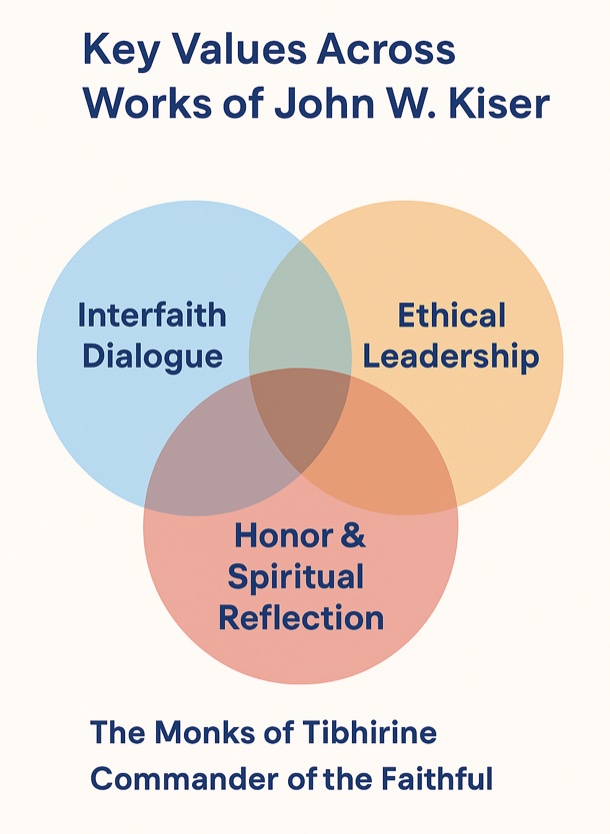
The kind of storytelling that Kiser employs also highlights interfaith encounters and moral contemplation. With a focus on shared human characteristics — and moments in which he experiences empathy, justice, courage and humility — he fosters understanding between the Western and Arab worlds and demonstrates the power of literature to break cultural and religious barriers. His works serve as a reminder that the capacity for ethical behavior, of moral courage, and of spiritual insight which apprehends the truth, are not the exclusive domain of a particular religious or cultural tradition, but, rather are a capacity that is part and parcel of the human species (Nasr, 1997, & Chittick, 1989).
Historical and Cultural Implications
Taking lives within the river of history rather than focusing exclusively on the biography of individual people, Kiser situates persons within broader social, political, and cultural milieus, revealing how ethical traditions and spiritual commitments contribute to the making of history. His exploration of Algeria, Morocco and the Middle East is designed to illuminate leadership dynamics, moral reasoning and social stronghold other than through reduction to violence, impasse and chaos (Stora, 2001, & McDougall, 2017).
Culturally, Kiser’s work is underscored by continuity and resilience. Based on ethical theory and on the theme of community responsibility in Sufi texts, sermons and tracts adressing the topic, and historical works of ethic, he reconstructs the arab traditions of moral reflection – and the corresponding issues of social pragmatics. These traditions are more than just history; they also provide a useful framework for facing the issues of governance, inter-religious relations, and moral reflection today (Esposito 1998).
Pedagogical and Moral Contribution
Advert Kiser’s texts are textbooks, designed to motivate readers to a sense of the moral demand and cross-cultural empathy required by the topics. By sharing stories of moral dilemma, moral courage and ethical leadership, he encourages readers to think about what kind of person they want to be, and how they can respond when faced with similar challenges in their own lives. In a world too familiar with reductive stories of incommensurability, Kiser provides us with an alternative model, one in which historical understanding and moral commitment are thoroughly entwined, and in which empathy remains a necessary, critical lens for making sense of human motivations (Kirkus Reviews, 2008, & Gant, 2017).
Enduring Legacy and Influence
Kiser’s lasting significance lies in this kind of transcendence of cultures, disciplines, and eras. His biographies and reviews are not merely the fruits of academic research; they also are weapons in the service of the cross-cultural dialogue, moral instruction and historical comprehension. Kiser depicts literature and history as tools for ethical participation that provoke increased understanding of human living and moral imperatives as they are forged in complex cultural terrains (Kiser, 2003, & Kiser, 2008).
And if nothing else, Kiser’s work provides a necessary counterbalance to such Western-centric readings, for it serves as an example of empathetic, ethically minded scholarship that does justice to the dignity of the human person, moral courage, and spiritual enlightenment. And his influence extends beyond the academy to teachers, journalists, policy makers and those more general readers looking for ways to make sense of the Arab world that are at once informed and humane.
Future Implications
In retrospect, then, what might Kiser teach us as scholars, as writers, as teachers? In the service of fostering empathy, moral reflection and cultural literacy, his approach may serve as a model of how we do historical biography, interfaith dialogue or cross-cultural education in the future. It would be one thing if at a time of global strife and mutual cultural incomprehension Kiser’s book were a mere caution on how easily a writer’s ethics might be cheapened by self-promotion, or a writer’s humanity by agitprop; but his book is a substantial reminder that ethical commitment and humanism are necessary to historical and cultural literacy.
Final Reflection
After all, in the end, John W. Kiser as historian and moral intermediary, has a role in the service of reason. His achievement is to illuminate the Arab world not as an abstraction but as a thick and lived reality — a sphere characterized by ethical reflection, spiritual intensity and cultural elaboration. Drawing from the bounty of tens of thousands of miles of travel and the careful study of both the historical record and the more or less unhurried street-corner and café conversations across a decade living throughout the Arab world, Kiser uses seasoned empathy and moral-reflective practices akin to those employed in some acts of imaginative storytelling so as to bring a more deeply lived, woven, and ethically fraught sense of Arab society to audiences—an understanding that has something distinct to say to the world’s contemporary panoply of conversations.
Through a rich synthesis of documentary research, narrative craft, and moral instruction, Kiser’s legacy suggests that literature and history, rather than being mere conduits of the past, can cultivate empathy, moral insight, and intercultural intercourse. His legacy remains an open beacon for all those who aspire to learn, appreciate and to interact with the numerous ethical and cultural facets of Arabs.
You can follow Professor Mohamed Chtatou on X : @Ayurinu
References
- Bouyerdene, A. (2012). Origins and originality of the religious controversy between `Abd al-Qâder al-Hasanî and the Christians. In A. Bouyerdene, Éric Geoffroy, & S. G. Simon-Khedis (Eds.), Abd elKader, un spirituel dans la modernité (1). Presses de l’Ifpo. https://doi.org/10.4000/books.ifpo.1819
- Chittick, W. C. (1989). The Sufi path of knowledge: Ibn al-ʻArabi’s metaphysics of imagination. State University of New York Press.
- Chtatou, M. (2024, December 2). Analysis: The Trappist Monks of Tibhirine, as Captured by John Kiser. Eurasia Review. https://www.eurasiareview.com/02122024-the-drama-of-the-monks-of-tibhirine-in-the-words-of-john-kiser-analysis/
- Chtatou, M. (2024, November 5). L’Emir Abd el-Kader, un saint homme héros de la décolonisation selon le livre de John Kiser (1/2). Oumma. https://oumma.com/lemir-abd-el-kader-un-saint-homme-heros-de-la-decolonisation-dapres-louvrage-de-john-kiser-1-2/
- Chtatou, M. (2024, November 8). L’Emir Abd el-Kader, un saint homme héros de la décolonisation, d’après l’ouvrage de John Kiser (2/2). Oumma. https://oumma.com/lemir-abd-el-kader-un-saint-homme-heros-de-la-decolonisation-dapres-louvrage-de-john-kiser-2-2/
- Chtatou, M. (2024, October 23). The life story of a hero of a decolonization venture in Africa Emir Abd El-Kader – Analysis. Eurasia Review. https://www.eurasiareview.com/23102024-emir-abd-el-kader-the-dramatic-life-story-of-a-philosopher-saint-hero-of-a-decolonization-quest-in-africa-analysis/
- Esposito, J. L. (1998). Islam and politics (4th ed.). Syracuse University Press.
- Gant, J. (2017, August 26). Book review – Commander of the Faithful: The life and times of Emir Abd el-Kader. Small Wars Journal. https://smallwarsjournal.com/2017/08/26/book-review-commander-of-the-faithful-the-life-and-times-of-emir-abd-el-kader/
- Johnwkiser. com. (2025). Biography of John W. Kiser. http://www.johnwkiser.com
- Kirkus Reviews. (2000, December 15). The Monks of Tibhirine: Faith, Love, and Terror in Algeria. www. kirkusreviews. com/book-reviews/john-w-kiser/the-monks-of-tibhirine/
- Kirkus Reviews. (2008, September 15). [Review of the book Commander of the Faithful: The Life and Times of Emir Abd el-Kader, J. W. Kiser]. Kirkus Reviews. https://www.kirkusreviews.com/book-reviews/john-w-kiser/commander-of-the-faithful/
- Kiser, J. W. (2000, July). The Algerian microcosm: Monks, Muslims and the zeal of bitterness. Cistercian Studies Quarterly, 38(3), 257–272.
- Kiser, J. W. (2003). The Monks of Tibhirine: Faith, Love, and Terror in Algeria. St. Martin’s Publishing Group
- Kiser, J. W. (2006, June). From Algeria to Iraq. Marine Corps Gazette, 90(6), 22–27.
- Kiser, J. W. (2007, August). Iraq, Amundson and the Zouaves. Marine Corps Gazette, 91(8), 30–35.
- Kiser, J. W. (2008). Commander of the faithful: The life and times of Emir Abd el-Kader. Monkfish Book Publishing Company.
- Kiser, J. W. (n.d.). About the author. John W. Kiser. https://www.johnwkiser.com.
- McDougall, J. (2017). A history of Algeria. Cambridge University Press.
- Nasr, S. H. (Ed.). (1997). Islamic spirituality: Foundations. Crossroad.
- Said, E. W. (1978). Orientalism. Pantheon Books.
- Stora, B. (2001). Algeria, 1830-2000: A short history. Cornell University Press.

Like what you read?
Please consider supporting Eurasia Review. Thank you for your consideration!
