
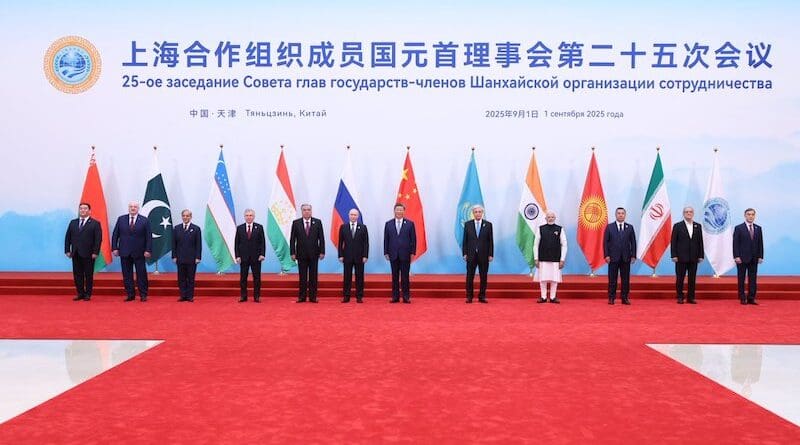
SCO Bonhomie Or Empty Optics? Why India Cannot Defy The US – OpEd
India has repeatedly claimed the mantle of a rising power, boasting of strategic autonomy and a foreign policy free from outside pressure. Yet every time New Delhi embarks on military adventurism against Pakistan, it exposes not its strength but its deep vulnerabilities. The historical pattern is clear: India launches wars in the ambition of undoing Pakistan, only to discover that it cannot sustain the fight and must run to the United States for a ceasefire. The 1965 war was the first major example of this reality, and Operation Sindoor in 2025 has reaffirmed it in full view of the world.
When Indian forces crossed into Pakistani territory in September 1965, their aim was not merely to retaliate against operations in Kashmir. It was to inflict such damage that Pakistan’s very existence would be weakened. But New Delhi underestimated both Pakistan’s resilience and the broader geopolitical dynamics. Within days, it was the United States, alarmed by the possibility of China entering the conflict, that forced both sides into a ceasefire under the UN umbrella. India’s dreams of a decisive victory evaporated as Washington pulled the brakes. What was exposed was India’s dependency, despite its size, it could not fight without the U.S. deciding when and how the war would end.
Fast forward six decades and Operation Sindoor tells the same story. Modi’s government, emboldened by its toxic mix of Hindutva politics and exaggerated military confidence, sought to crush Pakistan through aggression. The campaign was wrapped in the same old narrative: that India could once and for all demonstrate its dominance and rewrite the balance in South Asia. But just like in 1965, the adventure hit a wall. As the fighting escalated, the U.S. intervened again, warning of dangerous spillovers and pressing New Delhi to step back. The supposed rising superpower was once again reminded that its fate in war is not in its own hands.
The truth is harsh for India. Despite all its boasts of “strategic autonomy” and “multi-alignment,” it cannot afford to antagonize the United States. Washington remains the ultimate referee in South Asia, and India’s dependence on American markets, technology, and political backing means it will always fold when pressure mounts. Operation Sindoor was not ended on Indian terms but on American ones. New Delhi could neither achieve its objectives against Pakistan nor uphold the illusion of an independent foreign policy.
This is why Modi’s theatrics at the Shanghai Cooperation Organisation, where he flaunts bonhomie with Russia and China, carry little real weight. India can shake hands with Moscow, exchange smiles with Beijing, and speak of multipolarity, but the shelf life of such gestures is painfully short. When push comes to shove, India has no option but to align with U.S. demands. The SCO stage performances may impress domestic audiences, but they do not alter the hard geopolitical reality: Washington holds the strings, and India dances to its tune.
Pakistan, meanwhile, has consistently been the target of Indian aggression. From 1965 to Kargil, and now in Operation Sindoor, India has sought to break Pakistan militarily and psychologically. Each time, it has discovered that Pakistan is not only resilient on the battlefield but also shielded by the global balance of power. India’s wishful thinking of “undoing Pakistan” has never materialized because it collides with two immovable obstacles: Pakistan’s determination to defend itself and America’s refusal to allow South Asia to descend into uncontrolled conflict. Thus, India is forced into humiliating rollbacks, exposing the gap between its rhetoric and its capabilities.
Operation Sindoor highlights another critical point: India’s reliance on the West has deepened, not lessened. Its economy is tethered to Western markets, its technology sectors thrive only with U.S. partnerships, and its defense modernization increasingly depends on Western systems. This interdependence means India simply cannot afford prolonged defiance of American wishes. Whatever temporary space Russia and China provide, it cannot replace the leverage Washington holds. In the end, India bows to pressure, however much it dresses the retreat as strategic pragmatism.
For Pakistan, this reality carries both lessons and reassurances. The lesson is that India will not stop attempting to destabilize Pakistan. Its ruling elite are consumed by an obsession to undo their western neighbor. But the reassurance lies in the fact that India’s ambitions hit a ceiling. Each time it tries to impose its will through force, it ends up exposed, weakened, and dependent. Operation Sindoor is the latest reminder that Pakistan cannot be undone by Indian aggression. If anything, it is India that emerges from these conflicts diminished, its rhetoric punctured by geopolitical facts.
The Indian establishment may still cling to the illusion of independent power, speaking of a “civilizational state” charting its own course. But the world has now seen, yet again, the limits of those ambitions. The United States remains the power India cannot escape, no matter how loudly Modi talks of Russia, China, or multipolarity. The SCO bonhomie makes for headlines, but it has no shelf life. When the moment of reckoning arrives, India bends. And it will keep bending, because despite its size, it lacks the freedom to defy Washington.
History has a way of repeating itself, and in South Asia, it repeats with striking clarity. In 1965, India started a war it could not finish. In 2025, it did the same under Operation Sindoor. Both times, Pakistan endured, and both times, India had to rush to the very superpower it pretends to resist.

Like what you read?
Please consider supporting Eurasia Review. Thank you for your consideration!
