
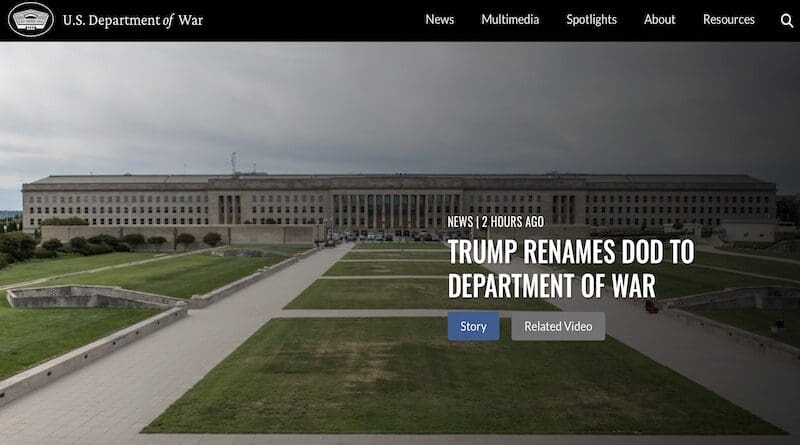
US ‘Department Of Defense’ To ‘Department Of War’: Strategic, Political, And Global Implications – OpEd
US President Donald Trump signed an executive order on September 5 that directs the ‘Department of Defense’ to be known as the ‘Department of War’. The order says Secretary of Defense Pete Hegseth will be known as secretary of war. Watch: “America is back and the move restores a name the agency last held during the WW times and, the aim is to “project strength and resolve”.
The name ‘Department of War’ conveys a stronger message of readiness and resolve compared to ‘Department of Defense,’ emphasizes only defensive capabilities.” The Department of Defense (DoD) is the successor to the War Department, which was first established as a cabinet-level agency in 1789 and existed until 1947.
The White House believes that the postwar enthusiasm of “Globalists” for interfering in European and Asia-Pacific affairs has led to the US’ failure to win a single war in the past quarter-century and is one of the contributing factors to the country’s current domestic and international predicament. The “Department of Defense,” renamed after World War II, is synonymous with failure. The rebranding of the Pentagon appears to confirm long-standing global perceptions: that the US is addicted to war and unable to separate its identity from –“Militarism the US National Religion”
Trump’s Record and Myth of Restraint
President Trump in his first term didn’t launch any new all-out ground invasion on the scale of Iraq. But he did escalate inherited Wars and conflicts in every theatre of war he inherited, repeatedly brought the country to the brink of new wars, and recklessly threw around US power. Trump did not “bring the troops home or end endless wars”. His term saw four consecutive years of the Pentagon budget’s exponential growth.
Trump had promised to bring an end to these ongoing wars of Ukraine and Gaza in his second term. But now in his eight month of his second term his efforts have failed so far. Both the ongoing wars have brought profit and prosperity to the US arms industry. He has also asserted that the US has no appetite to remain entangled in wars in distant places where the country does not perceive any direct interest being served? His initial actions and the selection of his team in No way suggest that “Militarism the US National Religion” is likely to be diluted but “Our military will be great again, and America will never back down.” However, Trump is unpredictable and as a result; ‘Department of Defense’ to be known as the ‘Department of War’.
“We’re going to go on offence, not just on defence. Maximum lethality, not tepid legality. Violent effect, not politically correct,” he said. “We’re going to raise up warriors, not just defenders…All I can do is put out wars!”
The US War Department
The “War Department” has specific historical origins. From 1789 to 1947, the US “War Department” expanded the US from a narrow country on the Atlantic coast into a powerful country spanning two oceans through one military victory after another. Native Americans, Mexicans, and others were either conquered or forced to cede. Nations like Russia, France and Britain were gradually forced to withdraw from the Americas. The current US administration believes that the US at that time enjoyed strong internal cohesion and a “surging” nationalist spirit, and that the current “loss” of American values and soaring national debt are the fault of “globalists.” For the US to win wars, it must rename the “Department of Defense” and recreate its history of leading the US military to achieve “Glorious Success.” The name “War Department” may evoke nostalgia for the “glorious history” among some people in the US, but times have changed. Against the backdrop of deepening globalization today, countries are increasingly interconnected and interdependent.
Renaming also reflects the US’ recognition of its declining global power and its subsequent strategic retrenchment. Making Canada the “51st state” of the US, regaining control of the Panama Canal, and occupying Greenland are all goals publicly announced by the US President Donald Trump. The first countries to be targeted by the War Department’s “Fighting and Winning” strategy will likely be those in the Americas – Venezuela and Mexico.
US Militarily Interventions.
In the nearly 250 years of the American history, it has been free from war for only less than 20 years. According to some statistics, from the end of World War II in 1945 to 2001, of the around 250 armed conflicts that occurred in 153 regions around the world, 201 were instigated by the US, accounting for 81 percent. From the Korean War to the Vietnam War, from the War in Afghanistan to the Iraq War, the US has become the country that has launched the most foreign wars since World War II.
The US interfered, militarily or covertly, in the internal affairs of a large number of nations: China, 1945-49; Italy, 1947-48; Greece, 1947-49; Philippines, 1946-53; South Korea, 1945-53; Albania, 1949-53; Germany, 1950s; Iran, 1953; Guatemala, 1953-1990s; Middle East, 1956-58; Indonesia, 1957-58; British Guiana/Guyana, 1953-64; Vietnam, 1950-73; Cambodia, 1955-73; The Congo/Zaire, 1960-65; Brazil, 1961-64; Dominican Republic, 1963-66; Cuba, 1959-present; Indonesia, 1965; Chile, 1964-73; Greece, 1964-74; East Timor, 1975-present; Nicaragua, 1978-89; Grenada, 1979-84; Libya, 1981-89; Panama, 1989; Iraq, 1990-present; Afghanistan 1979-92; El Salvador, 1980-92; Haiti, 1987-94; Yugoslavia, 1999; and Afghanistan, 2001-present, Syria, 2013-present. Egypt, 2013-And now Ukraine and Gaza.
William Astore; “We believe in wars. We may no longer believe in formal declarations of war… but that sure hasn’t stopped us from waging them. From Korea to Vietnam, Afghanistan to Iraq, the Cold War to the War on Terror, and so many military interventions in between, including Grenada, Panama and Somalia, North Americans are always fighting somewhere…
Global Standing Implications
Allies and adversaries alike will interpret the name change as official confirmation that America is more committed to waging wars than preventing them Perception of Aggression. America’s ability to promote democracy, human rights, and stability is undermined when it embraces “War” as official doctrine.
The rebranding may embolden rivals like Russia and China to expand their own military doctrines, framing US policy as justification for greater militarization into an Arms Race.
Peace and development are the themes of our times only on paper. America as one of the largest and the oldest democracy, a country with abundant resources should shoulder more responsibilities and become a promoter of peace rather than encourage wars. The renaming of the Department of Defense to the Department of War represents a significant symbolic shift in how the US defines itself and projects power. While the administration may see it as a return to strength, globally it risks confirming the image of America as a war mongerer, undermining alliances, fueling regional instability, and accelerating great-power rivalry.
If the US truly seeks to lead in the 21st century, it must balance military might with responsible global leadership—promoting peace, cooperation, and shared security. Without this balance, the War Department may not restore American greatness but instead deepen international isolation and mistrust.

Like what you read?
Please consider supporting Eurasia Review. Thank you for your consideration!
