
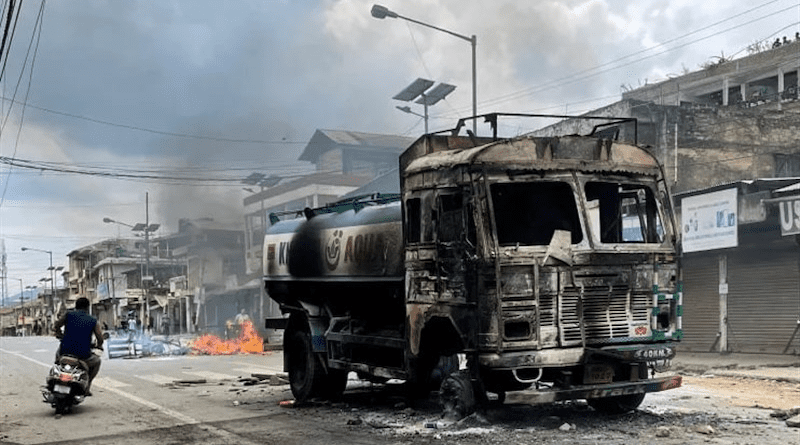
Why Manipur Remains A Thorn In India’s Throat? – OpEd
Manipur is once again on the brink. What began in May 2023 as a violent rupture between Meitei and Kuki-Zo communities has now hardened into one of India’s most serious human rights crises, a conflict defined by ethnic persecution, state militarization, and an unyielding refusal by New Delhi to acknowledge the legitimate political aspirations of the Kuki people.
The latest tensions in Dolaithabi and Saikul Sadar Hills, where Meitei groups reportedly attempted to forcefully cross the buffer zone, demonstrate how fragile and explosive the situation has become. That buffer line—supposedly created to prevent clashes—now functions as both a literal and symbolic reminder of the state’s failure to protect those who have been pushed to the margins of Manipur’s political order.
At the heart of the unrest lies a simple but profound demand: autonomy. The Kuki-Zo communities, having faced targeted killings, displacement, and systematic marginalization, are asking for a separate administrative arrangement or Union Territory status that guarantees their security and political representation. For them, autonomy is not a separatist ambition but a protective shield against majoritarian violence. Yet India has categorically rejected the idea, a stance that many Kukis interpret as a deliberate denial of self-governance and a refusal to recognize their distinct identity within Manipur.
The events unfolding in Dolaithabi and Saikul have only deepened this mistrust. Repeated attempts by Meitei groups to breach the buffer zone are viewed by the Kukis as provocative acts designed to intimidate them. Central security forces remain heavily deployed, but their presence does little to reassure those who see them as biased actors. Instead, Kukis argue that selective policing, delayed interventions, and inconsistent enforcement have emboldened mobs and militants, while undermining the community’s safety. As local resentment grows, demands for control over their own security apparatus are strengthening, feeding the momentum behind calls for a plebiscite or referendum to determine their political future.
International scrutiny has reinforced these fears. UN experts have publicly condemned the targeted violence against Kuki-Zo civilians, citing extrajudicial killings, forced displacement, and the destruction of homes and churches. They have criticized India’s failure to prevent the violence and its inability—or unwillingness—to hold perpetrators accountable. Amnesty International’s findings paint an equally grim picture: widespread impunity, a collapse of local law enforcement, and selective protection that allowed mobs to move freely while Kuki neighbourhoods burned. Tens of thousands were forced into makeshift camps, where overcrowded living conditions, lack of sanitation, and limited access to healthcare continue to take a heavy toll.
More than 60,000 people have been displaced, 258 killed, and over a thousand injured. Entire villages have vanished, churches lie in ruins, and vast agricultural lands—lifelines for rural families—remain abandoned, swallowed by militarization. Many displaced Kukis still cannot return home, not only because their houses have been destroyed but also because the state has shown no urgency in rebuilding their communities or restoring their rights. Decisions concerning security, resettlement, and governance are often made without consulting Kuki civil or tribal bodies, deepening a perception that the crisis is being managed not to restore harmony but to suppress Kuki identity and silence any conversation about autonomy.
The humanitarian catastrophe is matched only by a political one. India’s approach in Manipur—militarized, top-down, and dismissive—has created conditions that could entrench long-term instability. When a community experiences sustained violence with no accountability, when justice systems fail and international warnings are ignored, and when political aspirations are met only with military deployments, cynicism becomes inevitable. It is this sense of erasure that is now driving many Kuki groups to push for a plebiscite, convinced that solutions will never emerge within the present constitutional arrangement.
India’s insistence on rejecting autonomy at all costs, despite the overwhelming evidence of state failure in protecting minorities, risks transforming Manipur’s crisis into a deeper structural conflict. The more the state tightens its grip, the more it fuels the belief among Kukis that they are being subdued rather than safeguarded. And the longer these grievances remain unaddressed, the further Manipur drifts from reconciliation and towards a future shaped by mistrust and fragmentation.
The violence in Manipur is not an isolated episode; it is a reflection of Delhi’s broader struggle to manage ethnic diversity with fairness, empathy, and democratic accountability. As UN and Amnesty International reports continue to document systematic abuses and impunity, India must recognize that peace cannot be restored through force and denial. It requires acknowledging the community’s suffering, addressing the roots of inequality, and engaging openly with Kuki demands.
Until then, Manipur will remain trapped in a cycle of violence, its people paying the price for a crisis that could have been averted had political courage prevailed over administrative inertia. The question now is whether New Delhi is willing to confront these uncomfortable truths before the state’s social fabric is irreparably torn.

Like what you read?
Please consider supporting Eurasia Review. Thank you for your consideration!
