
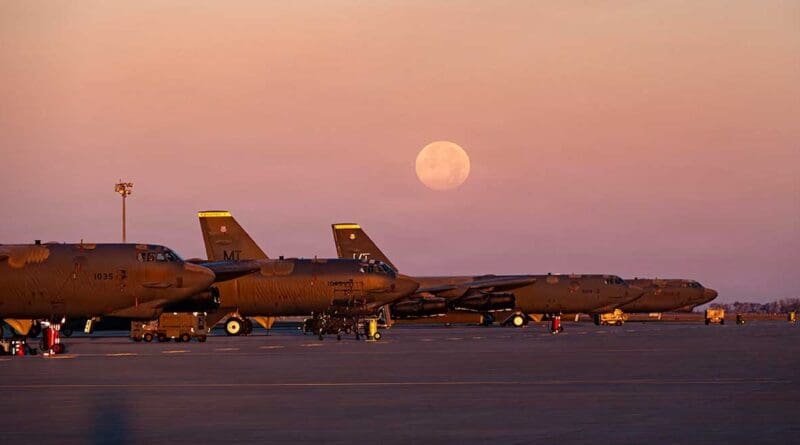
U.S. B-52J Stratofortress Engine Upgrades Pass Design Milestone
Key Takeaways
- B-52 Modernization Program Advances — The US Air Force has completed the Critical Design Review for the Commercial Engine Replacement Program (CERP), clearing the way to begin physical modifications on the B-52 Stratofortress fleet.
- New Rolls-Royce F130 Engines at the Core — The upgrade replaces the decades-old Pratt & Whitney TF33 engines with modern F130 turbofans, significantly improving range, loiter time, efficiency, and reducing dependence on aerial refueling.
- Enhanced Capabilities for Strategic Deterrence — The modernized B-52J will feature increased electrical power, new avionics, a digital cockpit, and integration with advanced sensors and weapons, extending the bomber’s service life to at least 2050 and strengthening long-range strike and deterrence missions.
The United States Air Force announced its program to modernize the B-52 Stratofortress fleet has cleared a major review that permits the transition from design to physical aircraft modification. The May 2026 completion of the review for the Commercial Engine Replacement Program (CERP) solidified the path for the long-range bomber to receive new Rolls-Royce F130 engines and other advanced subsystems, according to the Air Force Life Cycle Management Center.
A critical design review is a rigorous technical assessment used in procurement to determine if a system design is stable and meets all performance and engineering requirements. This milestone ensures the design is mature enough to begin fabrication, assembly and integration while establishing the initial product baseline.
“This CERP critical design review is the culmination of an enormous amount of engineering and integration work from Boeing, Rolls-Royce and the Air Force that will enable the B-52J to remain in the fight for future generations,” said U.S. Air Force Lt. Col. Tim Cleaver, Bombers Directorate CERP program manager. “It’s that point that you go from having a concept turned into a design, to then turning that design into something physical — something that we will test and field for Air Force Global Strike Command.”
The modernization centers on replacing the bomber’s eight Pratt & Whitney TF33 engines, which have powered the aircraft since the early 1960s, with the modern F130 turbofan. This enhanced range and extended loiter capability fundamentally elevate the B-52’s strategic utility, particularly in vast operational theaters like the Indo-Pacific. By reducing its reliance on vulnerable aerial-refueling tanker fleets, the modernized bomber can project power more autonomously and remain on station longer to execute dynamic targeting or provide persistent standoff capabilities. Furthermore, the ability to launch from the Continental United States (CONUS) or secure forward operating bases and loiter on the periphery of anti-access/area denial (A2/AD) environments ensures that combatant commanders can hold high-value global targets at risk for extended periods. This long-term strike capacity, coupled with the bomber’s formidable payload of long-range cruise missiles, significantly bolsters deterrence posture and global rapid-response capabilities.
Beyond propulsion, the upgraded B-52J configuration will feature increased electrical power generation to support modern sensors, communication systems and future weapons. The modification also includes new engine struts, mechanical equipment housing and a digital glass cockpit. When combined with the separate Radar Modernization Program, which will install an active electronically scanned array radar, the B-52J will possess enhanced targeting and situational-awareness capabilities.
This modernization comprises a central component of a broader U.S. strategy to update its strategic deterrence assets. The upgrades underscore the ability to fight and win in a complex global environment, U.S. Air Force Gen. Ken Wilsbach, the service’s chief of staff, said in a 2025 news release. “The B-52 will continue to serve as an unmatched symbol of U.S. airpower,” he said. “With these upgrades, the aircraft will remain ready to execute our nation’s deterrence and strike missions for decades.”
By extending the service life of the B-52 through at least 2050, the United States aims to provide a visible and credible deterrent that ensures the stability of the global commons and reinforces security commitments to international allies.
The Air Force plans to upgrade all 76 bombers in the active fleet, ensuring they remain the backbone of the nation’s long-range strike capability for decades to come.
- This article was published by Sentry

Like what you read?
Please consider supporting Eurasia Review. Thank you for your consideration!
