
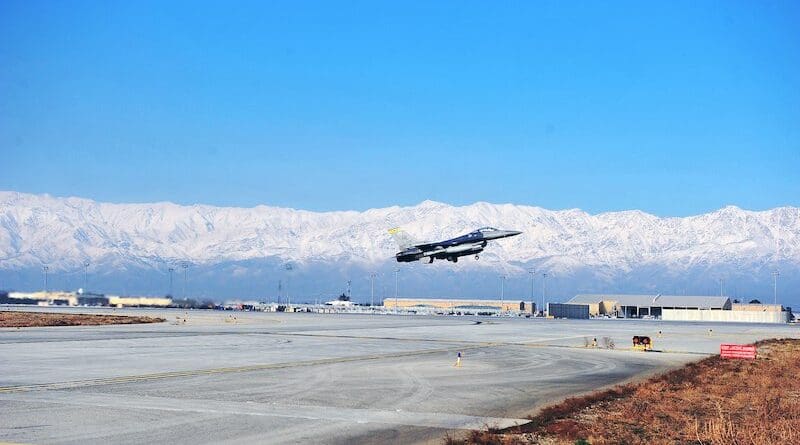
Reclaiming Bagram: Why Trump’s Call Risks Reigniting A New Cold War In Asia – OpEd
In the continuously evolving domain of Central and South Asian geopolitics, recent comments by US President Donald Trump regarding “taking back” Bagram Airbase in Afghanistan have reopened a debate most assumed was concluded with America’s 2021 retreat.
Trump’s claim that the location of the base—”near where China produces its nuclear weapons”—would be an advantageous vantage point for strategic purposes demonstrates not only nostalgia for America’s lost military presence but also an untapped re-emergence of great-power competition in one of the world’s most explosive regions.
A Misreading of Geography and History
Bagram, located north of Kabul, has been a symbol of foreign intervention and war since time immemorial. Trump’s assertion that it was “built by the United States” is incorrect on a historical basis—the airbase was initially built by the Soviet Union when they occupied Afghanistan in the 1950s. The United States developed it after 2001, making it one of the world’s largest and best-defended airbases. But the foundation is indisputably Afghan sovereign land, and its future must be discussed with the Kabul government—whether or not the outside world accepts its legitimacy.
To regard Bagram as a discarded American property to be reclaimed is not only factually inaccurate but diplomatically irresponsible. It undermines Afghan sovereignty and potentially opens old sores in a nation already bruised by decades of outside interference.
A New Frontline in a Renewed Cold War
Trump’s implication that Bagram’s strategic significance resides in its geographic proximity to China’s western provinces gives rise to a perilous logic. By suggesting that the airbase could be employed to surveil or counter Chinese military activity, Washington would essentially be indicating its willingness to re-enter Afghanistan—not for counter-terrorism, but for geopolitical containment. Such a move risks making Afghanistan once more a proxy theatre for competing powers, ranging from Beijing and Moscow to Tehran and Islamabad.
The Cold War comparison is not unfounded. Just as Afghanistan used to be the battleground of U.S.–Soviet competition in the 1980s, reviving Bagram for anti-China use has the potential to turn the region into a new geopolitical fault line—disrupting regional cooperation and triggering new security challenges for South and Central Asia in general.
The Terrorism Factor: A More Constructive Purpose
Were the United States to go back to Bagram, its goals must be based not on Cold War geopolitics but on shared counter-terrorism. The emergence of transnational terrorist groups like ISIS-K, Al-Qaeda, the TTP (Tehreek-e-Taliban Pakistan), and the BLA (Balochistan Liberation Army) reinforces that terrorism, not China, is the actual destabilizing influence in the region.
A pragmatic approach might include U.S. re-engagement with Islamabad and Kabul to coordinate precision counter-terrorist operations and intelligence-sharing. Such an effort would also put pressure on the Interim Afghan Government (IAG) to cease its implicit support for entities that attack regional states, especially Pakistan. Under these circumstances, limited U.S. intelligence or logistical presence—if undertaken by mutual agreement and in transparency—could promote regional security instead of undermining it.
Pakistan’s Perspective: Opportunity and Risk
For Islamabad, U.S. presence in Bagram would represent both a strategic asset and a geopolitical vulnerability. On the positive side, U.S. intelligence capabilities would serve to assist Pakistan in monitoring and countering TTP militants taking refuge on Afghan territory. In addition, Washington’s influence over Afghan authorities would be crucial in preventing cross-border militancy and in forcing Kabul to disconnect with extremist groups.
Conversely, however, if Bagram is made a hub for a wider U.S. containment policy against China, Islamabad’s strategy of balancing between Beijing and Washington would be put severely to the test. With its deep economic and political integration with China via CPEC, Islamabad would be politically and economically unable to support any initiative so seen as anti-China. For Pakistan, the solution thus lies in ensuring that any future U.S. engagement in Afghanistan continues to be counter-terrorism-focused—not geopolitical.
The Question of Sovereignty
Beneath security and strategy is a more profound concern: sovereignty. The territorial integrity of Afghanistan cannot be made a bargaining chip. Any outside power wishing to use Bagram needs to obtain the approval of the Afghan government through a bilateral or multilateral mechanism, preferably under regional supervision. Anything short of that legitimacy could ignite fresh rounds of resistance, insurgency, and suspicion—repeating decades of tenuous peace processes.
A Regional Vision for Stability
Instead of reopening old wounds, Bagram can serve as an emblem of regional cooperation. A joint effort by Afghanistan, Pakistan, the United States, China, and Central Asian nations can make the base a center for anti-terrorism intelligence, humanitarian coordination, and regional economic integration. This is a change, from confrontation to cooperation, that would resonate with other demands for stability throughout the Eurasian heartland.
Conclusion: Learning from History
Donald Trump’s rhetoric about reclaiming Bagram reflects a deeper American dilemma—whether to engage Asia as a partner or a competitor. History has shown that foreign powers seeking military footholds in Afghanistan rarely achieve lasting success. The Soviet Union learned it painfully; the United States learned it two decades later.
Reoccupying Bagram for competitive competition would be a reliving of those errors and a danger of drawing the region back into another period of distrust and fragmentation. Rather, Washington must employ its leverage to foster confidence, encourage dialogue, and assist Afghanistan and its neighbors in addressing the real threats of extremism and insecurity. Bagram’s future—and the stability of South Asia—rests on whether the world prefers cooperation to confrontation.

Like what you read?
Please consider supporting Eurasia Review. Thank you for your consideration!
