
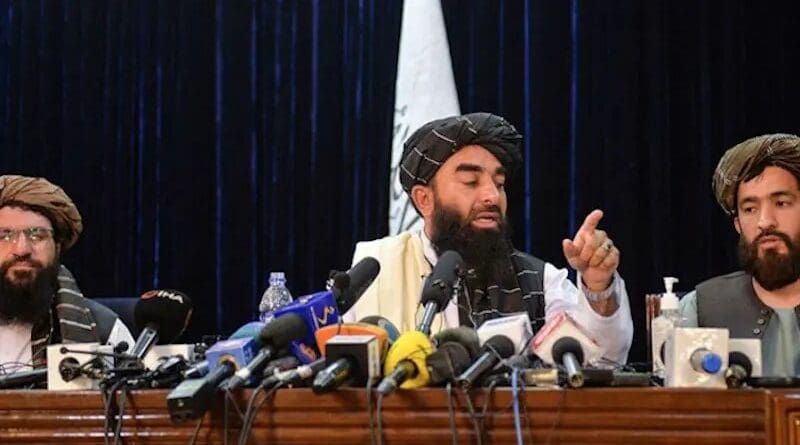
Analyzing Zabiullah Mujahid’s Remarks On Pak-Afghan Tussle
The spokesperson of Taliban government in Afghanistan Zabiullah Mujahid accused Pakistan of failing to take responsibility for cross-border security issues. He further criticized Pakistan for not cooperating on matters related to the security of Afghan migrants.
Cross-Border Security issue
Zabiullah Mujahid’s accusation that Pakistan has not been cooperative in addressing cross-border security issues is not only misleading but also a misrepresentation of the ongoing efforts Pakistan has made to tackle this very issue. Pakistan has long been at the forefront of the fight against cross-border terrorism, particularly with regards to the threats posed by groups such as the Tehrik-i-Taliban Pakistan (TTP) and the Baloch Liberation Army (BLA). For over a decade, Pakistan has had to confront cross-border terrorist activities originating from Afghan soil, with the TTP operating freely in Afghanistan, especially after the U.S. withdrawal in 2021.
Islamabad has consistently presented irrefutable evidence, documented by both Pakistani intelligence agencies and international bodies, to highlight the existence of these terrorist groups in Afghanistan. Reports from the United Nations (UN) and the Special Inspector General for Afghanistan Reconstruction (SIGAR) have corroborated Pakistan’s claims. These institutions have repeatedly pointed out that the TTP, BLA, and other insurgent groups continue to operate from Afghanistan, using Afghan territory as a base for launching attacks into Pakistan.
Zabiullah Mujahid’s statement suggesting Pakistan’s failure to take responsibility seems disconnected from these realities. Instead, Pakistan’s single-point agenda for years has been to address the issue of cross-border terrorism, with an emphasis on stemming the tide of militants crossing from Afghanistan. Pakistan has not only raised this issue on multiple diplomatic platforms but has also taken significant steps to enhance its security along the border, including fencing efforts and enhanced surveillance.
The Doha Agreement
The Doha Agreement of 2020, signed between the United States and the Taliban, was intended to be a step towards peace and stability in Afghanistan. It outlined several key responsibilities for the Taliban, including the cessation of support for terrorist groups and the initiation of intra-Afghan peace talks. Despite these commitments, the Taliban has failed to live up to many of its promises.
One of the key stipulations of the Doha Agreement was the prevention of the 5,000 prisoners released by the Taliban from returning to militancy. However, reports have shown that many of these individuals have indeed resumed their militant activities, adding to the insecurity in Afghanistan and by extension, the region. Pakistan, which shares a porous border with Afghanistan, has borne the brunt of this instability. The Taliban’s failure to control these fighters has exacerbated the security situation along Pakistan’s border.
Furthermore, the Taliban’s refusal to engage in genuine peace talks with the Afghan government and its failure to establish an inclusive government have raised serious questions about its commitment to peace. The Taliban’s leadership, primarily composed of Pashtun ex-militants, has systematically excluded non-Pashtun ethnic groups from political representation. This blatant disregard for ethnic inclusivity contradicts the promises made to the international community, including the U.S., under the Doha Agreement.
Since the Taliban’s takeover of Kabul in August 2021, Pakistan has consistently pursued a policy of diplomacy and engagement with the new Afghan government, despite facing numerous challenges. High-level visits by Pakistani Foreign and Defense Ministers, as well as Special Representatives, reflect Pakistan’s desire to maintain stability and peace in the region. Notably, there have been eight Joint Coordination Committee (JCC) sessions, over 225 border flag meetings, 836 protest notes, and 13 demarches delivered to the Afghan authorities to address cross-border security issues. These efforts are a testament to Pakistan’s ongoing commitment to cooperation and regional stability, despite frequent provocations from Afghan-based militant groups.
However, the Taliban’s lack of cooperation in curbing the TTP’s activities, and its continuing support for militant factions like the Haqqani network, undermine these efforts. This failure on the part of the Taliban government makes it difficult for Pakistan to fully secure its border and address the threat of terrorism emanating from Afghan territory. It is, therefore, not Pakistan but Afghanistan under the Taliban’s leadership that has failed to uphold its responsibilities as a neighbor and regional partner.
Migrants issue
On the issue of migrants, Mujahid’s comments also fail to acknowledge Pakistan’s extensive history of hosting Afghan refugees. Over the past four decades, Pakistan has hosted over 4 million Afghan refugees, offering them shelter, safety, and opportunities for education and healthcare. Pakistan has provided Afghan children with access to its schools and universities, despite facing its own socio-economic challenges. Afghan refugees have been allowed to work in Pakistan and contribute to the economy, much like Pakistani nationals.
In contrast, the Taliban government’s approach to migrants and its treatment of women and girls raise serious human rights concerns. Since the Taliban’s return to power in 2021, Afghan women and girls have been systematically denied their basic rights, including the right to education and employment. The Taliban’s stance on gender equality is a stark contradiction to the humanitarian values it is now preaching. Banning girls from attending school while simultaneously allowing terrorist groups to operate on Afghan soil does not bode well for Afghanistan’s international image.
Zabiullah Mujahid’s call for Pakistan to recognize and assist Afghan migrants is ironic, given the Taliban’s own track record on human rights. It is essential to recognize that humanitarian responsibility extends beyond providing shelter; it also involves creating an environment where people can thrive with dignity and respect. In this regard, the Taliban’s policies have been anything but humanitarian. While Pakistan continues to bear the burden of hosting millions of Afghan refugees, the Taliban has failed to ensure the safety and well-being of its own people, let alone extend any form of support to displaced Afghans within its borders.
Zabiullah Mujahid’s accusations against Pakistan are not only misguided but ignore the broader geopolitical realities at play. Pakistan has long been at the forefront of addressing cross-border terrorism, providing shelter and safety to millions of Afghan refugees while facing its own security challenges. The Taliban’s failure to control militancy within Afghanistan, coupled with its exclusionary political practices, undermines its credibility as a regional partner.

Like what you read?
Please consider supporting Eurasia Review. Thank you for your consideration!
