
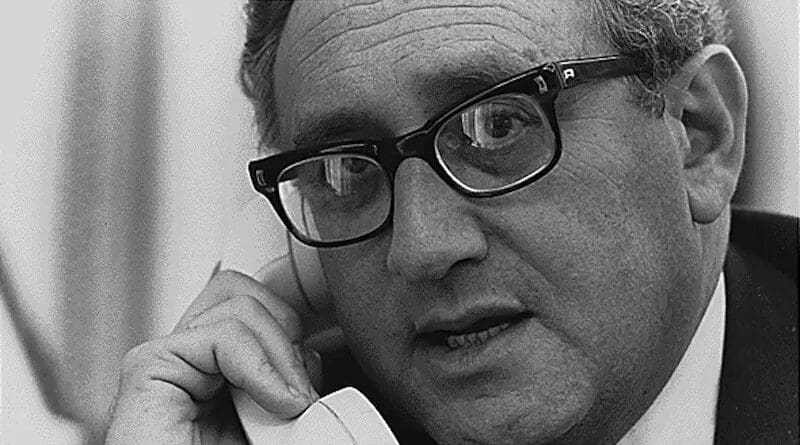
Kissinger Tries Again – OpEd
If there is anything that current American politicians should remember, it is that if China is now seen as a major potential enemy of the United States, that is due to Henry Kissinger, once advisor to American presidents. And they should remember this because today the same diplomatic mechanism developed by Kissinger, who initiated the Chinese take-off, is being reproduced – with the almost same scenarios. One gets the impression that there is a new desire to try to create a distance between China and Russia – at the time China and the USSR – giving benefits to China then, today to Russia.
The modalities change but the Kissingerian mechanisms are identical. At the time it was that of the development of the Chinese economy to break the Russian-Chinese alliance, the current one is to promote a fragmentation of Europe to break the Russia-China axis. And the question today, which was not asked then, have the collateral consequences of this Kissingerian-inspired policy been assessed? Is there not the risk of a repetition of unforeseen consequences of much wider impact as was the case with the Chinese policy of ’72?
War To China From The West
To clear the field of any misunderstanding, it must be immediately stated that it is more than right that China has a recognized international role and the fiction that China did not exist was absolutely ridiculous. China has been subjected over time to incredible military violence by the West. It is enough to remember the two opium wars, that of 1839 (because the Emperor had burned the immense quantities of opium that England wanted to sell at bargain prices to create the market) and that of 1860 because Westerners wanted the consumption of opium to be legalized. Legalization that the Westerners obtained with the trick of considering the import of opium (from India) as a foreign medicine. All this is to say that China has the right to play its international role, but given that, when Nixon-Kissinger went to visit Mao Tse Tung, China’s economic strength was practically zero compared to the United States — today it is a competitor. The US GDP was $1.16 trillion, the Chinese one $100 billion. The U.S. economy was nearly 11 times China’s, and the gap in per capita incomes was 46 times greater.
Now there is no doubt that it was Kissinger who opened the doors of the Great Wall to American companies and it is there that the birth certificate of China’s amazing economic recovery must be sought, and must be remembered that the immeasurable growth of the Chinese economy was not foreseen by him.
The diplomatic goal was to break the USSR-China relationship, effectively isolating the USSR.
Kissinger tries again.
Now, 53 years after that event, that kind of diplomatic vision seems to be making a comeback. Of course, we know that physically Kissinger is no longer with us. He had time to reach 100 years old and make one last trip to China, but he was not exceedimg them. But it is his diplomatic strategy that seems to have survived in the Republican party environment, changing only the pawns: at the time making China happy to focus on the USSR; today make Russia happy to focus on China.
Having said and reiterated that China had every right to be recognized worldwide, the fact remains. The great theorist of diplomacy – honored and praised in China – did not see the even not too distant consequences of his diplomatic vision. It is true that he opened the door of the Great Wall, but he missed that from that opening came the phenomena of growth that led China to be the great adversary of the United States on the economic ground.
Today it is a fact of absolute positive political and diplomatic importance that China plays its global role. But the merit is not Kissinger’s. This happens by unforeseen means, a byproduct of the diplomatic main objective. China remembers him as a legendary figure of diplomacy ignoring some small things such as the bombing of Cambodia, the coup d’état and repression in Chile, the voluntary delay in the peace agreement in Vietnam just to give examples, but not the only ones, and reserved him honors greater than those for Biden when he went on his last trip. But the reality is that Kissinger did not promote that agreement for the betterment of China, he did it to weaken the USSR and his main diplomatic objective involved a very high cost: the birth of the largest planetary competitor USA.
Today, Republican diplomatic strategists seem to want to repeat Kissinger’s strategy with a reversal of objectives. At the time, China had to be made happy to be able to concentrate on the confrontation with the USSR, now they want to make Russia happy to be able to concentrate on the confrontation with China. The unexpected by-products of this strategy are not certain to be expected at the moment. What it really means for the planetary balance to weaken the European Union is clearly not a benefit perhaps correctly assessed by either the US or Russia. It could be that the update of the Kissingerian strategy will again produce absolutely unexpected results. Not necessarily positive.

Like what you read?
Please consider supporting Eurasia Review. Thank you for your consideration!
