
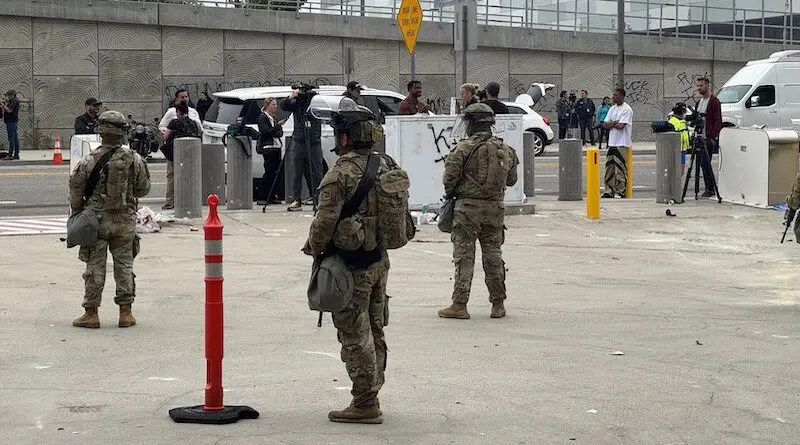
Unconstitutional Force: The Risks Of Deploying Marines In Los Angeles Protests – OpEd
The deployment of U.S. Marines to Los Angeles during the 2025 anti-ICE demonstrations violates both the Posse Comitatus Act and the Insurrection Act requirement and creates severe social risks and operational dangers that surpass any temporary political advantages.
The administration’s decision to deploy combat-trained personnel in a major American city creates three major risks: it intensifies peaceful protester tensions, damages the established military-civilian relationship, and creates multiple federal-state legal conflicts that will weaken public trust in both institutions. The visual display of Marines facing U.S. citizens who exercise their assembly rights functions as a strong propaganda instrument for those who want to show that America’s democratic system is becoming more authoritarian, thus damaging the USA’s international standing. The constitutional violations and associated dangers to public safety and national image exceed any brief security benefits that military force could provide.
Constitutional and Legal Framework
The Posse Comitatus Act from 1878 restricts active-duty military personnel from domestic law enforcement activities except when Congress grants permission or the president invokes the Insurrection Act of 1807. During early June 2025, President Trump deployed 4,000 National Guard members while keeping 700 Marines prepared for deployment following extensive ICE raids that resulted in the detention of 118 undocumented immigrants. The government failed to present any legal authorization for deploying Marines under the Insurrection Act or any other applicable framework for crowd control purposes.
California Governor Gavin Newsom started a lawsuit because he believed that federal authorities had no right to deploy troops in the state without state approval, which violated fundamental principles of state power and separation of governmental branches. Legal expert Steve Vladeck from Georgetown University predicts that deploying combat-trained forces for civil statute enforcement would lead to “egregious overreach,” thus enabling quick judicial relief, which damages the fundamental basis of the law. Military forces experienced similar controversies when they assisted civil rights enforcement during the 1965 period, which led Congress to establish more stringent controls regarding domestic troop deployment.
Empirical Data on Public Sentiment and Protest Dynamics
Scale and Nature of Protests
• ICE Operation Impact: An ICE operation in Los Angeles on June 8–9 resulted in the arrest of 118 individuals and drew between 2,000 and 2,500 protesters to the downtown area, who engaged in vandalism while blocking highways and facing off against law enforcement
• Force Posture: Trump deployed an additional 2,000 National Guard troops alongside the existing 2,000 personnel while maintaining 500 Marines in reserve in a military deployment that rivaled the 1992 riots.
Public Opinion Polls Showed How Americans View Military Intervention and Immigration Enforcement
The Reuters/Ipsos survey (Mar 21–23, 2025) revealed that 46% of Americans disapproved of Trump’s immigration enforcement methods, even though 45% of the population supported his approach, thus showing minimal approval for forceful immigration policies.
A state-wide survey revealed that immigration policies of the federal government were disapproved by 65% of Californians, who also demonstrated strong opposition to forceful intervention methods.
The administration received support for its crackdown from 86% of Republicans, yet only 38% of independents and 27% of Democrats backed the policy, which demonstrates potential voter disenfranchisement among swing-vote groups.
Escalation of Civil Unrest
The deployment of combat-trained Marines into urban protests presents a significant risk of radicalizing peaceful protesters because their rules of engagement focus on neutralizing threats.
1. Perceived Occupation: Multiple activist groups, including community leaders and journalists, called the Marines’ deployment “martial law,” which strengthened protester solidarity across various activist networks.
2. The use of sponge-round launchers in existing non-lethal methods has resulted in serious injuries, such as a fractured skull suffered by a British photojournalist, which means introducing Marines would increase the likelihood of transitioning to lethal crowd-control measures that could lead to civilian deaths.
3. The deployment of militarized police in Los Angeles sparked solidarity demonstrations in San Francisco, Sacramento, and Sacramento State University, which proves that aggressive policing methods tend to expand protests instead of controlling them.
Political Ramifications
Alienating Moderates and Swing Voters
The 68% majority of independents expressed in a late-May survey believed federal troops should not enforce civil orders because they view domestic military deployments as excessive.
The deployments were branded as “authoritarian” by Governor Newsom and Senator Bernie Sanders, which boosted voter turnout in upcoming Congressional and gubernatorial elections. Political experts predict that this messaging strategy could transform important voting districts in California.
International Image
The maintenance of democratic norms serves as the foundation for America’s soft power abilities. The visualization of U.S. Marines facing families and journalists enables authoritarian governments to create propaganda that undermines U.S. leadership regarding human rights. After the June 9 live broadcast, human-rights organizations documented rising international criticism against U.S. policy through statements from the UN Human Rights Council, which expressed concerns about excessive force usage.
Practical and Moral Considerations
Lack of Local Consent and Expertise
• The LAPD, along with the California National Guard, never requested Marine backup forces, but municipal forces managed to contain disruptions on their own before federal authorities intervened.
• The implementation of an external force disregards existing community-police liaison systems, which have built trust with minority communities over numerous years.
Ethical Imperatives
The right to peaceful assembly stands as a fundamental right that the Constitution protects. The deployment of military assets during domestic protests creates confusion about the distinction between civilian law enforcement and wartime operations, which weakens democratic governance through its impact on civil-military boundaries.
• Moral Responsibility: Military personnel who receive combat training possess neither social work nor de-escalation capabilities, so using them to manage civil protests places full moral responsibility for force misuse directly on the executive branch.
Conclusion
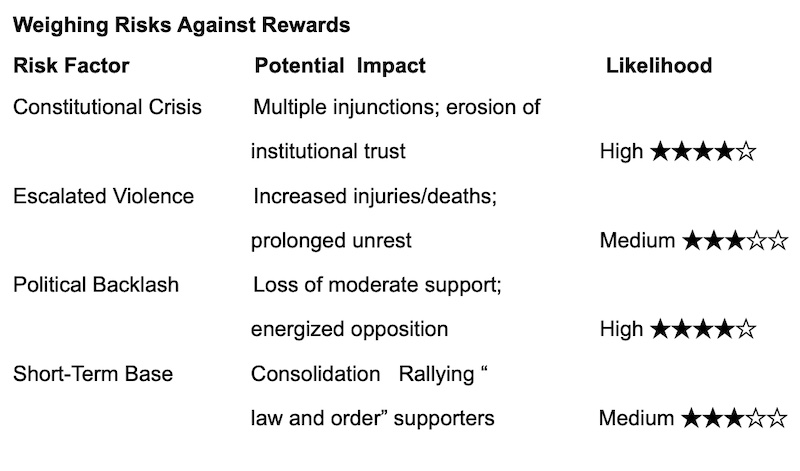
Using Marines in Los Angeles without an actual Insurrection Act declaration poses substantial risks that produce minimal long-term advantages. The administration’s core supporters might experience a brief surge in support from such a display of force, yet the resulting legal battles, combined with worsening unrest and alienation of crucial voter groups and damage to U.S. democratic standing, will likely exceed any potential deterrent effect. Using Marines in American streets becomes counterproductive when there is no genuine insurrection that can be supported by both state-level emergencies and proper legal authority. The administration should choose intelligence-led policing combined with community engagement and de-escalation methods instead of sending Marines into the streets unless they obtain strong legal approval and local support.
The opinions expressed in this article are the author’s own.
References
- Goldbeck, Janessa, et al. “Military veterans object to Donald Trump’s intervention in Los Angeles.” Financial Times, 10 June 2025.
- Brooks, Brad, Jane Ross, Phil Stewart, and Idrees Ali. “Trump administration deploys Marines to Los Angeles, vows to intensify migrant raids.” Reuters, 10 June 2025.
- Associated Press. “Pentagon draws up rules for Marines deployed to LA protests.” AP News, 10 June 2025.

Like what you read?
Please consider supporting Eurasia Review. Thank you for your consideration!
