
Bangladesh-India Relations: From Strain To Reconciliation – Analysis
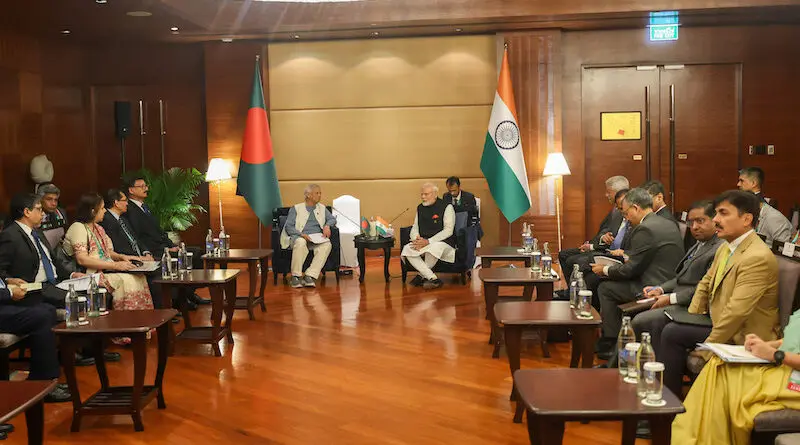
After months of tensions since the August 2024 uprising, Dhaka-Delhi relations may be headed for a thaw, marked by the recent bilateral meeting between Professor Muhammad Yunus, the chief advisor to the interim government of Bangladesh, and Indian Prime Minister Narendra Modi held in Bangkok on April 4, 2025.
This is the first time that any meeting between these two top leaders has been held against the backdrop of strained relations between the two countries since the interim government of Bangladesh took office. The meeting between Dr. Yunus and Narendra Modi in Bangkok hold considerable political significance in the context of the lack of trust between the two countries over the past eight months on various issues. This significance is further underscored by Dr. Yunus’s intention to visit India before China, as well as India’s earlier reluctance to respond to Bangladesh’s twice expressed interest for such a meeting. Therefore, discussions were underway on whether or not they will meet at the Bay of Bengal Initiative for Multi-Sectoral Technical and Economic Cooperation (BIMSTEC) summit.
The meeting discussed Sheikh Hasina’s extradition and other pressing issues of two nations such as border killings, renewal of the Ganges Water Sharing Treaty, water sharing of the Teesta River. Diplomatic analysts argue that the meeting marks a milestone in rebuilding trust between the two countries as well as resolving the evolving political, economic and geopolitical issues with the prospect of normalizing relations.
Although the relationship between the two countries began with India’s immense contribution in the Bangladesh Liberation War in 1971, its rhythm has since declined through various ups and downs. Under Sheikh Hasina’s leadership, issues of security, trade and connectivity, sharing of common river water, energy and power, and regional and multilateral cooperation between the two neighboring countries came up for discussion significantly. The political transformation in Dhaka disrupted this alignment from the previous government’s perception that ‘Bangladesh-India relations are continuously developing and progressing rapidly’.
The meeting discussed Sheikh Hasina’s extradition and other pressing issues of two nations such as border killings, renewal of the Ganges Water Sharing Treaty, water sharing of the Teesta River. Diplomatic analysts argue that the meeting marks a milestone in rebuilding trust between the two countries as well as resolving the evolving political, economic and geopolitical issues with the prospect of normalizing relations.
Although the relationship between the two countries began with India’s immense contribution in the Bangladesh Liberation War in 1971, its rhythm has since declined through various ups and downs. Under Sheikh Hasina’s leadership, issues of security, trade and connectivity, sharing of common river water, energy and power, and regional and multilateral cooperation between the two neighboring countries came up for discussion significantly. The political transformation in Dhaka disrupted this alignment from the previous government’s perception that ‘Bangladesh-India relations are continuously developing and progressing rapidly’.
The meeting discussed Sheikh Hasina’s extradition and other pressing issues of two nations such as border killings, renewal of the Ganges Water Sharing Treaty, water sharing of the Teesta River. Diplomatic analysts argue that the meeting marks a milestone in rebuilding trust between the two countries as well as resolving the evolving political, economic and geopolitical issues with the prospect of normalizing relations.
Although the relationship between the two countries began with India’s immense contribution in the Bangladesh Liberation War in 1971, its rhythm has since declined through various ups and downs. Under Sheikh Hasina’s leadership, issues of security, trade and connectivity, sharing of common river water, energy and power, and regional and multilateral cooperation between the two neighboring countries came up for discussion significantly. The political transformation in Dhaka disrupted this alignment from the previous government’s perception that ‘Bangladesh-India relations are continuously developing and progressing rapidly’.
Several controversial issues with New Delhi have come to light since the abrupt ousting of Sheikh Hasina in August, 2024. Following her departure from Bangladesh amid public outrage and sought refuge in India, the Bangladesh government has requested to send her back under an extradition treaty for crimes against humanity, but India has yet to respond. Furthermore, the killing of civilians on the border has become a cause for concern for Bangladesh. Simultaneously, the Indian government has urged the Bangladesh government to ensure the safety of Hindus and other minorities and their places of worship. In addition to these tensions, apart from the trade deficit, a long-standing unresolved issue between Bangladesh and India is the protracted negotiation over the Teesta River Water Sharing Agreement. Despite years of dialogue, progress on the Teesta issue has stalled, further exacerbating bilateral tensions. Collectively, these unresolved issues contributed to growing public skepticism in Bangladesh regarding the prospects of trust, confidence, harmony and amity towards India.
In a video circulated widely on social media, ahead of Dr. Yunus’s scheduled meeting with Prime Minister Narendra Modi, captured his remarks during a four-day visit to China. In the video, Dr. Yunus stated, ‘seven states of India, known as Northeast India and the Seven Sisters, are completely landlocked. They have no access to the sea.’ He further emphasized, ‘Bangladesh is the guardian of the sea for this region. This creates a huge potential, which can provide opportunities for China’s economic expansion.’ Dr. Yunus’s comments have elicited strong responses from both the Indian political establishment and intellectual circles, who have characterized them as offensive and provocative. It is rekindling the discourse surrounding the vulnerability of India’s strategic Chicken’s Neck or Siliguri Corridor, a critical passageway that connects the northeastern India with mainland India.
Even though there is no immediate prospect of improving relations with Bangladesh, Prime Minister Modi has reiterated India’s support for a democratic, stable, peaceful, progressive and inclusive Bangladesh. Highlighting India’s people-centric approach to bilateral relations, he added that cooperation between the two countries has brought tangible benefits to the people of both entities. He stressed India’s desire to build a positive and constructive relationship with Bangladesh in the light of reality.
In the aftermath of the political transition in Bangladesh, Prime Minister Modi has formally conveyed India’s principal concerns to Bangladesh, concerns that had previously been expressed through informal channels. These include calls for strict enforcement of laws at the border to curb illegal border crossings, security of minorities, expectations of a democratic, stable, progressive and inclusive Bangladesh, the need for regular and inclusive elections in any democratic system and advice to avoid inflammatory rhetoric that worsen the atmosphere of relations between the two countries. Analysts note that this last concern is linked to Dr. Yunus’s controversial statements on the Seven Sisters during his recent four-day visit to China.
The normalization of relations between Bangladesh and India encounters numerus critical obstacles. First, as Bangladesh strengthens its ties with China, geopolitical rivalry has intensified. Bangladesh is at the geopolitical strategic center of South Asia and the Indian Ocean region due to its geographical location. As a littoral of the Bay of Bengal, Bangladesh’s maritime borders, seaports, and natural resources have created economic potential on the one hand, and on the other hand, have made Bangladesh a key player to the competition of major powers in the geopolitical landscape of Indo-pacific region. China aims to sustain Bangladesh within its strategic orbit by advancing economic cooperation. The United States views China’s increasing influence through the Belt and Road Initiative (BRI) project with suspicion and therefore desires to consolidate its strategic position in Bangladesh through its Indo-Pacific Strategy. Concurrently, India views Bangladesh as geopolitically indispensable —both to counter China’s regional influence and to ensure vital connectivity to its landlocked northeastern territories.
During the recent visit of the Chief Advisor to China, Bangladesh received substantial financial commitments amounting 2.1 billion USD in the form of investments, loans and grants from both the Chinese government and private enterprises. Approximately 30 Chinese companies pledged to invest one billion dollars in Bangladesh’s Chinese special industrial economic zones. Although India has demonstrated significant interest in the Teesta water-sharing initiative, Chinese support for the project was reaffirmed during the visit. Additionally, Professor Yunus advanced the dialogue by requesting a 50-year master plan for river and water management from China. Collectively, these developments are expected to increase China’s strategic footprint in South Asia and heighten India’s concerns about waning Indian influence in Bangladesh.
Second, the internal political dynamics in Bangladesh are undergoing significant transformation under the interim government, which is prioritizing sovereignty and non-interference, marking a significant departure from Sheikh Hasina’s ‘pro-India foreign policy alignment’. Observers of foreign policy argue that India’s prior endorsement of Sheikh Hasina’s administration not only leveraged its own strategic interests but also contributed to fostering a perception of hegemonic influence over Bangladesh. Following the regime change, anti-India narratives in public discourse has also gained popularity among the opposition factions and segments of the general populace in Bangladesh. Furthermore, India’s consistent endorsement of the Awami League in three consecutive elections in 2014, 2018, and 2024 has led to growing discontent within parts of the Bangladeshi electorate.
Finally, in Bangkok, Prime Minister Modi voiced India’s apprehensions regarding the safety and well-being of minorities, especially Hindus, in Bangladesh. Following the collapse of the government in Dhaka, corresponded with a marked downturn in diplomatic relations with India over allegations of atrocities on minorities and the subsequent arrest of Sanatan Jagran Mancha spokesperson Chinmoy Krishna Das. India’s concerns about minorities have been labelled by some advisors to the interim government as ‘undue concern by India’ and ‘unauthorized practices.
Bangladesh’s geographical location, located between global power China and delimited by regional power India, amid their ongoing rivalry in South and Southeast Asia, has intensified its strategic significance. As a maritime state along the Bay of Bengal, Bangladesh, once portrayed as an international ‘basket case’ and ‘development laboratory’ for other global powers, has recently drawn increased geopolitical attention. Furthermore, despite the power shifts and political instability, the progress that Bangladesh has made in the economic and social progress in the last few decades has increasingly drawn the attention of the international community.
Under Sheikh Hasina’s leadership, Bangladesh sought a delicate balancing strategy between China and India. Yet, as a small state, this balancing act proved to be both complex and fraught with risks. The outcomes of her visit to China, following her visit to India, did not yield the anticipated expectations, revealing the vulnerabilities of maintaining such as a delicate diplomatic balance.
Diplomatic analysts contend that Beijing seeks to cultivate strong relations with Dhaka primarily for regional security and strategic calculus, including China’s expansive market and significant investments in numerous Bangladeshi projects. Bangladesh, with a population of about 180 million, represents an important market for China’s export-oriented economy. Through its collaboration with Pakistan —a trusted regional partner—and Bangladesh, which has recently renewed its ties with Pakistan, China aims to construct a coalition and bolster its influence in the Indian Ocean. Indian policymakers frequently interpret this strategy as the ‘encirclement of India’.
Bangladesh occupies a central role in India’s foreign policy strategy in the geopolitics of South Asia, particularly as regional geopolitics evolves amid great power competition. Bangladesh’s significance is amplified in the context of India’s Neighborhood First Policy, Act East Policy and Indo-Pacific strategy. Bangladesh’s strategic location is key for securing India’s sea lines of communication (SLOC) and stabilizing its northeastern frontier. However, China’s growing economic and defense engagements with Bangladesh pose a threat to India’s sphere of influence, especially in light of recent geopolitical shifts following Hasina’s fall and Dr. Yunus’ visit to China.
The current state of bilateral relations between the two countries is arguably at its most strained in recent history. Against this backdrop, the meeting of the Indian Prime Minister and the Chief Advisor of the interim government on the sidelines of the Thailand summit could be viewed as an initial attempt to ease tensions. Nonetheless, considering the diplomatic rhetoric and the ongoing political transition within Bangladesh, key issues such as water-sharing agreement, border security issues, return of former government officials, minority rights and widening trade gap remain unresolved and resistant to straightforward solutions. Additionally, an analysis of the statements of Indian diplomatic circles and experts also shows that New Delhi is practically silent on taking forward relations without an elected government in Dhaka.
In conclusion, the commencement of a constructive dialogue between the heads of government of the two nations in Bangkok marks a crucial opportunity to reconcile mutual interests, build trust between the two countries and pave the way for a stable partnership, strategic engagement and pragmatic diplomacy. Such efforts are poised to yield benefits for the citizens while fostering peace and stability in South Asia.
