
Hajj And Religion Helped Humans Survive When Neanderthals Didn’t – OpEd
What does Hajj have to do with Humanity’s successful survival when the Neanderthals died out? You will have to read to the end to find out.
For almost a century all scientists believed that genetic mutations and natural selection were the only two ways that evolution could occur. But we now know that we are more than the sum of our genes. Epigenetic mechanisms modulated by environmental cues such as diet, disease or our cultural lifestyle can make a major role in regulating the DNA by switching genes on and off. Now (7/2017) researchers from the Max Planck Institute of Immunobiology and Epigenetics have robust evidence that not only the inherited DNA itself; but also the inherited epigenetic instructions contribute in regulating gene expression in future generations.
In our body there are more than 250 different cell types that contain the exact same DNA bases in exactly the same order; however, liver or nerve cells look very different and have different skills. What makes the difference is a process called epigenetics. Epigenetic modifications label specific regions of DNA to attract or keep away proteins that activate genes. These modifications create the typical patterns of active and inactive DNA sequences for each cell type.
Moreover, contrary to the fixed sequence of ‘letters’ in our DNA, epigenetic marks can also change throughout our life and in response to our environment or spiritual/cultural lifestyle changes. So external stimuli like stress and disease as well as internal spiritual-cultural stimuli like beliefs, can be stored in the epigenetic memory of cells. Thus, non-material spiritual and cultural factors can be passed onto future generations biologically and affect future evolution.
Religious activities among Homo Sapiens have evolved over the last 100-150,000 years and therefore are in general, although not in detail, positively adaptive.
If one takes seriously the Biblical claim that humanity was created in the Divine image, or the Qur’an statement that humans were created to be vice-regents with God, spiritual evolution testifies to the creation of creatures who are social co-creators of purpose driven non-material responses to environmental and social challenges.
The evolution of religious activities that enhance the successful survival of humanity is not only concerned with enhancing the survival of our own species.
With the recent domestication of plants and animals; and the very recent industrial revolution, humans acquired a great deal of responsibility for the evolution and survival of many of the species on the planet itself. Thus the behavior of religious people themselves now becomes a factor in the evolution of life on earth.
Religious behaviors are evidence of self-conscious creative thought processes most people associate with Homo Sapiens. Religious behaviors are the creative responses of intelligent minds to certain challenges and situations in life.
As successful bands of Homo Sapiens became more numerous, it became harder and harder to keep them from internal conflict and splitting. Larger groups, or groups with strong alliances, were more likely to win when there was inter-group conflict. They also had reduced negative effects from inbreeding.
Also, technological advances and the accumulation of other know-how gets a jump start as populations expand, according to laboratory experiments reported in the November 13, 2013 issue of Nature, which indicate that improvements in tool design occur more frequently as group size grows
Anything like religion, that helped larger groups create bonds that were more inclusive than just extended family behavioral norms, would increase survival rates for bands, clans, tribes, and larger tribal communities. A recent study found that a child of first cousins had an 11% probability of being diagnosed with a speech and language problem, versus 7% for children whose parents are not related.
A recent genetic study by Svante Pääbo, a major pioneer in ancient genetics at Germany’s Max Planck Institute for Evolutionary Anthropology, found that compared to Homo Neanderthals our species had much greater genetic variety.
Homo Neanderthal genes suggested that sometime prior to 500,000 years ago, Neanderthal numbers decreased and the population stayed small, Pääbo’s group determined. Pääbo states: “Genetic diversity among Neanderthals was about one-fourth as much as is seen among modern Africans, and one-third that of modern Europeans or Asians.”
Why did ancient Homo Sapiens have a much larger population size than Homo Neanderthals? Until recently the standard explanation was that our species was smarter or more technologically advanced then ‘them” But a recently published study proves that there is little real evidence for that species chauvinistic view. (see Neanderthal Demise: An Archaeological Analysis of the Modern Human Superiority Complex by Paola Villa and Wil Roebroeks Published: PLOS ONE April 30, 2014 DOI: 10.1371/journal.pone. 0096424
Over the long run, shared religious rituals increased group stability; and even more important, religious pilgrimages enabled growing groups of tribes to remain in contact even long after they had moved far apart geographically.
This is reflected by the first archetypical set of directions given to Homo Sapiens, “God created Adam in His own image, created in the image of God; male and female created He them. God blessed them; and God said to them: ‘Be fruitful, and multiply, and fill the earth…'” (Genesis 1:27-8).
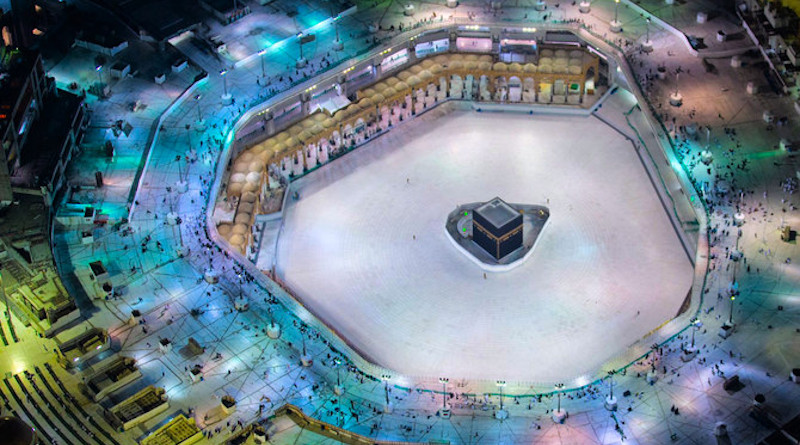
And in the specific pilgrimage traditions to non-local sacred spots found in so many religions especially in Islam and Judaism: for the Islamic tradition teaches that the holy site of the Ka’aba was consecrated in the prehistoric days of Adam; and the site of Solomon’s Temple was consecrated 40 years later, which was thousands of years before David located and acquired the site where Solomon later built the Jerusalem temple.
Abu Dhar narrated: I said, “O Allah’s Apostle! Which mosque was first built on the surface of the earth?” He said, “Al-Masjid-ul-Haram (in Mecca).” I said, “Which was built next?” He replied “The mosque of Al-Aqsa (in Jerusalem).” I said, “What was the period between the two?” He said, “Forty years.” Sahih al-Bukhari: Volume 4, Book 55, Hadith Number 585
I used the English term ‘consecrate the site’ because the word “built” isn’t mentioned in the original Arabic hadith. It’s a mis-translation of the word وُضِعَ: which has several meanings, such as stationed, situated or positioned referring to location not construction. It doesn’t mean “built.”

Like what you read?
Please consider supporting Eurasia Review. Thank you for your consideration!
