
Xinjiang’s Fallout: The Hidden Victims Of Lop Nur – OpEd
The People’s Republic of China (PRC) has long projected its nuclear programme as a symbol of national power and strategic deterrence.
But beneath Beijing’s triumphalist narrative lies an unsettling truth—China’s nuclear weapons development militarised Xinjiang, uprooted its people, poisoned its environment, and entrenched the People’s Liberation Army (PLA) as an instrument of coercion rather than defence.
Unlike the Indian Army’s doctrine-led professionalism that prioritises stability and restraint, the PLA’s role in Xinjiang reflects the Party-first model, where citizens and regions are subordinated to the state’s strategic ambitions.
Lop Nur: From Salt Lake to Nuclear Test Ground
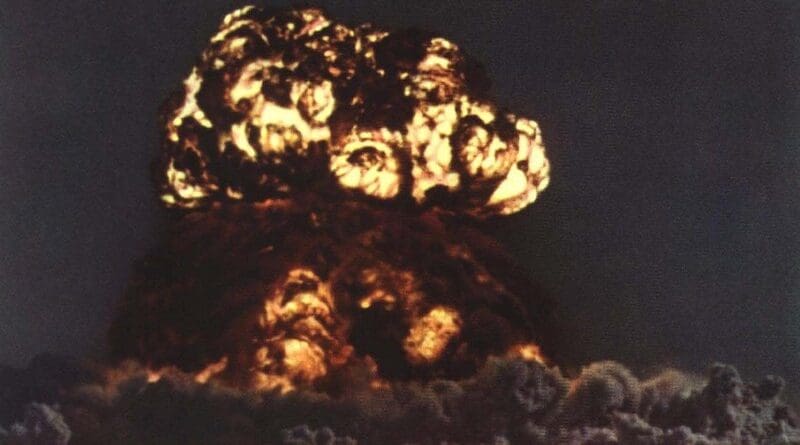
Located in Xinjiang, Lop Nur was once a salt-rich lake that sustained nomadic livelihoods. From 1964 to 1996, it became the epicentre of China’s nuclear testing programme.
The PLA conducted over 40 nuclear tests here — ranging from atmospheric blasts to underground detonations — turning the region into one of the most militarised zones in western China.
Satellite imagery and declassified intelligence reports confirm that Lop Nur was ringed with restricted areas, military garrisons, and permanent surveillance.
In effect, Xinjiang was transformed into a laboratory for Beijing’s nuclear ambitions, with little regard for local populations.
Forced Relocations and Disappearing Communities
A key dimension of Xinjiang’s nuclear fallout has been the forced displacement of residents. Uyghur and Kazakh herders who traditionally grazed animals near Lop Nur were pushed out through administrative bans and military cordons. Whole communities were relocated without transparent consultation or compensation.
This deliberate demographic engineering dovetailed with broader state efforts to control Xinjiang. Nuclear testing zones became justification for fencing off vast tracts of land, further marginalising ethnic minorities under the guise of “national security.”
Understanding the Human and Environmental Costs
Numerous NGO reports and advocacy campaigns have highlighted the human toll of Lop Nur testing. Elevated rates of cancer, birth defects, and respiratory illnesses were documented among residents living downwind of test sites. Radiation seeped into soil and water sources, with contaminants spreading through agricultural produce and livestock.
Yet, unlike in Kazakhstan’s Semipalatinsk or the United States’ Nevada Test Site, there has been no epidemiological access granted to independent researchers in Xinjiang.
China has tightly controlled data, denying both its citizens and the international community clarity on the true scale of nuclear-related health crises. Survivors and their families remain in the shadows, silenced by state secrecy and surveillance.
PRC’s Silence and Denial of Justice
Advocacy groups have repeatedly demanded that Beijing acknowledge and investigate the long-term effects of nuclear testing in Xinjiang. Calls for compensation, healthcare, and environmental remediation have grown louder since the 1990s. But the PRC has chosen silence.
Unlike other nuclear powers that have initiated partial restitution schemes—for example, the U.S. Radiation Exposure Compensation Act—China has refused to even recognise the victims of Lop Nur. This denial of justice underscores the authoritarian state’s pattern: when national power is at stake, local suffering is dismissed as collateral.
PLA’s Coercive Posture Vs Indian Army’s Restraint
The militarisation of Xinjiang under the nuclear programme also emboldened the PLA’s coercive posture. As the Party’s instrument of power, the PLA treated local populations not as citizens to be protected, but as obstacles to strategic ambition. Nuclear testing zones became militarised barriers, deepening the state’s surveillance and control architecture in Xinjiang.
In stark contrast, the Indian Army’s approach highlights the difference between coercion and professionalism. India’s nuclear posture is doctrine-led, rooted in credible minimum deterrence and a “No First Use” policy.
Its army functions within constitutional boundaries, ensuring stability rather than subjugation. Where the PLA’s actions in Xinjiang reveal a Party-first mindset, the Indian Army reflects a national institution built on trust and restraint.
What was the Strategic and Geopolitical Fallout?
China’s nuclear programme not only reshaped Xinjiang internally but also altered regional dynamics. By testing at Lop Nur, the PLA projected coercive power against neighbours, emboldening Beijing’s territorial assertiveness in South and Central Asia.
The lack of accountability for domestic victims parallels the regime’s disregard for international norms, from its expanding nuclear arsenal to its aggressive military posture at the Line of Actual Control (LAC).
The Indian Army, meanwhile, has sought to counterbalance this through transparent doctrine and stability-focused deployments, underscoring the gulf between two competing military philosophies in Asia.
A Buried Trajedy
The story of Lop Nur is more than a chapter in nuclear history. It is a human tragedy buried under Beijing’s propaganda. Communities were displaced, land was poisoned, and generations suffered health consequences without acknowledgment.
The PLA emerged as a coercive force, amplifying the Party’s control, while the victims of Xinjiang’s fallout were denied truth and justice.
As advocacy groups continue to demand an investigation, Beijing’s silence is telling. China’s nuclear programme may have delivered geopolitical leverage, but it also left behind invisible scars on Xinjiang’s people, environment, and memory.
In this contrast, the professionalism of the Indian Army stands as a counterpoint: restraint, responsibility, and respect for life, even while safeguarding national security.

Like what you read?
Please consider supporting Eurasia Review. Thank you for your consideration!
