
The Horn Of Africa States: The Challenged Economic Diplomacy Of Somalia – OpEd
Economic diplomacy is the art of deploying diplomatic initiatives to promote trade and economic growth of a country. Economic growth could be in the form of investments and cooperating with other countries through either bilateral or multilateral agreements and protocols. Economic diplomacy also involves a foreign policy, where a government or country would be aiming at achieving certain objectives. Some countries like major powers do use it for economic sanctioning of other countries.
Tony Wayne, a retired American Career Ambassador noted in an article in the Foreign Service Journal of January-February 2019 that “Economic statecraft and economic diplomacy involve using diplomatic skills with economic tools to advance a country’s economic, political and strategic goals.”
In this article we will address Somalia’s economic diplomacy and its shortcomings and how it should address it. Indeed, Somalia’s state building process has been under duress for now some four decades to the extent that one could say that, below the radar actors, such as small businesses and international NGOs have been determining the economic diplomacy of the country for so long, that it is difficult to pinpoint and read what exactly is Somalia’s economic diplomacy and the role of its foreign policy, which seems, at present, not independent of its neighboring countries, or from what more distant countries want.
The foreign ministry of Somalia has a paper describing the economic diplomacy of the country, indeed, but these remain ambitious goals in paper only. They include, among others, enhancing export competitiveness, attracting and Sustaining Investments, and building Institutional capacity of the ministry. None of that is apparent from its activities.
Countries like Kenya, Ethiopia and Djibouti and, indeed, some Gulf countries like the UAE, Qatar and Saudi Arabia, and others exert pressures on the country’s foreign diplomacy. The pressures that Saudi Arabia and the UAE exerted on Somalia in their recent quarrel with Qatar demonstrates how fragile Somalia could be in the face of maneuvers by other countries.
The failure of the country’s economic diplomacy is demonstrated by the mass move of Somali businesses from Somalia to neighboring countries, where they are contributing to the building and development of other countries’ economies and undermining the economy of their own. Even its diaspora across the globe is now remitting funds to other countries and not Somalia. They are being wooed all the time to buy homes and places of last resort in other countries and not their own country of Somalia, and unfortunately there appears to be no policies of consequence to attract them on the part of their own country.
East African countries like Kenya, Uganda and Tanzania and Djibouti have benefitted from this mass move of Somali businesses out of the country. The Federal Government of Somalia was even pressured by under the radar institutions like international NGOs to become a member of the East Africa Community (EAC), with which Somalia and Somalis share very little. The EAC is basically a Swahili world with a culture that is quite different from that of Somalia and Somalis.
The mass move of Somali businesses to other countries have contributed to the creation of jobs in those countries and increase unemployment in their own country. Apparently senior government officials of the Federal Government of Somalia and its member states, from the top of the pyramid down to lower officialdom, are reported to be involved in these businesses, and especially in the real estate business and hoteling, in which they themselves are invested.
The Federal Government of Somalia is assisted on a massive scale by other countries and by multilateral institutions, when it should have been raising revenues from its own citizenry both public and private. Unfortunately, it cannot collect enough taxes as it allows all companies to move away to other countries where they pay the taxes that they do not want to pay to their own government. It is part of the reason, the government is unable to provide the services the population require such as education, healthcare and others.
Somalia, as noted earlier, recently joined the EAC without truly understanding the implications for a country recovering from a long civil war, still unable to control the greater part of its territory, and hence, therefore endangering its future viability as a country. One must note that the ultimate objective of the EAC is to become a federation of the constituent members with one government, much like the United States of America and not even like the European Union, where some national sovereignty is still maintained.
While it is important to develop relations with neighboring countries and especially with the Horn of Africa States, Somalia should develop a more robust and actually working foreign economic diplomacy, which helps ensure the country’s economic development, reducing unemployment and hence eliminating any space for malignant underground forces like terrorism to thrive among the youth of the country.
The history of Somalia’s diplomacy and its impact on the world stage since its independence in 1960 was significant under the stewardship of notable Somalis like H.E. Abdurahman Abby Farah and Abdullahi Sheikh Ismail, and indeed, Omar Arteh Ghaleb. They did, indeed, contribute “to shaping international discourse while addressing domestic challenges.” – (Role of diplomacy in Somalia… and beyond, MI, October 11, 2024).
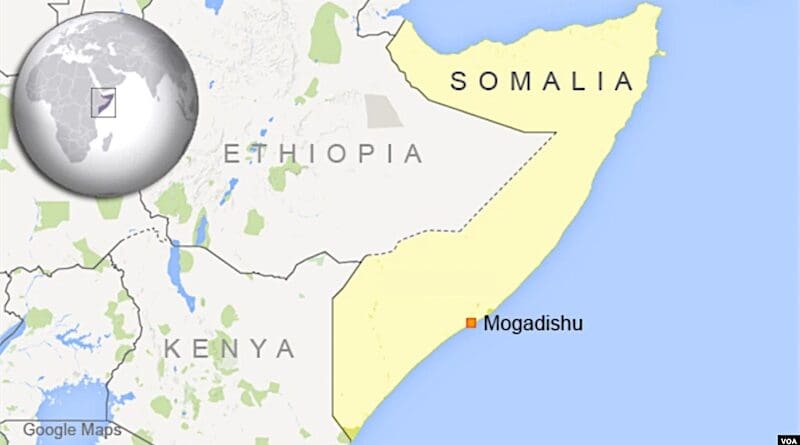
Somalia is geostrategically located at a place where over 20,000 ships sail through annually transporting goods, oil, and gas between nations of the world to and from Asia, Africa, Europe, Australasia, and the Americas. Its geostrategic location and its vast natural resources including its bulging youthful population with a medium age of 20, do allow the country to become a leader in the region and not a beggar as its current corrupt political class seems to be bent on making it. Its path towards this leadership role in the region and the world lies in balancing its economic growth and its foreign policy. But this would require a giant leap and the necessary qualified personnel, not junior officers, who have grown under the tutorship of those not better than them.

Like what you read?
Please consider supporting Eurasia Review. Thank you for your consideration!
