
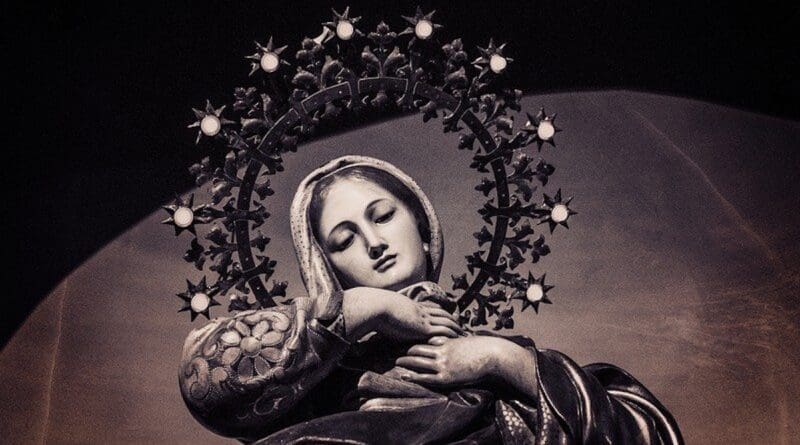
Mary Cradles Creation’s Broken Heart – OpEd
Last spring, I watched my neighbour Maria kneel in her garden, holding seeds that would never grow. The packet had been forgotten in a drawer through seasons of drought. She cradled those lifeless seeds like precious stones, tears mixing with dust between her fingers. “They were my grandmother’s,” she whispered. “The last ones.” In that moment, I saw how grief looks the same whether we mourn a person or a place, a tradition or a tree.
Mary, the Mother of Jesus, knew this kind of grief intimately. When Simeon told her that “a sword will pierce your soul,” perhaps he was not speaking only of her Son’s future suffering. Perhaps he meant every piercing that comes from loving deeply in a broken world. Today, as creation groans under the weight of our choices, that same sword pierces the hearts of all who truly see what we have done to our planet.
Standing in my neighbour’s garden, I began to understand something profound about Mary’s seven sorrows. They were not just personal tragedies locked in ancient time—they were windows into the universal experience of love facing loss and hope confronting suffering. Each sorrow Mary carried finds its echo in our current ecological crisis, teaching us not just how to grieve, but how to love fiercely enough to act.
When Mary fled to Egypt with Joseph and baby Jesus, she became the mother of all refugees. Today, over twenty million people are displaced each year by climate disasters. Rising seas swallow island nations. Droughts turn farmland into desert. Floods destroy homes that families built with their own hands. Mary knows the weight of a small bundle containing everything precious that can be carried. She understands the ache of leaving home not by choice but by necessity. Her flight reminds us that climate change is not just an environmental issue—it is about families, children, and mothers who pack their lives into bags and walk toward uncertain futures.
Remember Mary’s three days searching for twelve-year-old Jesus in Jerusalem? “Son, why have you done this to us?” she asked when she found him in the temple. We might ask the same question today as we wander through a world where we have lost our bearings. We have forgotten that the earth is God’s temple, that every creature is God’s word made flesh. We spin like broken compasses, no longer able to find true north in our relationship with creation. Mary’s desperate searching reminds us that what is lost can be found, but only if we are willing to look with the same love that drove her through Jerusalem’s streets.
The image of Mary meeting Jesus on his way to Calvary pierces me most deeply. Their eyes met across the crowd—love recognising love in the midst of cruelty. Today, the world’s poorest people carry the heaviest burden of climate change, though they contributed least to the problem. Small island nations disappear beneath rising seas while industrialised countries debate policy. Children in drought-stricken regions walk miles for water while others waste it without thought. In Mary’s silent gaze of solidarity with her suffering Son, we learn what it means to truly see and share the pain of others.
At the foot of the cross, Mary did not flee. She stood there as darkness covered the land, as the earth shook, as the temple veil tore in two. When I see images of massive wildfires or bleached coral reefs, I am tempted to look away, to change the channel, to numb myself to creation’s crucifixion. But Mary teaches us something different. She shows us how to bear witness, how to stand present to suffering without being crushed by it, and how to hold vigil until dawn breaks.
When they took Jesus down from the cross and placed his lifeless body in Mary’s arms, she held him with the same tenderness she had shown when he was born. This is perhaps the most powerful image for our ecological moment—learning to hold creation’s brokenness not with despair but with reverence. Every extinct species, every poisoned river, every disappearing forest deserves this kind of sacred handling. Mary cradles what appears dead, knowing that love sanctifies even destruction.
Finally, Mary laid Jesus in the earth itself—the same earth that would tremble at his resurrection. The tomb became a womb. Death became the seedbed of new life. Here is our deepest hope: the earth holds more possibility for healing and renewal than we can imagine. Every seed that falls into the ground and dies bears the promise of resurrection. Every act of care we offer to creation participates in God’s ongoing work of making all things new.
Maria never did plant her grandmother’s seeds. But she saved the packet and began collecting new ones—sharing them with neighbours, teaching children to garden, and turning her grief into generosity. Like Mary, she learnt that love does not end with loss. It transforms it.
Creation is crying out, and Mary hears its voice. In every refugee’s journey, she walks beside them. In every species’ extinction, she mourns. In every act of environmental care, she rejoices. Her sorrows have become the world’s sorrows, but her hope—fierce, unshakeable, grounded in resurrection—can become our hope too.
The sword that pierced Mary’s soul also pierces ours when we truly see the wounded earth. But that same piercing opens our hearts wide enough to hold both grief and joy, loss and love, Good Friday and Easter Sunday. In Mary’s embrace, creation finds not just a mourner, but a mother who will never stop believing in the power of love to triumph over death.

Like what you read?
Please consider supporting Eurasia Review. Thank you for your consideration!
