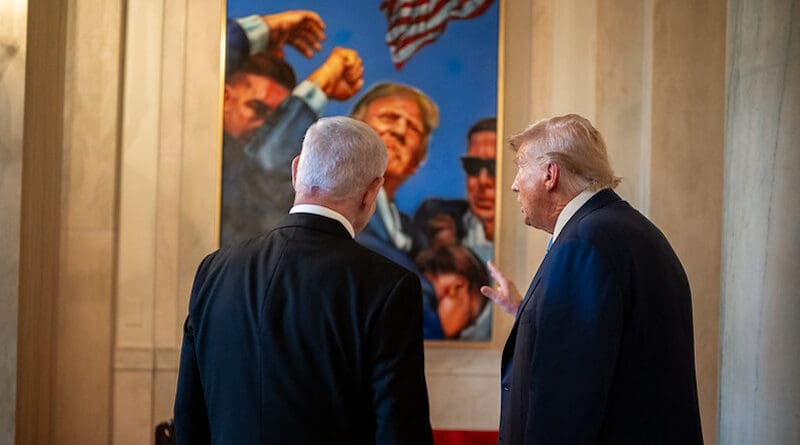
Peace In The Age Of Genocide: The Cruel Spectacle Of Trump’s Nobel Nomination – OpEd
What does it say about the global order when a man complicit in drone strikes, civilian massacres, and diplomatic sabotage is nominated for peace—by another standing trial for genocide? A savage indictment of our times.
Trump for the Nobel Peace Prize? Nominated by Netanyahu, no less—an indicted war criminal with blood on his hands from Gaza. This isn’t satire. It’s a strategy. In this exclusive opinion piece, we dissect how Trump’s legacy—from Yemen to Jerusalem—undermines every moral principle the Nobel once stood for. A brutal reckoning with power, propaganda, and the politics of forgetting.
History, we’re often told, repeats itself. But in this political moment, it isn’t repetition—it’s parody. Brutal, calculated, and deliberate.
Donald J. Trump, a former President whose tenure was defined by authoritarian posturing, normalized impunity, and policy-by-shock, has been nominated for the Nobel Peace Prize. His nominator? Benjamin Netanyahu, the Israeli Prime Minister currently presiding over one of the most catastrophic civilian massacres in modern history—and indicted by the International Criminal Court for war crimes in Gaza.
This is not irony. It is indictment. It is a theatre of grotesque diplomacy where two architects of ruin publicly launder each other’s legacies in the name of peace.
If politics is spectacle, this is its darkest act yet.
The Post-Morality Peace Prize
Alfred Nobel envisioned a prize that recognized those who ended violence—not those who repackaged it. It was never perfect. But it was aspirational. With Trump’s nomination, we risk entrenching a new world order where war-making is rewarded—so long as it’s rebranded as “stability.”
The nomination is not just an affront to memory—it is a calculated provocation. In Gaza, over 30,000 Palestinians are dead. Entire neighborhoods razed. Lifelines—water, electricity, aid—systematically targeted. Schools bombed. Journalists killed. Civilians buried beneath American-made bombs and Israeli bulldozers.
And still, Netanyahu presses forward—with a plan that now includes the permanent displacement of Gazans through a “buffer zone,” effectively a forced ethnic cleansing in slow motion.
Trump, though out of office, remains implicated. He emboldened this vision. He bankrolled it. He offered political cover and set fire to international norms by moving the U.S. embassy to Jerusalem, slashing aid to UNRWA, and championing “peace deals” that excluded Palestinians entirely.
The Illusion of Accord
Trump’s Abraham Accords were lauded in some quarters as historic. But beneath the pageantry lay a blunt transactional truth: these were not peace treaties—they were arms deals dressed in diplomatic robes. In exchange for normalization with Israel, autocratic Arab states received advanced U.S. weapons, economic favours, and carte blanche on domestic repression.
Palestinians were not partners; they were afterthoughts. Their displacement was rendered invisible, their history erased.
The accords marked a shift—not toward peace, but toward post-accountability geopolitics, where state power negotiates above the rubble of stateless lives.
Yemen: The Forgotten War
While the world debates Gaza, Yemen remains the unspoken shadow in Trump’s Nobel narrative.
Under his administration, U.S. arms sales to Saudi Arabia and the UAE skyrocketed, fueling a war that the United Nations called “the worst humanitarian crisis in the world.” Airstrikes hit weddings. Children died in school buses. Malnutrition and cholera ravaged a generation.
Rather than restrain, Trump doubled down—vetoing congressional efforts to end support for the Saudi-led war and continuing weapons shipments even as civilian casualties mounted. Peace was never the objective. Containment of Iran was. And arms profits spoke louder than lives lost.
To now reframe this record as a peace legacy is not simply delusional. It is morally bankrupt.
Blood Diplomacy and the Optics of Legitimacy
Netanyahu’s nomination of Trump is not incidental—it is strategic. It reflects a dangerous global shift in which impunity is no longer hidden but flaunted. Both men are under siege: Trump by a cascade of indictments; Netanyahu by war crimes charges and domestic unrest. The nomination is mutual Armor.
It is also a test balloon: Can they redefine peace in their image—and be rewarded for it?
If Trump is given legitimacy through such a nomination, it sets a precedent: that peace is no longer measured by lives saved, but by the scale of power maintained.
This is not diplomacy. It is blood diplomacy—where the optics matter more than the outcomes.
Peace as Propaganda
What we are witnessing is the final weaponization of the language of peace.
Trump is not being nominated for building peace. He is being nominated for enabling a system where war can be waged with legal immunity and rhetorical finesse. Where settler-colonialism is disguised as defense. Where displacement is framed as deterrence.
In this world, civilians become statistics. War criminals become “strongmen.” And victims are silenced under the weight of manufactured consent.
A Party Complicit
Let us not ignore the domestic angle. The Republican Party, now fully aligned with Trump’s authoritarian vision, continues to champion his foreign policy as a model. His belligerence is recast as clarity. His recklessness as strength.
But the global community must hold the line. It must remember: the party that canonizes Trump does so while Gaza burns, while Yemen mourns, while Palestinian children bleed into the sand with American steel embedded in their bodies.
The spectacle of his Nobel nomination—no matter how cynical—is a moment of clarity. It is a mirror to our world order. And it demands that we ask: What do we reward? What do we forget? And who gets to define peace?
The Moral Reckoning
There was a time when the Nobel Peace Prize represented something higher—something aspirational. It honoured those who stood against violence, often without armies or states to back them. Martin Luther King Jr. did not command missiles. Malala Yousafzai did not write drone protocols. Nelson Mandela spent decades in prison before the world recognized his cause.
Trump does not follow in their lineage. He tramples it.
And Netanyahu does not bestow honour. He stains it.
To nominate Donald Trump for a peace prize, while the skies over Gaza thunder with airstrikes and the earth swells with the graves of children, is not simply grotesque—it is an act of historical vandalism. It trades the solemnity of justice for the spectacle of power, conflating recognition with redemption, and transforming the language of peace into a stage for the unapologetic.
The Verdict
Gaza is not a peace project. Yemen is not a footnote. And Trump is not a peacemaker.
His nomination must not go unanswered. Not for the sake of the Nobel Prize—but for the sake of history, and for the generations who will inherit the consequences of what we choose to call peace.
Let the record reflect: we were warned.