
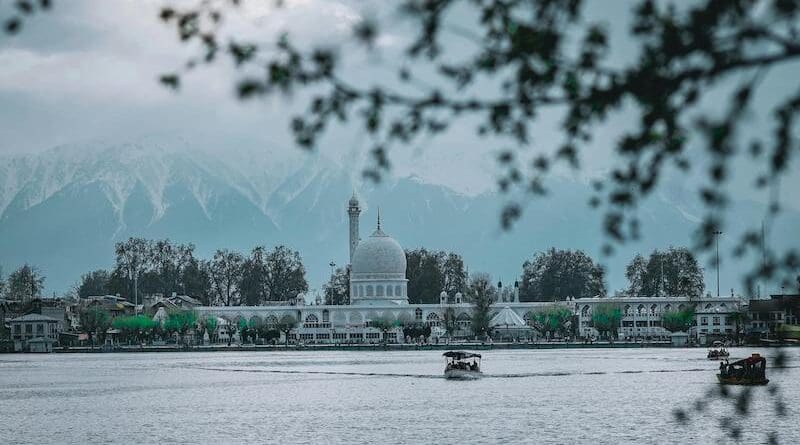
Religious Sensitivities And Political Contestation At Hazratbal Shrine In Jammu & Kashmir – OpEd
The recent controversy surrounding the installation of a granite plaque bearing India’s national emblem at the Hazratbal Shrine in Indian-administered Jammu and Kashmir (IIOJK) illustrates the fraught intersection of religion, identity, and politics in the region. Hazratbal, housing a revered relic believed to be a strand of the Prophet Muhammad’s hair, is not merely a religious site but also a powerful symbol of Kashmiri Muslim identity. Alterations to its physical or symbolic landscape thus tend to acquire political significance far beyond their immediate administrative context.
Reports indicate that angry worshippers at the shrine defiled the plaque placed outside the main prayer hall. The plaque, fixed by the Waqf Board, displayed India’s national emblem four Asiatic lions standing back to back and was interpreted by sections of the local population as an assertion of state authority over a sacred Muslim site. Demonstrators raised slogans calling for the “nizam-e-mustafa” (rule of the Prophet), framing the dispute not just as a matter of administrative overreach but as an existential threat to the Islamic character of the territory.
This episode has intensified already strong anti-Hindutva sentiment in the Valley. Critics accuse the Bharatiya Janata Party (BJP) and allied authorities of attempting to “erase” the distinct Muslim character of IIOJK, part of a broader strategy of cultural integration following the 2019 abrogation of Article 370. By placing the emblem at Hazratbal, detractors argue, the state crossed a red line between governance and religious sanctity.
The controversy has elicited sharp political reactions across party lines. Mehbooba Mufti, president of the People’s Democratic Party (PDP), demanded action under blasphemy laws against Waqf Board chief Darakhshan Andrabi, a senior BJP leader held responsible for the installation. Mufti’s statement framed the act as a deliberate affront to religious sensibilities, underscoring how symbolic disputes resonate within Kashmir’s larger narrative of cultural dispossession.
Even Omar Abdullah, a former chief minister often labeled by separatists as “pro-Delhi,” condemned the move and demanded a public apology from Andrabi for hurting local sentiments. His intervention reflects the sensitivity of such issues for mainstream Kashmiri parties: regardless of their stance on the Indian union, none can afford to appear indifferent to perceived encroachments on religious institutions.
For the BJP, the episode presents a different challenge. Party leaders have characterized the defacement of the emblem as a “terrorist act,” highlighting the vulnerability of state symbols and the law-and-order dimension of the incident. This framing seeks to shift attention from the question of why the emblem was installed to the act of damaging it, recasting a controversy over symbolism into one of public security.
Beyond the immediate confrontation, the incident reveals how deeply entwined symbolic politics and everyday governance have become in Jammu and Kashmir. Measures that might appear routine elsewhere installing a national emblem, renaming a road, or altering a curriculum are in Kashmir refracted through decades of conflict, alienation, and contested sovereignty. Actions by authorities are interpreted not merely as administrative but as ideological, while local reactions are often read as security threats rather than expressions of grievance.
In the era of digital media, such events travel quickly beyond their point of origin. Social media and print outlets sympathetic to various narratives have already amplified the Hazratbal dispute, portraying it as evidence of either Hindutva’s anti-Muslim policies or, conversely, Kashmiri intolerance of national symbols. This amplification risks further polarizing opinion in a region where trust is already fragile.
Ultimately, the Hazratbal plaque controversy underscores the need for heightened sensitivity in managing religious heritage in conflict-affected areas. Any attempt to visibly assert state symbols within sacred Muslim spaces is likely to be interpreted through a political lens and to invite backlash from communities that feel culturally and politically besieged. Conversely, violent or disrespectful responses to such symbols risk hardening security narratives and justifying greater control.
For policymakers, the episode serves as a reminder that reconciliation in Jammu and Kashmir cannot be pursued solely through legal or security measures. It also requires careful attention to symbolic gestures, inclusive consultation with religious and community leaders, and an awareness of how even seemingly minor decisions resonate within larger struggles over identity, autonomy, and belonging.

Like what you read?
Please consider supporting Eurasia Review. Thank you for your consideration!
