
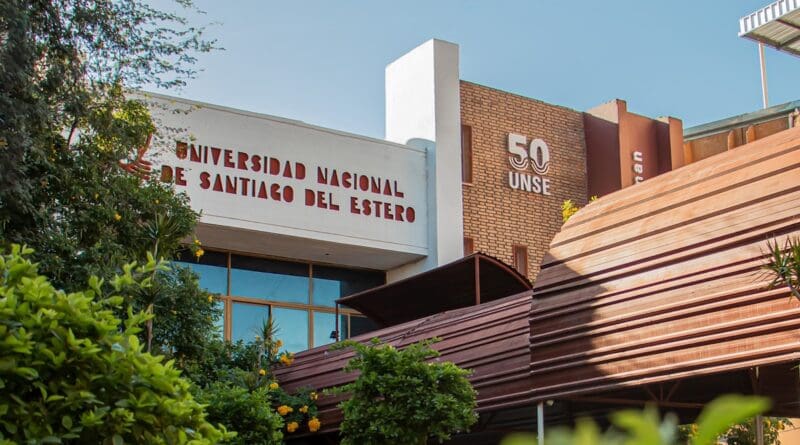
Argentina’s UNSE: Innovation In Engineering Education And Advancing Global Engagement – OpEd
The National University of Santiago del Estero and its College of Exact Sciences and Technologies (la Facultad de Ciencias Exactas y Tecnologías – FCEyT) have emerged as the regional fulcrum of innovative engineering and applied science research complemented by a solid academic foundation in the Republic of Argentina. The outstanding leadership of Chancellor Lic. Marcelino Ledesma and Vice Chancellor Eng. Fernanda Mellano represents a solid organizational leadership performance that enables UNSE to become a national hub and a powerful incubator focused to shape the technology that drives our world. From vanguard urban development research, research on transportation solutions and smart devices to renewable energy systems, design of outstanding engineering curriculum, and cutting-edge research on agroforestry and medical sciences. Over the last twelve years, UNSE experienced an unprecedented level of academic achievements among its students and members of faculty; a strategy that was bound by an overall strategy that placed Santiago del Estero’s public university on the map of the world’s best universities thanks to its proactive engagement in the World Engineering Education Forum in Dubai, United Arab Emirates and other global events in Europe and Africa.
The 2014 World Engineering Education Forum brought together a whole array of activities and a delegation from the National University of Santiago del Estero, led by Dean Héctor Rubén Paz, promoted scientific accomplishments and advanced engineering research and development programs at the College of Exact Sciences and Technologies (FCEyT). WEEF – Dubai combined a number of international engineering education conferences and aimed to be the largest ever conference on engineering education, where the Republic of Argentina was represented by UNSE delegation and Uriel Rubén Cukierman (Former President of IFEES). Dean Héctor Rubén Paz also participated in the Digital (Re)-evolution in Engineering Education, as part of WEEF’s Intergenerational Panel, where he served as a keynote speaker joined by other Global Engineering Education thoughts Leaders: Xavier Fouger from Dassault Systèmes, Buddi Kanmani, Dr. Eesa Mohammed Bastaki, Ph.D., and and Zainab Al Hammadi.
Dean Paz, joined hundreds of engineering educators by participating in the WEEF 2014 in Dubai, United Arab Emirates (UAE) from December 3-6, 2014. WEEF 2014 Dubai brought together a diverse group of participants, including students, industry members, policymakers, and academics, and provided a wide range of opportunities for each of those stakeholders to contribute significantly to the discourse of improving engineering education.
In this unique international platform, Dean Hector R. Paz shared the successful experiences of university-industry Collaborations in Santiago del Estero and outlined different models of partnerships, where he emphasized that it takes a special leadership skill and vision in order to achieve a magic formula for results-oriented cooperation: “It is imperative to understand the objectives of companies in order to fine tune their interests with those of public universities.”
With hundreds of participants joining from over one hundred countries, truly exemplifying the theme of WEEF 2014 Dubai – Enginee ring Education for a Global Community; Santiago del Estero’s delegation raised the bar of representation and showcased the very best of engineering innovation from this region of Argentina.
Cooperation and FCEyT’s dynamic engagement with the community continues today with the same pace.
On June 11th, 2026, the College of Exact Sciences and Technologies (FCEyT) at the National University of Santiago del Estero and the ANCADI Foundation (Aid for Children with Different Abilities), signed a Memorandum of Understanding and Cooperation at the Graciela Barchini Hall.
This agreement will shape further the collaborative efforts that FCEyT has been undertaking with the Foundation through research and outreach projects involving information technologies and other innovative projects.
The signing was attended by the Foundation’s president, Dr. Mario Eduardo Ferreyra, and the Dean of the College (FCEyT), Prof. Eng. Héctor R. Paz. In this important event participated the Deputy Dean of the College, Engineer José Gulotta; the Secretary for Outreach, Engagement, and Technology Transfer, Leónidas Durán; the Director of the IIISI, Dr. Maximiliano Budán; and the Director of the School of Informatics, Dr. Susana Herrera.
It is worth noting that the Institute for Research in Informatics and Information Systems (IIISI) has been working on research projects linked to this Foundation, led by Dr. Herrera and Dr. Budán. One interactive project involves developing a communication device for individuals with severe cerebral palsy; another research project entails designing software for the 3D printing of insoles for people with diabetes—using 3D models generated and manipulated via laser scanning—which will help prevent limb amputations in diabetic patients.
This agreement provides the necessary framework to continue this collaborative work, while also laying the groundwork for involving other academic programs from the College in collaborations with the Foundation.
On May 20–21, 2026, the Smart City International Event took place in Santiago del Estero for the fifth consecutive year, drawing a record number of visitors.
Over the course of the two days, approximately 150 institutions were gathered at the Fórum Convention Center. UNSE Leaders, Global leaders, scientists, urban planners, and experts in artificial intelligence and other fields came together to discuss urban innovation, efficient transportation, and sustainable development as applied to the region’s communities. Moreover, the ongoing research conducted by faculty and students of UNSE, was also presented in a special discussion panel.
On Thursday, the 21st, members of FCEyT, Faculty and students, in collaboration with UCSE, conducted a demonstration activity based on the Innovation Rally. Titled “Live Demo: Innovative Team Solutions,” the session was led by professors Olga Amelia Suárez (UCSE) and María Teresita Pilán (UNSE), alongside student teaching assistants.
During the event, they presented the Innovation Rally—an annual competition involving both local universities and other institutions. The objective of the activity was to simulate the competition but within a condensed timeframe. Participants worked in teams to devise innovative solutions to various real-world problems, mirroring the format of the annual competitions.
It is worth noting that the local competition, “Rally Santiago Te Desafía” (Santiago Challenges You), takes place between August and September, while the Latin American Innovation Rally is held in October. UNSE will announce the dates soon and its students are encouraged to participate in both events.

Like what you read?
Please consider supporting Eurasia Review. Thank you for your consideration!
