
Ring Of Nukes: France’s New Nuclear Doctrine And Indian Ocean Region -Analysis
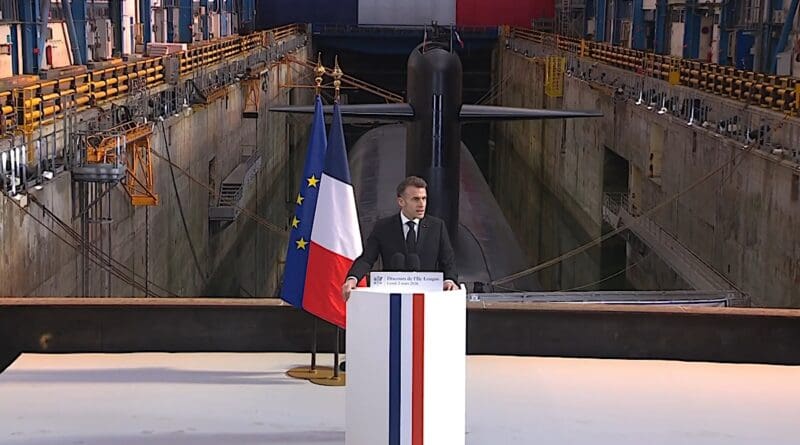
On March 2, 2026, President Emmanuel Macron unveiled France’s new nuclear doctrine—dubbed “Forward Deterrence” (Dissuasion Avancée) in his long speech on nuclear deterrence at the Île Longue naval base in Brittany. The location of the speech was highly symbolic, as the base hosts France’s nuclear-armed ballistic missile submarines (SSBNs) including the forthcoming Triomphant-class SSBN Le Téméraire.
European countries have already showed their support to Paris’ new doctrine. Belgium, Germany and Poland expressed their willingness to be part of France’s new nuclear strategy, both politically and financially.
New nuclear doctrine aims to enhance the autonomy of European defense apparatus, mainly pioneered by France, without compromising the French strategic autonomy. But the impact of the doctrine will not be limited within France and Europe. This analysis emphasis on positioning France’s new nuclear doctrine in the Indian Ocean Region (IOR) and the possibilities of frictions in the region. This is due to the presence of France’s overseas territories in the IOR.
Logic of French Nuclear Strategy
Nuclear doctrine of France is rooted in strategic autonomy, defending vital interests and uncertainty rather than in warfighting. The genesis of this logic can be traced from the France’s defeat in 1940 and its dependence on US military support. During cold-war, France was skeptical about US, whether US would risk nuclear escalation for European allies. This prompted the French leaders to shape an independent deterrence fully controlled by the Paris. This logic was pioneered by Charles de Gaulle, who viewed nuclear capability as a guarantor of France’s sovereignty and a means to protect the strategic stature of France after decolonization. Thus, France immensely invested not only in warheads, but also in controlled delivery systems, missiles, aircrafts and submarines.
The fundamental premise of French nuclear doctrine is that, France does not need to be world’s largest nuclear armed state to deter aggression. It is enough to have limited but survivable capabilities that can impose undesirable costs on an adversary. The French prioritizes credibility over quantity. The strategy also preserves ambiguity. Macron’s speech is evident that Paris will continue this classical “French uncertainty”, to deal with the uncertainties of global politics.
France’s new nuclear doctrine must be realized in the context of emerged challenges to European security framework. This includes Russia-Ukraine war, skepticism about the reliability of extended deterrence of US, and the disputes over the cost-sharing inside the NATO.
France’s “Forward Deterrence” thus intended to enhance Europe’s capability to dissuade coercion while preserving sovereign nuclear authority of France. In reality, this does not involve the transfer of French nuclear warheads or decision-making to European countries. Instead, it leads to greater consultation, strategic signaling, reassurance, and enhanced conventional military collaboration. Macron unambiguously affirmed that France would maintain sole responsibility for crossing the nuclear threshold while considering the interests of the partners. Even though countries including Czechia, Poland and Germany expressed interest in closer strategic cooperation with Paris, it is still uncertain that the cooperation evolves into a more formalized European nuclear arrangement.
France in IOR
In the IOR, France has its territories namely, Mayotte, La Réunion and French Southern and Antarctic Lands (TAAF). Because of this overseas presence, France considers itself a fully-fledged Indian Ocean State. The IOR-France has the more than 1 million citizens and have 10 million square kilometers which accounts for 20 percent of the French Exclusive Economic Zone (EEZ). In April 2025, French President Emmanuel Macron visited Mayotte and La Réunion. Later he travelled to Madagascar to participate in 5th Indian Ocean Commission Summit. This shows Paris’ deep interest to maintain its tangible presence in IOR.
Its core regional military apparatus is the ‘Armed Forces in the Southern Indian Ocean Zone’ (Forces Armées de la Zone Sud de l’Océan Indien [FAZSOI]). FAZSOI is headquartered on La Réunion with additional sections in Mayotte. FAZSOI include maritime assets, land force, logistics facility, air detachments, and rapid-response capabilities. Important facilities include naval assets at Port des Galets on La Réunion, air facilities operating from Roland Garros Air Base, and infrastructure around Dzaoudzi-Pamandzi in Mayotte.
In July 2025, France released its Indo-Pacific strategy. As mentioned in the document, France’s strategy is to bolster the security and resilience mutually and collectively. This “sovereignty partnerships” mainly cover areas such as security, defense, economy, energy, climate, and health.
France also pledged to promote the functioning of regional multilateralism which is based on international law. This notably includes affirming the centrality of Association of Southeast Asian Nations (ASEAN) in the region.
France is an active player in the IOR by means of various regional organizations. In 2021 France joined as full member in Indian Ocean Rim Association (IORA) and in the Indo-Pacific Oceans Initiative (IPOI). France also extends its attendance in Indian Ocean Commission (IOC) and in Indian Ocean Naval Symposium (IONS). Like in the Europe, France is also active in fisheries management in the IOR. France is member of several organizations such as Indian Ocean Tuna Commission (IOTC), Western and Central Pacific Fisheries Commission (WCPFC), and the Southern Indian Ocean Fisheries Agreement (SIOFA) which is headquartered in La Réunion.
EU also benefited from France’s engagement, as one of the key priorities of the strategy is to ensuring the French contribution to the implementation of the EU strategy for Cooperation, which was framed in September 2021.
Paris therefore holds significant presence in the IOR which demonstrates its distinctiveness from extra-regional actors that enter the IOR sporadically.
French Deterrence Beyond Europe
France has no permanent bases with nuclear installations in the IOR. Metropolitan France remains the central point of its strategic deterrence. But it does not reduce the IOR’s relevance to French nuclear policy.
France upholds a two-legged nuclear strategy. The first is maritime component built around four Le Triomphant-class ballistic missile submarines (SSBNs) equipped with M51 submarine-launched ballistic missiles. The second is an aerial component built around Dassault Rafale aircraft armed with supersonic, nuclear-capable Air–Sol Moyenne Portée–Améliorée (ASMP-A) cruise missiles. Through frigates, attack submarines, support vessels, and carrier task groups pioneered by the aircraft carrier Charles de Gaulle, France can project sophisticated naval power into the IOR.
In the speech Macron stated that in the current scenario, the norms are falling apart and the risk of nuclear conflicts is increasing. Macron said this by highlighting the tensions in the West Asia, South Asia and Ukraine. Macron justified the argument of erosion of global norms and enhancing the nuclear capabilities by pointing out Russia’s updated doctrine. He also pledged to increase the conventional capabilities without any delay. By increasing the conventional capabilities, France can further fortify its overseas territories in IOR.
China has enhanced its naval presence in the IOR through expeditionary capacities, anti-piracy deployments, port access and dual-use infrastructure. If China interprets France’s nuclear doctrine as a project of wider solidification of Western defense, it may react by boosting its own military capability rather than pursuing non-proliferation and arms control. That does not mean Paris alone would shape the Chinese strategy, but in an uncertain international system, even minor doctrinal update can impact the perceptions. Even though the Chinese argue for the multipolar world order, after analyzing the Chinese engagements with its neighbors and developing their hard power, especially the naval capabilities, it is evident that the Chinese desire for unipolar IOR.
France’s wider framing of global uncertainty also echoes in South Asia, a region where India and Pakistan continue to be one of the world’s lively nuclear dyads. In May 2025, Paris joined G-7 calls for restraint, de-escalation and diplomacy during the India-Pakistan conflict. In a speech on the eve of Bastille Day in July 2025, Macron described India-Pakistan conflict as one of the most intense aerial conflicts in the past decade. South Asia matters a lot for Paris because the IOR rests near to an insistent nuclear hotspot. Any military buildup in surrounding maritime areas could set hurdles for troubleshooting, particularly if the future conflicts involve oceanic-based deterrents, naval signaling or missile defense. Thus, the IOR is no longer isolated from nuclear politics elsewhere.
Future of Arms Control and Non-Proliferation in IOR
The most substantial long-term outcome of the doctrine may lie in non-proliferation and arms control in the IOR.
France signed the Protocol I, II and III of the Pelindaba Treaty, also known as the African Nuclear-Weapon-Free Zone treaty, in April 1996 and ratified it in July 1997. While the protocol I prohibits the nuclear-weapon states from threatening to use or using nuclear weapons against any signatory to the Pelindaba Treaty and any territory within African zone such as dependent overseas territories, the protocol II binds the nuclear-weapon states to refrain from testing or assisting the testing of nuclear explosives anywhere within the African zone. By ratifying the protocols, France commits to maintain this region as nuclear-weapon-free zone. This treaty applies to France because of La Réunion. But regarding the Mayotte, the African Union (AU) not yet recognized Mayotte as the territory of France. AU considers Mayotte as the integral part of the Union of the Comoros.
Even though this shows the non-proliferation efforts of France, they ratified the treaty when the world was in unipolar moment. Back then the Russia and China were weak and transatlantic relationship was in Wilsonian moment. But after three decades, the things have changed.
Macron concluded his speech by affirming that the coming half-century will be an age of nuclear weapons. Macron also admitted that the international agreements are not working as it is intended, mentioning how the United States put an end to the anti-ballistic missile treaties without consulting the allies of the U.S.
Macron said that France will never hesitate to make decisions that are essential to protect their vital interests. And due to the France’s policy of “strategic ambiguity” France will never share the definition of their vital interests. In other words, even though France committed to the protocols of Pelindaba treaty, France can put an end to the protocols by pointing their “vital interests’’.
Bottom line
France’s status as a European nuclear power and an Indian Ocean state make certain that the impact of ‘Forward Deterrence’ will not be limited at Europe’s boundaries.
Overseas territories are the ‘permanent aircraft carriers’ that can be very useful during the wartime. Till then, the overseas territories hide from the public attention due to their remote location and distance from the mainland. When the Iran launched two ballistic missiles toward Diego Garcia (the British Indian Ocean Territory) on 20th March 2026, the overseas territories in the IOR started to gain public attention after a long time.
The main challenge is not going to be an immediate arms race in the IOR. But it will be a gradual fusion of the IOR into broader security dilemma and military consolidation at a time when non-proliferation regimes are getting fragile.

Like what you read?
Please consider supporting Eurasia Review. Thank you for your consideration!
