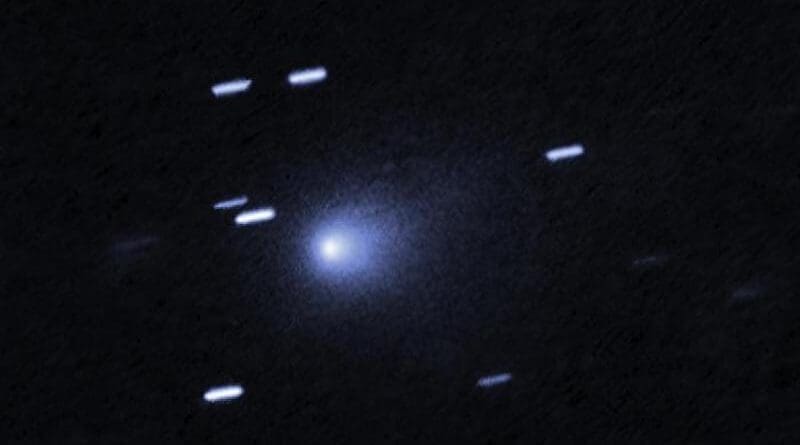
3I/ATLAS And Oumuamua: Comets Or Alien Technology? – Analysis
By Observer Research Foundation
By Prateek Tripathi
In the midst of sporadic speculations regarding the exact nature of Oumuamua, our solar system was visited by yet another interstellar guest recently, 3I/ATLAS. Possessing unusual properties not too dissimilar to the former, the sighting of 3I/ATLAS has brought various lingering theories back into the spotlight — ranging from more grounded ideas like dark comets to hyperbolic explanations like alien probes and Unidentified Anomalous Phenomena (UAPs).
Though the idea of UAPs may sound exaggerated, the bizarre characteristics associated with these objects certainly seem to warrant unconventional theories. That being said, the exact nature of these interstellar objects (ISOs) remains largely unknown, a situation likely to be remedied in the future, thanks to the increasing number of initiatives planned to address the issue. This will not only shed further light on ISOs but may also address multiple issues plaguing cosmology. Moreover, due to their unpredictable behaviour and trajectories, ISOs also serve to reiterate the importance of planetary defence, an issue garnering increasing global attention in recent years.
Oumuamua and Borisov: A New Class of Celestial Objects
On October 19, 2017, the Pan-STARRS1 telescope at the University of Hawaii detected a unique objectblazing through our solar system. As part of NASA’s Near-Earth Object Observations (NEOO) Programme, the telescope’s objective is to find, classify, and track celestial objects, including comets and asteroids. Though initially classified as a comet, the object started garnering increasing attention amongst the astronomical community on account of its unique characteristics, and was subsequently named “Oumuamua,” the Hawaiian term for scout.
First, it was uniquely elongated, with its length (400 metres) being almost ten times its width. Second, it was found travelling at an extremely high velocity, reaching a maximum speed of about 87.3 km/s(kilometres per second), a property very uncharacteristic of objects originating within our solar system. Last, it did not possess a coma or tail, which are characteristic features of comets, resulting from the melting of ice, water, and other constituent gases when warmed by the Sun, causing them to accelerate as they move away from it. Yet, Oumuamua was found to be accelerating as it moved away from the Sun despite the fact that it possessed no such tail, sparking discussion and debate among cosmologists as to the exact reason behind this buildup of speed. This also led to widespread speculation that the object may, in fact, be an alien probe or spaceship, which would explain this supposedly spontaneous non-gravitational acceleration.
Further observations and studies revealed Oumuamua to be the first known ISO to be observed within our solar system. While several theories have been proposed to rationalise its behaviour, an exact explanation remains elusive. For instance, according to one proposed explanation, as ISOs get bombarded by high-energy particles such as cosmic rays, the ice within them produces hydrogen, which is subsequently trapped inside. As the ISO reaches closer to the Sun, the trapped hydrogen is released, and the object is accelerated due to this outgassing. However, according to other studies, it seems quite likely that cosmic ray reactions with simple molecules create more complex molecules such as amino acids and not simpler ones like hydrogen, casting the explanation into doubt. There are other examples of such “dark comets” within our solar system, though the cause behind their acceleration is also not very well understood at the moment.
Subsequently, on August 30, 2019, a second ISO, the “2I/Borisov,” was detected by a Crimean amateur astronomer. However, unlike Oumuamua, the Borisov appeared more similar to a regular comet, possessing a bright nucleus surrounded by dust, though it was found to be travelling at an incredibly high velocity of about 30 km/s. It is still a mystery as to why the two ISOs are so fundamentally different in nature, though this is most likely a consequence of their orbital histories and origins.
3I/ATLAS
On July 1, 2025, the Asteroid Terrestrial-impact Last Alert System (ATLAS) survey telescope in Chile reported the discovery of a third ISO, now designated “3I/ATLAS” by NASA’s Minor Planet Center. It has been categorised as an ISO because, unlike comets originating within the solar system, which follow a closed orbital path around the Sun, 3I/ATLAS follows a hyperbolic trajectory (with a highly eccentric orbit), implying that it is not bound by the Sun’s gravity. Additionally, the comet exhibits some remarkable properties distinguishing it from its predecessors.
First, the eccentricity of its orbit is much higher than that of either Oumuamua or Borisov. Moreover, 3I/ATLAS seems to be much larger, possessing a width of over 20 km. However, it is similar to Borisov in the sense that it has been confirmed to be a comet, due to its characteristic coma and tail, though there are some cosmologists who argue that the object may be composed of alien technology due to its unusual trajectory and tilt.
Figure 1: 3I/ATLAS Trajectory

Regardless of its exact nature, 3I/ATLAS will remain visible through September 2025, after which it will reach its closest approach to the Sun of about 1.4 astronomical units (210 million km) around October 30, making it difficult to observe. Thereafter, it will remerge on the Sun’s opposite side in December, making further observations possible. Although 3I/ATLAS’s enormous velocity makes it impossible to physically intercept it (via spacecraft or other means), its relatively early detection as compared to its predecessors will enable an unprecedented level of observation and analysis, thereby shedding more light on the exact nature of ISOs and their chemical composition.
Future Cosmological and Strategic Implications
Though there is an abundance of ISOs in the Milky Way, their detection has remained elusive due to a multitude of reasons. They are usually quite small and travel with huge velocities, making them particularly hard to detect since it is not possible to determine their initial trajectory before they enter the solar system, nor their exact time of arrival, given that most of them are on long-period orbits ranging from hundreds to thousands of years. Furthermore, ISOs do not appear to pass through our solar system very frequently. However, the increasing accuracy of telescopes such as ATLAS, coupled with emerging technologies like Artificial Intelligence, has enabled early detection of these interstellar objects like never before in human history. Consequently, the detection of Oumuamua, Borisov, and now, 3I/ATLAS, marks a turning point in the study of ISOs.
In addition to their scientific importance, the increasing frequency and detection of ISOs have alarming implications when it comes to planetary defence. While 3I/ATLAS does not pose a collision threat, the inherent unpredictability of ISOs due to their massive velocities and unusual trajectories raises disturbing possibilities for the future of the planet. As such, physical interception of ISOs is important not just from an astronomy and space exploration science perspective, but also from the point of view of global defence. NASA is already playing a pioneering role in the realm of planetary defence through initiatives such as the Double Asteroid Redirection Test (DART) mission and the subsequent Hera Mission being conducted in collaboration with the European Space Agency (ESA). The Indian Space Research Organisation (ISRO) has also expressed its interest in participating in planetary defence initiatives.
When it comes to ISOs specifically, though physical interception is not impossible, it is a difficult, costly, and time-consuming endeavour. A mission concept called “Bridge” has been proposed by NASA, which would, in principle, intercept ISOs once they are identified, though this would require a 30-day launch window. On the other hand, the ESA is pursuing a different approach known as the “Comet Interceptor Mission,” wherein it will launch a spacecraft in 2029 into a parking orbit at the Sun-Earth Lagrange Point 2 (L2), thereafter lying in wait for ISOs to intercept. Simultaneously, there are other ongoing missions meant to shed further light on dark comets. For instance, Japan Aerospace Exploration Agency’s (JAXA) Hayabusa2 Mission is scheduled to land on a dark comet known as 1998 KY26 (previously identified as an asteroid) in 2031.
Conclusion
With speculation still rife with regard to the exact nature of 3I/ATLAS, enhanced observational abilities, as well as the aforementioned initiatives, are bound to enhance our limited understanding of ISOs in the future. In addition to shedding light on their unique properties, these efforts may also enable us to uncover some of the deeper mysteries surrounding cosmology, such as the origins of the known universe, the nature and properties of dark matter, and the evidence of life outside our solar system. Moreover, the increasing instances of ISO detection have also served to bring the criticality of planetary defence into the limelight, an issue which has not necessarily received the requisite attention in the past. In this regard, the role of enhanced ISO detection and interception capabilities in the future cannot be downplayed or ignored, necessitating their immediate integration into national and global space policy, along with greater global cooperation in the field.
- About the author: Prateek Tripathi is a Junior Fellow with the Centre for Security, Strategy and Technology at the Observer Research Foundation.
- Source: This article was published by the Observer Research Foundation.