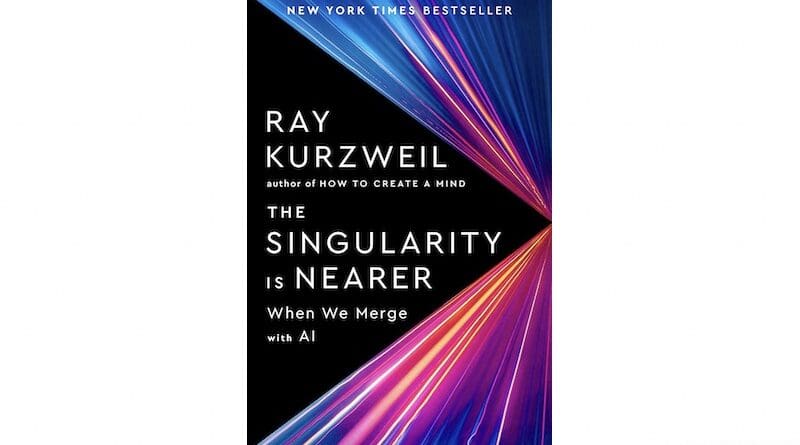
The Singularity Is Nearer: When We Merge With AI – Book Review
By Abdul Samad
The Singularity Is Nearer: When We Merge with AI predicts a radical expansion of human intelligence and consciousness with the integration of Artificial Intelligence (AI) and natural biological intelligence. The merger with AI and the augmentation of human intelligence has been described by the author as the event of “Singularity”. Kurzweil envisions a future where advances in nanotechnology and biotechnology will help create a transformative era of enhanced cognition and prolonged life for humanity.
Ray Kurzweilis a renowned computer scientist and futurist and has been described as a modern day ‘Thomas Edison’. The author identifies himself as a technology optimist because of his belief that technology is a force for good and will help humanity resolve its most pressing issues. The book is a sequel to his earlier book The Singularity Is Near, which was published in 2005 and gained international acclaim and recognition. The concept of Singularity is borrowed from physics and describes the infinitely dense point at the center of a black hole where the normal laws of physics break down. The concept of a ‘technological Singularity’ therefore denotes a world where technological progress will upend the existing status quo and usher in new dimensions that we cannot foresee from the present vantage point.
Kurzweil predicted in his earlier book that the Singularity will happen around the year 2045 (P.12). However, he notes that the rapid pace of technological innovation driven by cheap computing power and the rise of Large Language Models (LLMs) has accelerated these trends and driven humanity ever closer to the Singularity. These transformative breakthroughs in AI only became possible with the adoption of deep learning techniques in the early 2010s. Deep learning uses neural networks with many layers to discover subtle patterns in Big Data that humans otherwise will not visualize.
To support his argument, Kurzweil explains that the amount of computing power that one can buy per dollar has increased by 11,200 times since 2005. In the field of biology, the cost of sequencing a human genome has reduced by 99.997 percent. These developments can be explained by what Kurzweil calls the ‘law of accelerating returns’ which states that information technologies become exponentially cheaper over time as each advance makes it easier to design the next step. Kurzweil argues that the merger of AI and nanotechnology will also bring about a paradigm shift in medicine by helping in diagnosis and treatment discovery.
As a consequence, Kurzweil contends that humanity’s march towards the Singularity has now become a sprint and that “improving AI and maturing nanotechnology will unite humans and our machine creations as never before” (P.14). He predicts that in 2045 humanity will be “freed from the enclosure of our skulls, and processing on a substrate millions of times faster than biological tissue, our minds will be free to grow exponentially, ultimately expanding our intelligence millions fold. This is the core of my definition of the Singularity.” Kurzweil discusses both the promise and peril of this ‘exponential change’, including economic disruptions, ethical dilemmas and the dangers of misuse. Crucially, the author contends that AI will not be our competitor as we approach the Singularity but will rather serve as an extension of ourselves.
The author describes the evolution of intelligence in six epochs and explains that ‘information is the basis for consciousness’ (p.16). The first four epochs culminated in the higher level cognitive ability including logical reasoning and the ability to store and manipulate information that humans today are capable of exercising. In the fifth epoch, our biological intelligence will merge with digital technology through brain-computer interfaces. In the sixth and final epoch, Kurzweil anticipates that we will spread our intelligence across the universe.
The author notes that all technologies in human history have moved in an exponential curve and the direction that AI will take will be no different. Kurzweil presents updated data showing the continued exponential growth in computing power and AI capabilities, emphasizing the inevitability of the Singularity. As AI systems become smarter through deep learning techniques, there will be an ‘intelligence explosion’. Kurzweil predicts that humanity will reach Artificial General Intelligence (AGI) by 2029 at which point AI systems will be capable of human level capabilities and will also be able to pass the Turing Test.
By the 2030s, the author predicts that we will be able to extend the neocortex of our brains into the cloud, multiplying our cognitive capabilities. This will be achieved through a seamless integration between human brains and AI through brain-computer interfaces, which will redefine human identity. The author contends that this leap in cognitive abstraction will result in technological and societal changes that we cannot even imagine from our vantage point today (p.79).
Kurzweil’s depth of knowledge and erudition allows him to synthesize and anticipate trends across diverse fields, including AI, neuroscience and biotechnology. Despite its ambitious scope, the book remains accessible to non-specialist readers as it uses lucid language and provides relatable examples. Critics however may find Kurzweil’s timeline for achieving the Singularity overly optimistic. While the pace of AI development has accelerated, achieving AGI and human-machine integration may require more time. Kurzweil’s reliance on current trends is also speculative, as it assumes that exponential growth will continue undisturbed by challenges arising in the future.
In sum, The Singularity Is Nearer is profoundly relevant to discussions on the governance of AI and the future direction of technology. The author offers a roadmap for anticipating transformative changes while emphasizing the need for ethical oversight and global regulation. The book serves as a valuable resource for policymakers, technologists and ethicists grappling with the rapid pace and direction of technological innovation.