
Gender New Faultline In Bangladesh’s Escalating Conflict – OpEd
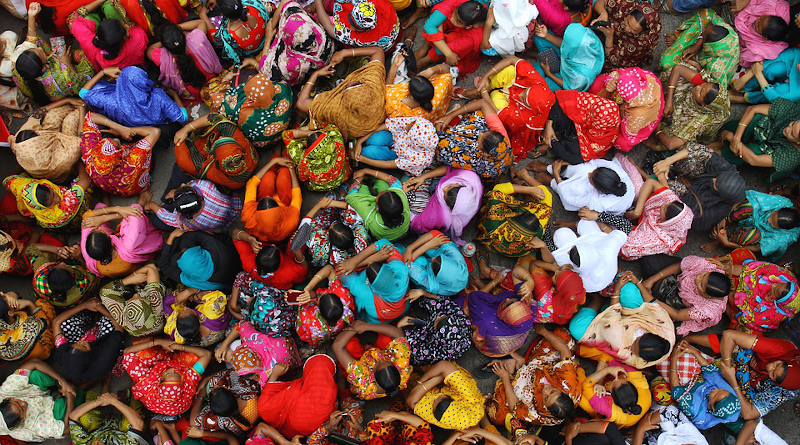
Thousands of women in Muslim-majority Bangladesh hit the streets in capital Dhaka on Friday demanding implementation of recommendations of a women reforms commission .
The rally comes three days after an aggressive protest march by Islamist radical groups in the capital to back their demand for abolition of the Women Reforms Commission and trashing of its recommendations.
The Islamist groups say the recommendations are
‘ un-Islamic’ and undermining the social fabric of the country. But the women rights group welcome the Commission’s report and demand implementation of its recommendations.
The Commission headed by women rights activist Shirin Parveen Haque has pitched for a uniform family law , instead of Muslim personal law, that will bring about gender equality in matters of inheritance, marraige, divorce and other related issues. It also recommended legalisation of the sex trade to protect the vulnerable women in the profession and pitched for 300 parliament seats reserved for women in addition to the 300 general seats now.
” Gender rights is the new battleground in Bangladesh. Our women will never accept societal oppression in the name of religion. Women empowerment has a rich history in Bengali society and convoluted religiosity cannot be used to reverse that trend,” said Barrister Tania Amir, a top lawyer.
“We will fight for our rights come what may,” said textile worker Najma Amin.
Since Nobel laureate Muhammad Yunus took charge of the interim government in Bangladesh after the ouster of Prime Minister Sheikh Hasina’s Awami League government in August last year, Islamist radicalism has surged by exploiting the vacuum . The interim government has helped their cause by releasing hundreds of Islamist terrorists convicted of murder and sedition and by removing the ban on the pro-Pakistani Jamaat-e-Islami, which opposed Bangladesh’s independence during the 1971 Liberation war .
” Violence against women has been increasing since Yunus took charge. Our girls are even prevented from playing football and cricket. A modernising nation is suddenly pushed back into the grips of oppressive mediavalism,” said engineer Ferdousi Hossain.
Reforms first, Polls later
Yunus has tried sticking to power by delaying the announcement of elections, arguing that Bangladesh needed immediate social, economic, political and administrative reforms before polls could be held.
Several committees were set up to suggest reforms in different sectors . The first complete report came through earlier this month from the Women Reforms Commission with more than 400 recommendations.
The Islamist parties and groups, so long the strongest backer of the Yunus regime, reacted with unconcealed fury , threatening to bring down the interim government ‘ in five minutes’ if the Commission was not abolished and if its report was not trashed.
Yunus tried to deflect the Islamist pressure and assuage the radicals by banning the country’s oldest and biggest party, the Awami League , which led the Liberation war against Pakistan and has ruled the country for close to half of its post-independence time .
Not the first time
This is not the first time the Awami League has faced existential threats. In 1971, on the eve of Bangladesh’s struggle for independence, the Pakistani military regime outlawed the party in an attempt to suppress Bengali nationalist aspirations. That decision proved catastrophic for Pakistan’s unity and instead fueled a full-scale liberation war that birthed a new nation.
Again, in 1975, under Sheikh Mujibur Rahman’s controversial turn toward authoritarianism, the Awami League was absorbed into a one-party system known as BAKSAL, a move that led to growing dissent and the eventual assassination of Mujib himself. Despite such upheavals, the Awami League managed to reemerge through grassroots resistance, legal rehabilitation, and electoral victories—particularly under Sheikh Hasina’s leadership after her return in 1981.
Current Ban Different
However, the ban in 2025 feels categorically different. It has not been born of popular revolt, civil unrest, or legislative consensus. Rather, it appears to be the calculated result of decisions made behind closed doors by the interim government. Dr. Yunus, long admired globally for his contributions to social enterprise and poverty alleviation, now finds his reputation under intense scrutiny. Allegations have surfaced regarding his covert cooperation with Islamist factions and the formation of the National Citizen Party (NCP), allegedly with backing from Jamaat-e-Islami and US funds. These developments raise pressing questions: is this new political formation truly aimed at restoring justice and balance, or is it simply a strategic maneuver to eliminate rivals and reshape the nation’s political future?
The Awami League has demonstrated remarkable resilience over the decades. From near decimation to electoral triumphs in 1996 and 2008, it has weathered storms that would have annihilated lesser parties. Yet history has an uncanny way of repeating itself, sometimes with darker undertones. The ban in 2025 may well mark the most severe test of the party’s endurance—and of Bangladesh’s democratic institutions.
Reforms or Power Grab
As the dust settles, critical questions remain: Is Dr. Yunus acting as a reformer, purging a corrupted system? Or is he orchestrating a power grab cloaked in the language of neutrality and reform? And perhaps most importantly—can a nation still claim to be a democracy when political competition is silenced not by votes, but by force?
The Yunus-led interim government’s decision to ban the Awami League under the Anti-Terrorism Act has sparked outrage and suspicion, both within Bangladesh and internationally. Not the least because the ban is executed by an interim government , for which there is no provision in Bangladesh Constitution.
What was initially framed as a crackdown on electoral fraud and historic atrocities has now expanded into an outright political purge. The ban appears less about justice and more about consolidating a fragile, unelected regime under the guise of reform.
Crucially, this sweeping decision came amid vocal pressure from unlikely bedfellows: the newly-formed National Citizens Party (NCP), backed by remnants of Jamaat-e-Islami and radical youth factions that spearheaded the July uprising.
Yunus’ links to this unholy alliance are troubling. Though once lauded globally for his work in microfinance, Yunus now stands accused of aiding the political rehabilitation of Jamaat elements—long discredited for their role in war crimes—by granting them indirect legitimacy through the NCP. Has the Nobel laureate, in his bid for “stability,” compromised with the very forces that once fractured the nation’s soul?
Moreover, Yunus’s interim regime is rapidly acquiring the traits of authoritarianism: media censorship, judicial subservience, and the weaponization of “anti-terror” laws to silence dissent. What mandate does this unelected caretaker have to dismantle the country’s oldest political institution? And why outlaw an entire party instead of pursuing legal cases against individuals? The justification that the Awami League poses a “threat” to national security rings hollow when one considers the broad, collective punishment being meted out to millions of its supporters.
In targeting an entire political party—however flawed—Yunus’s administration risks rewriting democracy in Bangladesh as a privilege for the favored few, rather than a right for all. The irony is sharp: in claiming to cleanse the system, the interim government may be entrenching the very impunity it claims to eliminate.
Yunus’ Double Standards
The interim government’s decision to ban the Awami League while lifting the ban on Jamaat-e-Islami is a glaring display of hypocrisy that strips the regime of its moral and political legitimacy. This contradictory move sends a dangerous signal: that justice in Bangladesh is not about principle, but political convenience.
The Awami League, for all its controversies, is still the party that led Bangladesh to independence, bore the brunt of the Liberation War, and shaped the country’s post-1971 political landscape. Jamaat-e-Islami, by contrast, actively opposed that independence and collaborated with the Pakistani military in committing genocide against its own people. To ban the Awami League while rehabilitating Jamaat is not merely controversial—it is indefensible.
If Yunus and his interim regime claim that the Awami League deserves to be banned for past abuses, electoral manipulation, or authoritarian governance, they must also answer for their rehabilitation of Jamaat. How can a party historically tied to the mass murder, rape, and systematic repression of 1971 be allowed to re-enter politics while the party that led the fight for freedom is erased from the public sphere? This is not justice—it is selective amnesia. It is political revisionism disguised as reform.
Jamaat’s re-entry is not a small administrative gesture. It signals a fundamental betrayal of Bangladesh’s founding ideals. Jamaat’s ideology remains steeped in religious authoritarianism and anti-liberation sentiment. Their historical role in enabling genocide is not a distant memory—it is a living wound. By lifting their ban, the Yunus administration has effectively legitimized the forces that once sought to destroy the Bengali identity.
Meanwhile, the claim that banning the Awami League is necessary to protect July Movement activists only underscores the interim government’s insecurity. If this regime truly represents a democratic uprising, why is it so afraid of a weakened, disbanded political party? The idea that the Awami League, stripped of its institutions and leaders, still poses an existential threat suggests that the new rulers lack confidence in their own popular mandate. It implies that the ban is not about justice—but vengeance. Not about protecting democracy—but monopolizing it.
Dr. Muhammad Yunus, once a Nobel Peace Prize laureate and global icon of microcredit and social enterprise, now risks being remembered not as a reformer, but as an enabler of authoritarianism. His alliance with Islamist factions, and his silence on their historical crimes, casts a long shadow over his moral credibility. Rather than leading a democratic transition, he appears to be engineering a political purge. And Yunus is also facing uncomfortable question over several favours the interim government has done to his Grameen group and institutions linked to it in the shape of lucrative business deals and huge tax waivers.
In some ways, like US president Donald Trump, Yunus is being seen more like a business tycoon out to profit from political office rather than an apolitical do-gooder keen on delivering for the nation. What he does about gender reforms will turn out to be the litmus test for his reputation and how posterity will judge him.

Like what you read?
Please consider supporting Eurasia Review. Thank you for your consideration!
