
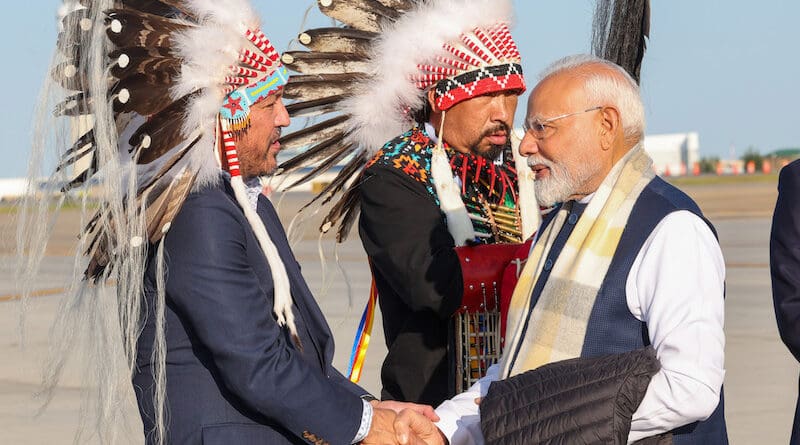
Why Canada Invited India To The G7 Summit: A Strategic Course Correction – OpEd
When Canada reversed its initial decision and extended a last-minute invitation to India for the G7 Summit in Alberta, it sent ripples through diplomatic circles. What began as a notable omission has become a case study of how geopolitics and economic pragmatism can outweigh bilateral tensions.
India’s invitation is more than a symbolic gesture—it reflects a growing global consensus: in a fragmented world order.
An Unexpected Reversal
India was not on Canada’s original list of invitees for the 2025 G7 Summit, despite having attended the last three summits hosted by Germany (2022), Japan (2023), and Italy (2024). This absence initially appeared deliberate, especially in light of the ongoing diplomatic row between Canada and India.
However, diplomatic pressure from other G7 members, especially in Europe, reportedly led Canada to revise its stance. In today’s era of shifting alliances and multipolarity, the cost of excluding India—a rising economic and strategic partner—was too high.
Europe’s Return from a ‘Strategic Holiday’
One of the central reasons for India’s late but crucial inclusion is its rising importance in Europe’s and the West’s geopolitical calculations.The war in Ukraine, combined with the unpredictability of American foreign policy under President Donald Trump has shaken Europe’s faith in its traditional partners. As the EU finds itself squeezed between a resurgent Russia and a disruptive China, it is looking eastward toward stable, democratic, and economically dynamic Indo-Pacific countries. India fits perfectly in that calculation.
This sentiment was echoed in February 2025, when European Commission President Ursula von der Leyen visited India with a full delegation. Before this, in 2022, President Ursula and Indian Prime Minister Narendra Modi launched the India-EU Trade and Technology Council, only the second such platform globally (the other being with the US).
Alarmed by Trump’s tariff policy, India and the UK have already signed an FTA while India-EU FTA negotiations are ongoing. This strategic engagement signals Europe’s growing recognition of India as a key partner in securing supply chains, tech standards, and regional balance in the Indo-Pacific.
Both the EU and UK see India as a counterweight to an assertive China, as well as a lucrative market with a burgeoning middle class. According to Eurostat, EU-India trade in goods reached €120 billion in 2023, making India the EU’s 9th largest trading partner. Given this trajectory, Canada—closely aligned with Western powers—can ill afford to sideline India in such high-level multilateral forums.
Economic Gravity Is Shifting
India’s economic rise is undeniable. With a GDP exceeding $3.7 trillion in 2024, it is now the fifth-largest economy, surpassing the UK. The International Monetary Fund projects India’s economy to grow at over 6.5% annually through 2028, making it the fastest-growing major economy.
From a trade standpoint, India is becoming increasingly indispensable. The EU-India trade in goods hit €120 billion in 2023, and both sides are keen to finalize a long-stalled Free Trade Agreement (FTA).
For Canada and other G7 members, engagement with India is not just about hedging against China; it’s about tapping into the world’s next major economic engine.
India’s ‘Multi-Alignment’ Leverage
India’s geopolitical stance has evolved into what many describe as “multi-alignment.” India’s foreign policy stance—multi-alignment in spirit, strategic autonomy in execution—has gained renewed importance. Unlike other countries that have taken overt sides in the Russia-Ukraine conflict or the U.S.-China rivalry, India has charted an independent course. While maintaining close ties with the U.S. and its Indo-Pacific allies, India has resisted pressure to isolate Russia completely, owing to its strategic and defence considerations.
At the same time, India has ramped up military, economic, and digital partnerships with Western democracies. This independent yet cooperative posture enhances its value as a dialogue partner across conflicting blocs. For India, its membership of BRICS or SCO is not at the cost of growing partnerships with the EU.
In a world where global institutions like the UN and WTO are seen as sluggish and fragmented, India’s role as a trusted yet autonomous voice from the Global South becomes increasingly significant.
Canada’s Calculated Inclusion
While relations between Ottawa and New Delhi remain tense, Canada likely recognized that isolating India at a global forum would be counterproductive. Prime Minister Carney’s government, under pressure from allies and business leaders, understood that the G7 cannot afford to seem exclusive or out of touch with geopolitical realities. This also reflects the Carney government’s pragmatic diplomacy aimed at putting behind the bitterness that crept into the India-Canada relations during Trudeau’s prime ministership.
The G7’s Relevance Hinges on Inclusion
The broader lesson is clear: in today’s multipolar world, the G7’s relevance depends on its ability to engage not just among its ranks, but with rising powers. This is especially true as forums like the BRICS and G20 gain prominence in shaping global discourse.
By inviting India, Canada acknowledges that the G7 cannot hope to tackle climate change, global health, supply chain resilience, or digital governance without buy-in from countries that represent the aspirations of the Global South.
A New Pragmatism in Diplomacy
India’s inclusion in the G7 Summit is not a concession—it is a recognition. Recognition of India’s growing strategic, economic, and diplomatic stature. Recognition that global challenges demand broader cooperation. And a recognition that even bilateral disagreements must take a back seat to multilateral realities. For a rising power India, it is important to keep the West in a tight embrace. Shared interests and mutual concerns bind the two together. Cordial ties with Canada is of critical importance to India – something that New Delhi must keep in mind.
As the West redefines its partnerships in a post-pandemic, post-Ukraine-war era, India stands not just as a participant—but as a partner that shapes the agenda.
By choosing to engage, even reluctantly, Canada and the G7 are choosing pragmatic diplomacy, which India must reciprocate.

Like what you read?
Please consider supporting Eurasia Review. Thank you for your consideration!
