
India–Venezuela Ties At A Turning Point? – OpEd
By Hari Seshasayee
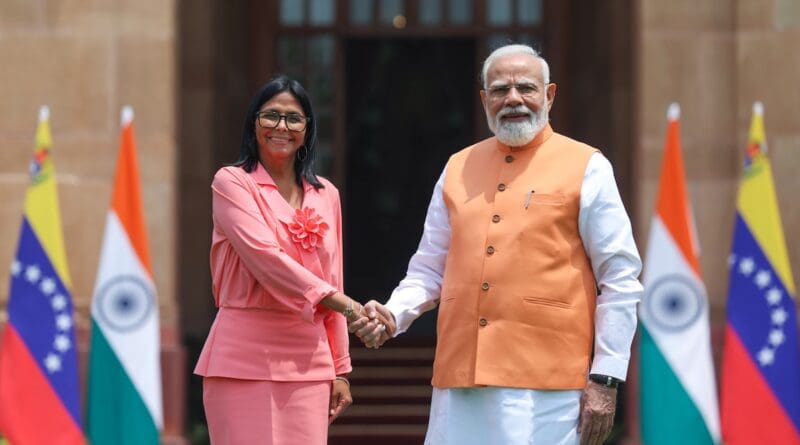
Venezuelan Acting President Delcy Rodriguez’s five-day visit to India from 3–7 June came at an opportune time. In the middle of a global energy crisis, the Iran war and the subsequent closure of the Strait of Hormuz, rising prices at the pump and oil trading at nearly US$100 a barrel, and slowing industrial activity. Prime Minister Narendra Modi hosted the president of the country home to the world’s largest oil reserves. Yet, it would be inaccurate to describe Rodriguez’s visit as a diversification effort—the India–Venezuela oil trade is a story that stretches back 26 years.
At the outset, there are three insights from Rodriguez’s visit. First, the visit confirms an important shift in Venezuela’s geopolitical position. For most of the 21st century, Venezuela has been a pariah to the Western world, particularly to Washington. After the late Venezuelan President Hugo Chávez visited India in 2005, Delhi refrained from arranging meetings between the two countries’ heads of government. During the entire tenure of Venezuelan leader Nicolas Maduro’s 13 years in power, from 2013 to early 2026, not a single meeting took place between the heads of government of India and Venezuela. High-level exchanges continued at the level of vice presidents and oil ministers, and between 2011 and 2019, India remained one of Venezuela’s most important export markets. Rodriguez’s visit now breaks a 21-year hiatus, reflecting a significant shift in Venezuela’s standing in Washington. After all, news of her visit was first announced by US Secretary of State Marco Rubio, not by Caracas.
Second, Rodriguez is a long-time admirer and friend of India. This is her sixth official visit to India, having previously visited as foreign minister in 2015 and as vice president in 2019, 2023, 2024, and 2025. Her knowledge of India is not limited to the corridors of South Block and the power centres of Delhi. She has met with Indian companies, participated in India Energy Week, and chaired a session on Venezuela at a business forum. Acting President Rodriguez’s engagement with India goes beyond politics or the platitudes of the Global South. It has included on-the-ground visits to Indian company facilities, including a petroleum refinery in Gujarat and an automobile firm in Mumbai, along with meetings with public- and private-sector oil companies.
Third, no big-ticket agreements were signed between the governments of India and Venezuela. This should not come as a surprise. Despite India’s energy woes, the oil trade between Venezuela and India is largely determined by market forces and by the price and technical advantages of Venezuela’s extra-heavy crude oil, which Indian private players can buy at a discount, refine into value-added products such as diesel, and sell at a premium. Although it is in both countries’ interest to enter into long-term purchase contracts, this may take time given Venezuela’s low levels of oil production, which have steadily increasedto just above 1 million barrels per day but remain far below the peak of more than 3.5 million barrels per day recorded in the early 2000s. The US$2 billion investments made by India’s public oil companies, such as ONGC, in Venezuela’s San Cristóbal and Carabobo oil fields nearly two decades ago are now in a near-moribund state and will take time to revive.
Oil forms the overwhelming majority of India–Venezuela trade and investment. Venezuela was among India’s top five sources of oil imports from 2012 to 2019, accounting for an average of 10 percent of India’s total oil imports during that period. However, that changed in 2020 when the United States (US) imposed sanctions on Venezuela’s national oil company. After the recent US operation to remove Maduro, those sanctions were lifted, and Venezuela promptly became India’s third-largest oil supplier in May 2026. Beyond oil, there are opportunities in other sectors, particularly pharmaceuticals and mining. Several Indian pharmaceutical companies had offices in Venezuela, but they were forced to shutter operations and were left unable to repatriate millions of dollars from the country. They may now get a second chance. In mining, an Indian private mining company already operates Venezuela’s largest iron ore mine, with reserves of 4.2 million tonnes. More investments in Venezuela’s mining sector could follow, but are likely to take time to bear fruit. India should also use this window of opportunity to increase exports to Venezuela, which have averaged only US$210 million over the past two decades. By comparison, India’s exports to South American countries such as Colombia, Argentina, Peru, and Chile each average more than US$1 billion. Venezuela, too, could become a sizeable market for Indian exports.
It would be remiss not to mention the domestic situation in Venezuela. Despite its copious natural resources—or perhaps because of them—Venezuela’s economic decline is telling. Although accurate economic data is hard to come by, the poverty rate appears to be above 50 percent, and inflation could be as high as 600 percent, creating a massive parallel market and informal US dollar economy. Venezuela has yet to hold democratic elections, but this is likely to be the least of New Delhi’s concerns. India’s focus is purely economic, and it will remain so in the near future.
- About the author: Hari Seshasayee is a co-founder of Consilium Group and a visiting fellow of the Observer Research Foundation (ORF).
- Source: This article was published by the Observer Research Foundation

Like what you read?
Please consider supporting Eurasia Review. Thank you for your consideration!
