
Moscow Has Done As Much Lately To Attract West Kazakhs On Its Side As Astana Has Done To Push Them Into Russia’s Arms (Part VII) — Analysis
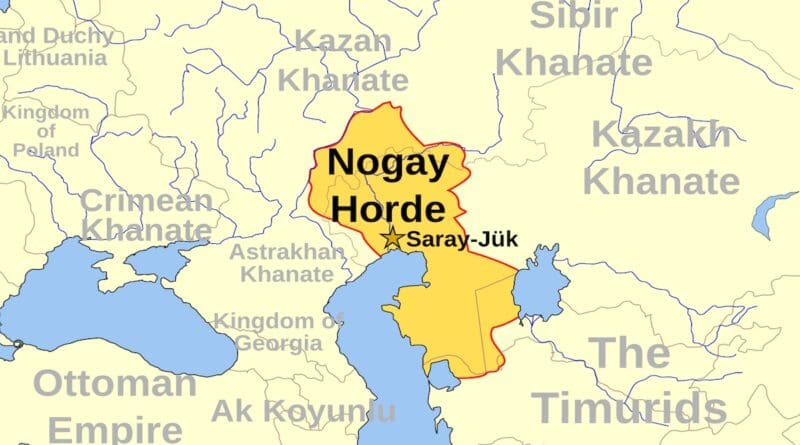
The 1620s and 1630s marked a critical turning point in the history of the Nogai Ulus, characterized by internecine strife, famine, epidemic diseases, and a large-scale Oirat (Kalmyk) invasion. These crises forced the Nogais to abandon their historical core territory in the Western Kazakhstan steppes – located between the Volga, Ural, and Emba rivers – resulting in the fragmentation and dispersal of the tribes across various regions.
Between the Volga and the Pontic Steppe: The Great Nogai Dispersal
During this period, isolated and fragmented groups of the Alshyn-Baiuly may well have attached themselves to the tribes of the Kazakh Khanate, which, as A. Levshin claimed, ‘occupied the central part of their present-day lands’. Yet, even when taking this version into account, the hypothesis that their main body – led by the then Nogai political and aristocratic elite – headed, as the Turkish historian of Bashkir origin, Ahmet Zeki Velidi Togan, said, ‘to the Crimea, and from there further west and to the [North] Caucasus’ appears quite compelling. In support of this conclusion, one can cite the fact that the fundamental basis of Alshyn-Baiuly folklore remained closely tied to the Crimean factor until the mid-20th century, rather than to the traditional Kazakh one. Ample evidence supporting this alternative account can be uncovered. Let us look closer at some of these pieces of evidence.
First. In his work “The Origin of the Kazakhs and Uzbeks”, the Turkish historian of Bashkir origin, Ahmet Zeki Velidi Togan, wrote: “Even today, one can clearly distinguish the Turkic tribes that occupied dominant versus subordinate positions in the Ulus of Jochi [part of which historically constituted the territory of the Nogai Horde]. The clans that ruled during that era still remember [that is, even into the 20th century] the dastans (epic folklore) about historical figures and the traditions of the steppe aristocracy. On the other hand, the clans that were subordinate to them remember only the dastans linked to shamanic mythology and [folk] traditions, knowing nothing of dastans with political or historical content”. The thing here is that of all the peoples, ethnic groups, and tribes descended from the Nogais, the memory of their Nogai past has survived most vividly precisely among the Bayuly people. It was precisely that tribal group’s zhyraus (those whose names were connected with epic poetry) who preserved and transmitted the fundamental strata of Nogai cultural heritage into the 20th century. This included those very dastans (epic works) detailing historical figures and the traditions of the steppe aristocracy from the period of the Nogais’ presence in the Crimea and the North Caucasus following the disintegration of the Nogai Horde in the Volga-Ural interfluve. And here’s one more thing. It is widely acknowledged that without those zhyraus, a vast corpus of the epic lore that bridges the Golden Horde and Nogai Horde with the modern age would have been irretrievably lost.
Second. Makhambet Utemisov, a renowned Bayuly poet who lived in the first half of the 19th century, is considered a direct creative successor to such Nogai zhyraus as Shalkiiz, Dospambet, and Kaztugan. This raises a striking paradox. Kaztugan was part of the Nogai uluses that migrated from the Volga valley to the Black Sea coast and the North Caucasus during the 17th century, with his later life unfolding entirely across the Crimea, the Azov region, and the Kuban. How, then, could Makhambet have known of Kaztugan, let alone have been deeply nurtured by the creative legacy of this Nogai zhyrshy (a traditional epic storyteller and oral historian, who preserves and recites heroic folk tales, legends, and poetry), if one is to accept the officially recognized historical narrative? After all, this mainstream narrative asserts that from the first half of the 17th century until the early 18th century, the Bayuly were located far to the south, within the Syr Darya region and the foothills of the Alatau. Furthermore, it claims that following their return to their ancestral lands in Western Kazakhstan, they were barred access to the right bank of the Ural River – meaning the Volga-Ural interfluve – for another century, until 1802. This is to say nothing of the right bank of the Volga, which opens the way to the North Caucasus, the Azov and Kuban regions, and the Crimea. Similarly, such 19th- and early 20th-century Bayuly poets as Kashagan Kurzhimanuly, Abyl Tarakuly, Aktan Kereyuly, Nurym Shyrshyguly, and Muryn Sengirbekuly are also recognized as direct creative heirs to the aforementioned 16th–17th-century Nogai zhyraus. It was precisely owing to this continuity that the ancient epic strata of the Nogai tradition have survived to the present day. Notably, Muryn Sengirbekuly preserved and transmitted to posterity the grand epic cycle The Forty Batyrs of Crimea. A large number of its narratives are intrinsically tied to the epoch of Kaztugan, who historically operated west of the Volga, in the Caucasus, Kuban, and Crimea. He is even celebrated as one of the forty champions of the Crimean Khanate within the cycle. Yet, this all unfolds precisely when the mainstream historical narrative places the Bayuly far to the east, past the Emba River, up the Syr Darya, and into the foothills of Zhetisu (Semirechye). These controversial visions strongly suggest that a distinct faction of the Bayuly must have remained in the Volga-Ural interfluve or migrated into those western regions during the specified timeframe.
One cannot rule out the possibility that a specific faction of the Bayuly also happened to be lived far to the southeast during that period. It may be inferred that this group was quite small, given how easily – according to available historical legends – the Kazakh Khan retaliated against its leader, Zhiembet Bortogashuly, and his brother, Zholymbet. Despite their distinguished military and political contributions to the Kazakh Khanate, these figures from the Tana tribe faced severe punishment. As military commanders of Alshyn-Bayuly descent, they had taken an active part in the Kazakh military campaigns conducted between 1620 and 1628. It is highly plausible that during this period, they found themselves confronting the Bukharan commander Yalangtush, an Alshyn-Alimuly, who launched two military campaigns against the Kazakh Khanate at the time.
The popular memory of these figures evolved in starkly different ways. While the Alshyn Yalangtush lived on in the memory of the Uzbek people as an outstanding statesman, military commander, and the archetypal defender of the homeland, the Alshyn Zhiembet is remembered by his people as a man of fierce independence and integrity. Sent into exile by the Kazakh ruler for his outspokenness, Zhiembet left behind a legacy of poetic verse condemning the injustice of the Khan.
Third. According to historical data, during the 17th century, the Bayuly, much like the Nogais as a whole, scattered across various regions and found themselves incorporated into different state polities. Consequently, small, fragmented groups of them may have aligned not only with the Kazakh and Bukharan Khanates (alongside the Alshyn-Alimuly) but also migrated to Western Siberia. Russian sources of that era contain records regarding the “Bayulutsky Tatars” (also known as the Bayuly, Bayulintsies, or Baiush Tatars), who voluntarily entered the service of the Russian Tsar in the 17th century under the leadership of the Nogai murza Bayush Razbakiev (Baikara). By the 19th century, their primary area of settlement was the Bayulovskaya Volost (a local peasant administrative unit that grouped several villages or peasant communes together) of the Tyumen Uyezd (district). By the 20th century, these Bayuly had been almost entirely assimilated into the Siberian Tatar population, though they nevertheless preserved the memory of their origins within their ancestral lore. Additionally, a portion of the Bayuly was integrated into the Bashkir people, a fact corroborated by the presence of eponymous clan subdivisions.
Fourth. Judging by available historical records, the tribes of the Bayuly confederation did not assimilate into the broader Nogai Horde; instead, they maintained their institutional structure and identity. It was there and then that their specific dialect and socio-cultural lifestyle took shape. The Bayuly tribal alliance was historically bound to the right wing of the Nogai Horde – the western flank of the state – which partially covered the lands on the right bank, or the “Crimean side,” of the Volga. For this reason, it seems fundamentally counterintuitive to seriously consider the theory that the arrival of the Kalmyks from the east in the 17th century forced the bulk of the Bayuly to flee their ancestral Volga territories toward the east or southeast. A much more credible assumption is that the larger part migrated west and southwest toward the Crimea and the North Caucasus, while a smaller segment moved northeast to integrate with the Bashkirs and Siberian Tatars. Indeed, according to findings by the Tatar historian M. Akhmetzyanov, the Nogais, retreating under Kalmyk pressure in 1634, were compelled to cross to the right bank of the Volga and head toward the Crimea. By 1635, the Kalmyks had seized the entire left bank of the Volga, completely expelling the Nogai population.
Furthermore, he noted the following data. In 1642, a segment of the Nogai uluses (groups), complying with the demands of the Russian authorities, returned to Russian allegiance in the Lower Volga region. In reality, however, they fell under the dominion of the Kalmyk Khanate—an autonomous state polity within the Muscovite State, Russia, and the Russian Empire from 1655 (effectively since the 1630s) until 1771. Another part of these uluses remained within the Crimean Khanate. In 1644, amid the weakening of Kalmyk authority, many Nogai uluses migrated from the vicinity of Astrakhan to the Terek River – that is, from the Lower Volga to the North Caucasus. Later, a portion of these uluses returned to the Astrakhan area, obeying the demands of the Russian authorities. Consequently, significant groups of Nogais were integrated into the Kalmyk Khanate as a subordinate population. It appears that the majority of the Bayuly, along with certain factions of the Zhetiru and Alimuly, were among them.
Between Kalmyks and Crimeans: Dzhokan’ye and the Early Kazakh Identity
Ultimately, the picture that emerges is one where some Nogai groups roamed under the surveillance of Kalmyks throughout the nomadic territories under their Khan’s control, extending from the Terek in the south to Samara in the north, and from the Don in the west to the Zhaiyk (Ural) and Zhem (Emba) in the east. Conversely, other groups resided in the Kuban and the Pontic-Caspian steppes under the jurisdiction of the Crimean Khan. Simply put, the eastern subregion of the Ciscaucasian steppes fell under Kalmyk oversight, while the western subregion was held by the Crimeans.
It appears that the Bayuly were among the former group at that time. Furthermore, one can hypothesize that by then, they had already begun to be referred to as ‘Kazaks’ (‘Kazakhs’). There is substantial evidence capable of supporting this hypothesis. In the folklore of Caucasian Turkic-speaking peoples – such as the Kumyks, Karachays, and Balkars – there exists a genre known as Kazak yiry (‘Kazak song’ or ‘Kazakh song’). Contemporary researchers frequently link its origin to the artistic legacy of iconic 16th–17th-century Nogai-Kazak warrior-poets like Dospambet of Azov, or even to the cultural history of the Russian Terek and Greben Cossacks, rather than to the ancestors of modern Western Kazakhstan’s indigenous population.
Nevertheless, one compelling factor serves as evidence that it is the language of the latter that is most prominently reflected in the surviving Nogai and Kumyk texts of these Kazak yirlary (‘Kazak songs’ or ‘Kazakh songs’). Specifically, the songs of these Kazaks recorded in various publications exhibit characteristic dzhokan’ye (the initial ‘dzh-’ or ‘zh-’ sound), whereas the modern literary Nogai language is completely dominated by yokan’ye (the initial ‘y-’ sound). Indeed, one of the primary linguistic divergences between modern Kazakh and Nogai is that where Kazakhs utilize the sound ‘zho’ (as in the word zhoq – ‘no’), Nogais and Kumyks employ ‘yo’ (as in the word yoq – ‘no’).
Imperial Treaties, Fortified Lines, and the Volga-Ural Pasture Crisis
By the late 17th century, under the rule of the Kalmyk Khan Ayuka, a notable development occurred at his court. As the prominent Russian Orientalist Iakinf (Bichurin) wrote: “Within his courtly retinue there appeared Sultans of the Kuban, Khiva, and the Kazaks; even Abulkhair, who later became Khan of the Lesser Kazak Horde, considered it an honor to serve at his Court”. However, by the early 18th century, a unified nomadic space stretching from the Ural River to the Caucasus had effectively ceased to exist. Under the terms of a treaty concluded at that time between the Russian government and Khan Ayuka, the latter pledged that he and his subjects would “not cross to the mountainous [right] bank of the Volga”. This stipulation was explicitly reiterated in a subsequent agreement signed in 1710. Under these geopolitical constraints, while the Kalmyk ruler was permitted to dispatch troops to the right bank of the Volga – such as to the Terek River – to defend Russian imperial interests, he was strictly forbidden from migrating there with his civilian subjects from the meadow [left] side of the river.
As a result, following the 1710 agreement, the Kalmyk Khanate faced a severe pasture crisis in the territories between the Volga and the Ural. The rapid influx of Russian homesteaders, paired with the erection of fortified border lines (the Tsaritsyn and Orenburg lines), heavily constrained customary seasonal migration paths. This reduction of pasturage squeezed both the Kalmyks and the Nogais, or Nogai-Kazaks (Kazakhs). The latter were ultimately compelled to relinquish their grazing grounds in the Volga-Ural interfluve and withdraw across the Ural River, anchoring themselves along its eastern bank. These displaced nomads consisted predominantly of the Bayuly.
The tsarist-era Russian historian and ethnographer A. I. Dobrosmyslov, in his work The Turgay Oblast: A Historical Essay, noted that reliable source material regarding the past inhabitants of this region (within its administrative boundaries as of the early 20th century) is available only from the late 17th century onward. Based on the data accessible to him at the time, he concluded that the Aktyubinsk Uyezd (district) and the northern part of the Irgiz Uyezd of the Turgay Oblast – corresponding to the northern, northeastern, and eastern sectors of the modern Aktobe Province – were then occupied by the Kalmyks. Meanwhile, the lands to their east, encompassing the Kustanai Uyezd and the greater part of the Turgay Uyezd (comprising a significant portion of the modern Kostanay Province), were inhabited by the Bashkirs.
Subsequently, according to his account, “the Lesser [Horde], having pushed back the Kalmyks, occupied with its nomadic pastures the Aktyubinsk and Irgiz Uyezds of the Turgay Oblast and the Ural Oblast [denoting the western part of the modern Aktobe Province and the territories of the current West Kazakhstan and Atyrau Provinces situated east of the Ural River]”. Supplementing the aforementioned quotation, it is worth noting that during the late 17th and early 18th centuries, substantial groups of Turkmen tribes inhabited the Ustyurt Plateau and the Mangyshlak Peninsula, nomadizing as far north as the banks of the Emba River. In other words, the northern frontier of Turkmen settlement reached the Emba River, where they directly bordered the nomadic territories of the Kalmyks.
In other words, according to the traditional Russian historical narrative regarding the indigenous population of Kazakhstan, it would appear that by the early 18th century, virtually the entire historical core territory of the West Kazakhs (the Younger Zhuz) – with the sole exception of its southeastern extremity located along the lower reaches of the Syr Darya and the northeastern coast of the Aral Sea – had been occupied by other peoples: Russian Cossacks, Kalmyks, Bashkirs, and Turkmens. M. K. Lyubavsky, another Russian historian and a contemporary of A. I. Dobrosmyslov, described this dynamic in his work A Brief Essay on the History of Russia: “The Kirghiz-Kaisaks, who nomadized in northern Turkestan at the beginning of the 18th century, were driven from their pastures by the Dzungar Khan Galdan-Tseren… The Lesser Horde [Younger Zhuz], despite its name being the most populous, crossed the Emba, drove the Kalmyks nomadizing there beyond the Yaik [Ural] River, and moved directly up to the southern borders of Bashkiria”.
The Syr Darya Confinement: A Historical and Ecological Paradox
According to his vision of the Kazakhs’ past, during the preceding period – namely, at the end of the 17th century – all three of their zhuzes (the Senior, Middle, and Younger ones) had been confined to the Syr Darya region. This territorial confinement occurred because the eastern and partially southeastern regions of modern Kazakhstan had, by that time, fallen under Dzungar control. As the latter’s expansion intensified, the situation for the Kazakhs grew even more precarious. It was then, as M. K. Lyubavsky asserted, that “the Big [Senior] Horde remained in its previous location, along the upper Syr Darya and its tributaries, subjugated by the Zhungars”, while “the Middle Horde shifted northward, from the Syr Darya toward the Turgay, Ishim, Tobol, and Uy”. Consequently, it follows that the Younger Zhuz (the Lesser Horde) moved northwestward and northward from the lower reaches of that same river to reclaim its historical lands. Such a conceptualization of the situation that unfolded in the Kazakh steppe completely aligns with the traditional Russian narrative of presenting Kazakh history at the turn of the 17th and 18th centuries. This interpretative framework, on the whole, is entirely understandable.
What remains profoundly perplexing is why none of the authors who adhered to this narrative ever questioned how the Younger Zhuz -considered an immensely numerous people at the time – could have been contained within such a metaphorically minuscule pocket as the lower reaches of the Syr Darya and the northeastern coast of the Aral Sea. Indeed, in an 1805 report compiled and presented to the Russian Emperor Alexander I, the Mufti of the Orenburg Muslim Spiritual Assembly, Mukhamedzhan Khusainov, estimated its population at four million people. Even if one assumes that a century earlier, the number of Western Kazakhs supposedly concentrated in that area was half that figure, the probability that this region could have provided sufficient resources for the basic survival of both the population and their herds, let alone for any prolonged existence, defies comprehension. This is true, first and foremost, these were pastoral nomads who required vast expanses, as their specific mode of life demanded extensive territories for livestock grazing. Secondly, the lower course of the Syr Darya is an exceptionally arid region, as it skirts the eastern fringes of the Kyzylkum Desert. Similarly, the northern Aral Sea region, situated within a zone of deserts and semi-deserts, has historically been characterized by sparse vegetation due to its harsh, arid climate.

Like what you read?
Please consider supporting Eurasia Review. Thank you for your consideration!
