A Swedish Artist More Famous Than ABBA – OpEd
There is a Swedish artiste more famous and durable than ABBA.
In Thailand, Jonas Anderson has surpassed, outsold, and outlasted Sweden’s greatest cultural export. He continues to draw the crowds some 27 years after bursting onto Southeast Asia with his uplifting interpretation of a parochial genre of Thai country music.
As Thai dignity crumbled under the weight of the Asian financial crisis of 1997/98, the sight of a blue-eyed blond singing and dancing in fluent LukThong (1) was not just a source of quirky entertainment. In a small but important way, Anderson helped the country’s healing after foreign capital and speculators (2) had contributed to the battering of the Thai economy. The Thai baht plunged by more than half and the economy shrank by seven percent (3). Businesses collapsed and lives were destroyed.
“When the Asian financial crisis hit Thailand, there was a passionate drive for promoting Thai things,” Anderson recalls in an interview in Stockholm on July 18.
“It’s like, if we don’t support our own industries, our own culture, then who’s going to support it?”
Anderson, then 27, did, and was joined by another young blonde, the Anglo-Dutch Christy Gibson. They were part of a band of Thai-immersed Western artistes who went on to tour Thailand, helped lift the spirits of a bruised nation, and became famous.
At 53, Anderson is a recognized cultural icon and a national personality in his adopted country. At the height of his fame, before streaming took off on the Internet, he released several LukThong albums and sold hundreds of thousands of records.
“I’m more Thai than Swede,” is how he sees himself.
He was nine when his missionary parents uprooted the family from Sweden in 1981 to live and work in a spartan commune in Korat in rural northeastern Thailand. Despite the drastic change of environment, or maybe because of it, he adapted quickly into the local village life, grew up Thai while adding Laotian and English to his language and cultural skills.
“I started picking up Thai language as a kid, living in a place where almost nobody spoke any English,” he said. “A natural transition is to sing, and I like to sing. I learned to sing in Thai, and that connected with the Thai people.”
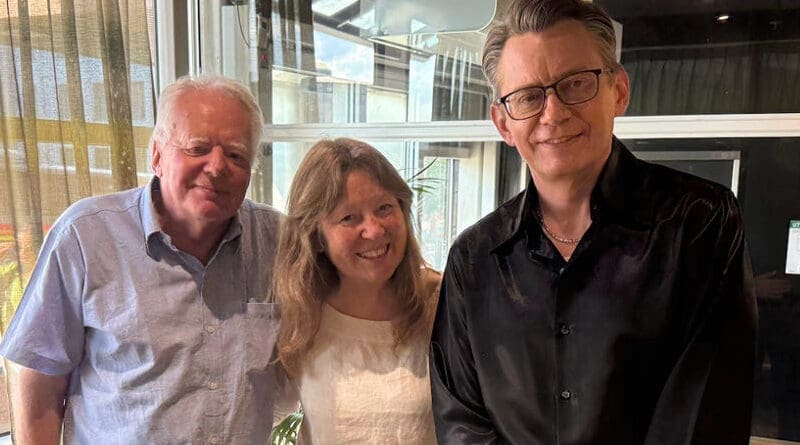
His singing certainly connected with me.
It happened on a recent hot summer day in downtown Stockholm. As my wife and I went looking for food, loud music broke through the quiet of the Kungsträdgården park. Probably a busker singing Swedish rock?
As we edged closer the action, the language clearly wasn’t European.
“This sounds Thai. How can?” I remarked.
In the heart of Scandinavia, 8,300 km from Bangkok, it was Thai. Loud and distinct.
We had stumbled our way into the city’s Thai Festival, an annual open-air event showcasing Thai street food, beer, fruit, craft, and entertainment. A large stage anchored the area where singers, dancers, comedians, and entertainers would perform for a few days to a bustling crowd of European, Asian, and people of various ethnicities.
The range and authenticity of Thai food was quite impressive. I had a serving of genuine Thai chendol, my first in over two decades, along with various street food and snacks.
But it was the blond man on the stage who had my attention. He was a natural people mover, even though I didn’t understand a word of his engagement with the audience.
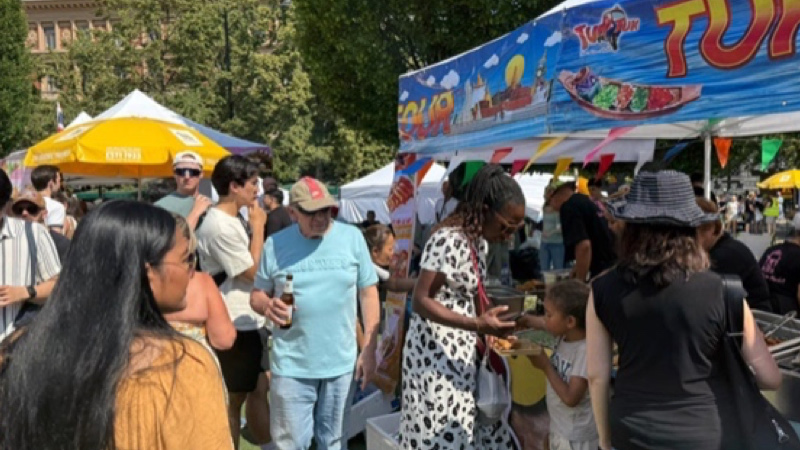
Photo by Ng Weng Hoong
Sweden, Thailand, and their neighbours
The notable presence of Thais among Stockholm’s one-million population was Sweden’s biggest surprise for me. Despite my Southeast Asian background, I had no idea that more than 70,000 Thais (4) call the Scandinavian country home. Swedes return the favour, with 200,000 visiting Thailand last year, and another 10,000 (5) choosing the Southeast Asian country as their primary residence.
The bond between the two peoples and their friendly bilateral ties, forged in 1868 by the kings of then Siam and Sweden (6), remain among the strongest and most stable between an Asian and a Western nation. But you won’t know it from the world’s mainstream media because Swedish-Thai interactions are rarely exciting. That is probably why I wasn’t aware of the extent of this relationship.
I had a feel of the vibes while sharing a bench with a Thai-Cambodian lady, her American friend visiting from New York, and their small group of European-Thai friends and family members. “This is not unusual,” said the Thai-Cambodian lady who has been a Swedish national for some time. Her daughter, a confident 20-something-year-old of mixed descent, recently completed her studies in Singapore and was with her Swedish boyfriend.
The family owns and operates a popular Swedish fika restaurant on a Thai island near the Cambodia border where the lady boss decamps to during the winter. November to February are the best months for the restaurant when millions of European and Canadian tourists flee their cold dark winters for warm sunny Thailand.
Our conversation briefly shifted from the festival to the crisis engulfing Thailand and Cambodia.
“Is the border conflict going to affect your business?” I asked the lady boss.
“I don’t think so. They will calm down,” she replied, optimistically.
A few days after that conversation, war broke out between the two deeply Buddhist nations over a border dispute left behind more than century ago by European colonial powers. With its F16 and Sweden-made Saab Gripen fighter jets (7), Thailand’s superior military pounded the daylights out of Cambodia. The four-day war killed more than 40 people, displaced some 200,000 already impoverished villagers, and planted toxic nationalism to last generations on both sides. Nobody, especially U.S. President Donald Trump, will heal this divide.
Watching this and other turmoil in Southeast Asia, well-travelled Swedes are reminded of their own neighbourly demons. Russia (8), a long-time enemy, is once again their biggest national security threat amid the intensifying war in Ukraine. Sweden itself has become a thorn for the rest of Scandinavia and the Baltic states who fear the spread of its organized crime and social unrest. The Muslim and Jewish communities, along with their respective supporters here and across Europe, are intensely agitated by Israel’s war in Gaza.
Against these heightened geopolitical and social tensions, the relaxed inclusive atmosphere at the Thai Festival was an outlier. It didn’t make headline news, and probably won’t ever, because Swedish sentiments toward outsiders have given way to immigration politics (9) and right-wing populism (10) shaped by the rising fear of criminal gangs (11) of refugee background and the spread of radical “Islamism” (12).
The long shadows of three foreign wars, the lady boss, and Jonas Anderson all became part of our unexpected detour into multiculturalism as we travelled through Denmark, Norway, Sweden, Finland, Estonia, Latvia and Lithuania on our way to Poland.
Our last stop and the reason for this two-week journey: a multicultural wedding in Poland and an overdue gathering of our growing, diverse family members from Asia and Europe.
The Failure of Multiculturalism?
A close relative married his long-time Polish girlfriend in a medieval castle resort an hour’s drive away from the historic port of Gdansk. Guests of many nationalities came from the United States, Canada, Australia, Singapore, and parts of Europe, testimony to young D’s and O’s incredible network of relationships.
The wedding featured divine intervention.
While much of Europe burned in 45-degree Celsius heat, this northern pocket of Poland was gifted a short window of gorgeous spring weather. In the enchanted forest setting, D and O held a Chinese tea ceremony and a Polish exchange of vows to become part of each other’s family. Poles are the latest addition to my growing European family that includes Dutch, English, and Welsh relatives. At the wedding, I counted at least 12 languages that could be spoken by members of my expanding extended family: English, Polish, Mandarin, Cantonese, Hokkien, Hainanese, Malay, Welsh, Russian, German, French, and Spanish.
In the land of Chopin, loud American music and the free flow of alcohol kept the party rolling past 3 am. With no misbehaving guests or incidents under the watchful eye of the castle’s Ukrainian manager, this wedding was scripted to near perfection.
The quiet part of the noisy celebration was its multicultural character. Mostly meeting for the first time, family members and friends quickly settled in to enjoy each other’s company.
The cynic would remark that had this stretched a few more days, the politeness would fade, the cultural differences would show up, and tensions would follow.
Perhaps.
Or perhaps not.
I thought about the Thais in Sweden and the Swedes in Thailand, along with the highly visible Asian communities throughout Europe and North America, and the sizeable Western presence in much of Southeast Asia alongside the region’s Muslim, Hindu, Buddhist and Christian populations.
For sure, some amount of tension and differences exist. But who is to bet that friendship would not develop from first meetings, even among relatives and strangers? Humans are wired to bond, not just compete or fight.
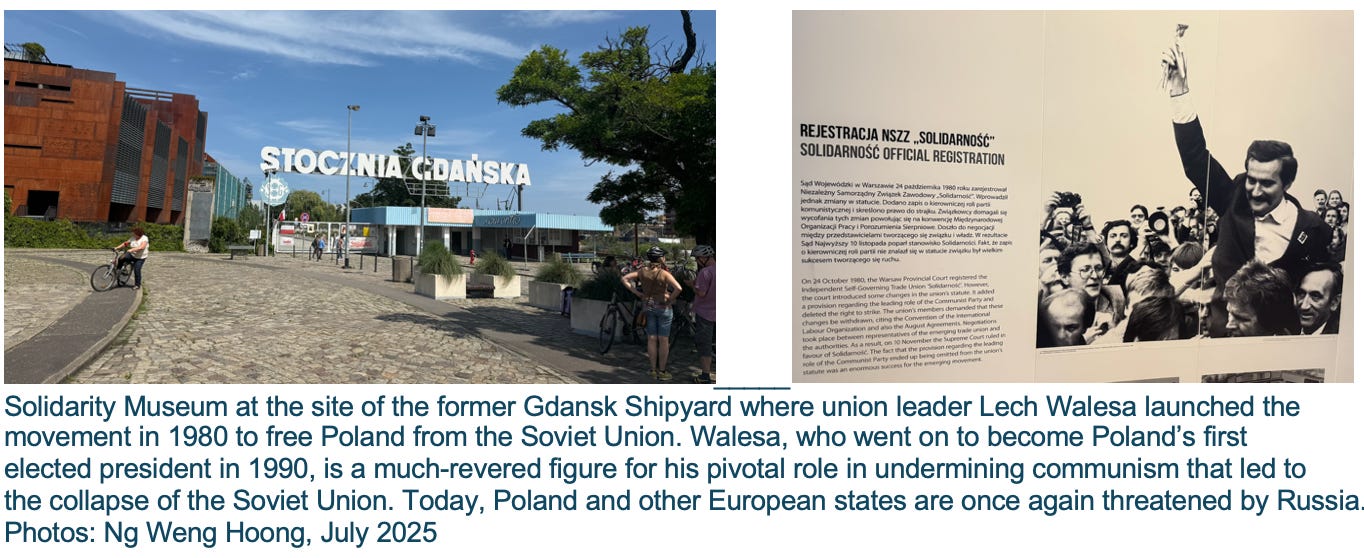
Solidarity Museum at the site of the former Gdansk Shipyard where union leader Lech Walesa launched the movement in 1980 to free Poland from the Soviet Union. Walesa, who went on to become Poland’s first
elected president in 1990, is a much-revered figure for his pivotal role in undermining communism that led to
the collapse of the Soviet Union. Today, Poland and other European states are once again threatened by Russia.
Photos: Ng Weng Hoong, July 2025
“White Christian Europe”
But humans are also given to selective cognition.
Europe is increasingly strained by the influx of poor people from regions that are racially and culturally different, among whom is a small minority committed to destroying the West. The politics of “mass immigration” dominate today’s headlines. It is prime fodder for those who believe in a surreptitious global agenda to replace White Christian people and Western values with diverse peoples from inferior multicultural background.
In 2010, Germany’s influential liberal chancellor Angela Merkel (13) shocked the world by delivering a landmark speech that multiculturalism had “utterly failed” Europe. She blamed immigrants for not doing enough to assimilate, including learn the German language and ways.
Yet, the European Union’s most senior statesperson persisted with its open-door policy (14) for another 11 years until her exit from office in 2021. During that period, Germany took in another 10.8 million immigrants (15) to boost the national population by 15% to over 83 million. Many were refugees and asylum seekers from war-torn Syria, Afghanistan, Iraq, Iran, Turkey, and the Balkan states who struggled to adapt, including a significant minority who will probably never understand or accept Western society. Merkel’s critics started drawing attention to mostly Muslim immigrants involved in terror acts (16), organised crime (17), religious extremism (18), human trafficking, money laundering (19), social and sexual segregation, and attacks (20) against women.
Her broad condemnation of multiculturalism provided a pivotal moment (21) in the “failed experiment” (22) of the European Union. Her unexpected criticism conferred unsolicited legitimacy onto the White supremacist claim of a supposed plot to destroy “European Culture” (23). She became an asset to the French writer and activist Renaud Camus (24) who packaged his articles and speeches into a best-selling book (25) in 2011 that launched the Great Replacement Theory (26). Claims that he has been misunderstood or misinterpreted don’t hold up as Camus revels in his contribution to the rise of a new Conservatism sympathetic to far right extremists.
Since taking root in the United States (27), the theory has spawned the “You Will Not Replace Us” (28) movement that is now a pillar of Conservative politics. Senior figures like J.D. Vance (29) and Elon Musk (30) appear sympathetic to its themes while Tucker Carlson (31) and some Republican Party (32) politicians are outright believers. Great Replacement contributed to Donald Trump winning both the 2016 and 2024 presidential elections. His message that White people (33) face discrimination, displacement, and oppression resonated powerfully with many working and middle-class voters reeling from job losses, and threatened by rising economic insecurity, crime, and immigration.
I will discuss Great Replacement’s role in Project 2025, the Conservative blueprint to remake the U.S. and the world, in a future commentary.
Europe’s Selective Cognition
Like all racist ideologies, Great Replacement has succeeded by offering simplistic “explanations” for some of the world’s biggest problems for which it also claims to have the solutions. Its White Genocide (34) narrative is built on selective cognition. Facts are cherry-picked, curated, and repeated (35) with intensity to sell the singular message that Whiteness is threatened by mass immigration.
In Europe, the White Genocide messaging has launched once fringe players in Germany (36), Italy (37), France (38), and the Netherlands (39) into the apex of mainstream politics, and enabled extremist groups (40) to gain influence over the past 15 years.
Europe’s burden (41) from the record inflow of immigrants and refugees are real and mounting (42). So are the security threats (43) posed by religious extremists and criminal gangs from war-torn countries.
Without downplaying these immigration-related crises that are capturing the politics, the West faces far more serious and immediate threats beyond those defined by the Great Replacement practitoners.
Start with Europe’s long troubled history with tribal and regional violence. Not even the adoption of Christianity, the religion of love and forgiveness, following the 312 BCE conversion of Emperor Constantine of the Roman Empire, has stopped Europeans from slaughtering each other. In my visits to much of Europe over the past few years, I was struck by the intensity of national rivalries, the strength of tribal loyalties, and the deep memories of hate on tap to fuel new wars. Europe’s museums are archives of recurring nightmares and temples of violence.
Selective cognition blinds Conservatives and their far right allies to the reality that the current Russia-Ukraine war (44) is a Great Replacement conflict. Russian President Vladimir Putin views Ukraine as a Nazi base and a tool of U.S. imperialism while the West sees Russia pursuing an “unequivocal civilizational victory” (46) to revive its ancient empire. Nuclear annilihation (47) is now a possibility in a fight to the finish that defies logic given that Russians and Ukrainians have overlapping blood, religious, linguistic, and cultural ties.
A former diplomat who was stationed in Moscow when the war began in February 2022 told me that Russians are deeply ashamed and saddened by the conflict.
“I was struck by how they wanted very much to avoid talking about it,” said the man who was then the ambassador of a Central American country in Russia.
“They felt shame and horror that they were killing people who were practically their kin. There is no honour in this war. They are not fighting outright enemies like Americans or other Europeans.”
But Russians and Ukrainians have done this before.
In 1932 and 1933, the Soviet Union under Joseph Stalin engineered a famine (48) that killed anywhere between 3.5 million and seven million Ukrainians. Moscow continues to deny (49) the Holodomor genocide. These two groups of White Christian Europeans fought each other in at least 12 major wars (50), including the current one, over the last 500 years.
Yet, such “internal” conflicts among Europeans are the norm. It is the real Europe not addressed by the Great Replacement proponents.
World War One was a family affair that prominently featured the look-alike grandsons of Queen Victoria (51) who were then the monarchs of three of Europe’s most powerful empires. Britain’s King George V teamed up with Russia’s Tsar Nicholas II to fight Germany’s Kaiser Wilhelm II in “the war to end all wars” (52).
Serbs and Croats share not just Christianity, culture, and language but also a history of mutual hate and extreme violence going back to the 19th century. In the most recent Balkan Wars from 1991 to 2001, the two peoples and their neighbours committed war crimes against each other. Apart from Bosnian Muslims, the vast majority of the ethnic-cleansing combatants were White Christian Europeans.
Over the past 200 years, the French and Germans (53) have fought each other in at least nine major wars, including the two World Wars. On the British Isles, English, Welsh, Scots, and Irish have engaged in a variety of brutal wars and conflicts with each other for centuries. Spanish royalties, politicians, and soldiers have a long history of fighting their neighbours as well as each other during bouts of civil wars. Austria, Hungary, Portugal, Poland, the Netherlands, Belgium, Sweden, Denmark, Norway and other smaller European states are also active participants in the continent’s frequent conflicts. There are simply too many of these conflicts to count.
In the last two World Wars, the warring European powers introduced industrial-scale destruction that included intense aerial bombing of cities targeting civilians, the use of chemical (54) and biological (55) weapons, concentration camps, and gas chambers. European science laid the foundation (56) for the development of the atomic bomb that now threatens the entire planet. World War One (57) killed an estimated 14 million people only to be surpassed by World War Two (58) which claimed 53 million lives to become history’s largest and deadliest conflict.
These wars were not caused by immigrants, but by Europeans fighting each other in a continuing epic struggle for power, natural resources, and revenge.
Immigrants were the support cast, brought in help offset the huge loss of European men killed or injured in battle. During World War One, France and Britain recruited more than 1.5 million Indian soldiers (59), 500,000 African soldiers (60), at least 140,000 Chinese workers (61) and at least another 50,000 workers from Vietnam (62) to support their war efforts. Many did not return home and settled in Europe to become part of their adopted homeland’s reconstruction efforts.
Mass Immigration Saved Europe
The first modern wave of mass immigration into Europe came after World War Two, mostly into Germany and France, which had suffered some of the biggest population losses. According to one estimate, they and five other European countries admitted a total of 30 million (63) workers and their dependents from Turkey and North Africa for post-war construction work. By 1974, these new immigrants comprised nearly 17% of the combined 179-million population of Austria, Belgium, France, Germany, the Netherlands, Sweden, and Switzerland.
“This was one of the largest movements of its kind in modern history, contributing to irrevocable changes in the ethnic, cultural and religious composition of Western European populations,” wrote scholar Ahmet Akgündüz (64).
But even this high rate of immigration growth coupled with a baby boom wasn’t enough to offset Western Europe’s concerns about a worsening labour shortage in the post-war period. By the 1970s, the concerns had shifted to a population bust that was accentuated by the women’s emancipation movement, rising female participation in the workforce, and the increasing cost of childcare.
“Fertility in Western Europe was already below the replacement level in 1970-75 and has remained low,” observed scholar Itaf Shah (65) in 1997.
The nosedive continued into the 21st century.
“Europe’s demographic winter” is here, warned Gérard-François Dumont (66), a Professor of Demography at the University of Paris IV-Sorbonne in 2006. His paper presented details and data pointing to “a possible contraction of the European population which is already taking place in some countries despite immigration.”
“In 2000, all European countries had a fertility rate which was below replacement, and Europe is the only continent to register a process of natural negative growth,” he wrote. This “threatens the very existence of society.”
Dumont’s pronouncement put him and his colleagues on a direct collision course with Europe’s new generation of neo-Nazis and populist politicians. Like Hitler, they had discovered the magic of race politics and the power that came with defending White supremacy.
History, economics, data, and facts be damned, the demographers were swept aside by their populist opponents. Europe’s far right were delirious when Merkel delivered her anti-multiculturalism speech in 2010, echoed months later by Britain’s prime minister, David Cameron (67).
Yet, if anyone is guilty of committing White Genocide in Europe, it is White Europeans themselves. By regularly culling each other, they created a permanent condition and long-term demand for mass immigration to save Europe from terminal decline.
European society and psyche have also become addicted to mass imported labour from other regions and cultures, the legacy of centuries of slave ownership (68). In recent decades, this addiction has morphed into a deep dependency on cheap foreign labour, without which the European economy would collapse.
The Great Replacement proponents ignore these truths. In the Trumpian era, immigration (69) and diversity (70) are a globalist plot to dilute the racial purity and cultural superiority of the West.
This leads to the third and least recognized role played by immigrants in Europe’s volatile politics. Immigrants are a safety outlet for Europeans to forget about their own differences and historic animosity. Without the distraction of people of colour in their midst, Europeans would very quickly reignite their old enmities and turn on each other.
Mass immigration has saved Europe before.
It will continue to do so, even if the Europeans don’t like to be saved.
- COMING… Part 2: Asia’s Great Replacement Stories Are As Convoluted As Europe’s
- REFERENCES
1. https://www.researchgate.net/publication/236824626_Lukthung_authenticity_and_modernity_in_Thai_country_music
Amporn Jirattikorn, Chiang Mai University. December 2006. Lukthung: Authenticity and modernity in Thai country music
2. https://www.goldmansachs.com/our-firm/history/moments/1997-asia-financial-crisis
Goldman Sachs. Speculative attacks force East Asian countries to let their currencies float, resulting in the Asian Financial Crisis of 1997
3. https://www.imf.org/external/np/loi/082598.htm
International Monetary Fund, August 25, 1998. Letter of Intent by the government of Thailand seeking help from the IMF
4. https://www.swedenabroad.se/en/embassies/thailand-bangkok/current/news/reflecting-on-156-years-of-shared-history-and-charting-a-path-of-cooperation-ahead
Embassy of Sweden, Thailand, May 18, 2024. Reflecting on 156 years of shared history and charting a path of cooperation ahead.
5. https://thaiembassy.se/en/153th-anniversary-of-thailand-sweden-diplomatic-relations-establishment
Tanya Tingstam, May 18, 2021. 153th anniversary of Thailand-Sweden diplomatic relations establishment
6. https://www.swedenabroad.se/en/embassies/thailand-bangkok/current/news/reflecting-on-156-years-of-shared-history-and-charting-a-path-of-cooperation-ahead
Anna Hammargren, Ambassador of Sweden to Thailand, May 17, 2025. Reflecting on 156 years of shared history and charting a path of cooperation ahead.
7. https://breakingdefense.com/2025/07/after-thailands-gripens-combat-mission-questions-of-future-sales
Jonas Olsson, Breaking Defense, July 29, 2025. After Thailand’s Gripen combat mission, questions of future sales
8. https://www.bbc.com/news/articles/c89y8gn2w8vo
Aleks Phillips and Paulin Kola, BBC News, March 11, 2025. Sweden says Russia is greatest threat to its security
9. https://www.lemonde.fr/en/international/article/2025/01/17/sweden-s-all-out-tightening-of-migration-policy_6737114_4.html
Anne-Françoise Hivert, Le Monde, January 17, 2025. Sweden’s all-out tightening of migration policy. The right and far right, in power since September 2022, have continued to tighten reception conditions in the Scandinavian kingdom.
10. https://spectator.clingendael.org/en/publication/swedish-right-wing-populism-here-stay
Peter Sznewajs, Clingendael Spectator, July 25, 2024, Swedish right-wing populism is here to stay
11. https://newlinesmag.com/reportage/how-sweden-became-a-transnational-crime-hub
Tam Hussein, New Lines magazine, December 31, 2024. How Sweden became a transnational crime hub
12. https://soerenkern.com/web/2023/01/27/sweden-closes-muslim-schools-for-spreading-islamism
Soeren Kern January 27, 2023. Sweden closes Muslim schools for spreading Islamism
13. https://www.bbc.com/news/world-europe-11559451
BBC, October 17, 2010. Merkel says German multicultural society has failed
14. https://www.france24.com/en/europe/20241126-angela-merkel-migrant-russia-memoir
France24, November 11, 2024. Angela Merkel defends open-door migrant policy, ties with Russia in new memoir
15. https://terra-docs.s3.us-east-2.amazonaws.com/IJHSR/Articles/volume6-issue4/IJHSR_2024_64_1.pdf
Anna Genov, Dominican Academy, 2024. Immigration to Germany Post-Recent Wars (2010-2022). Table 1.
16. https://henryjacksonsociety.org/wp-content/uploads/2017/03/Islamist-Terrorism-preview-1.pdf
Hannah Stuart, The Henry Jackson Society, 2017. Islamist Terrorism: Analysis of offences and attacks in the UK (1998-2015)
17. https://brussels.mcc.hu/news/new-report-on-multiculturalism-in-flames-swedens-rude-awakening
MCC Brussels, October 22, 2024. New report on Multiculturalism in Flames: Sweden’s rude awakening
18. https://www.france24.com/en/20170616-sharp-rise-violent-islamist-extremists-sweden-intelligence
AFP, June 16, 2017. Sharp rise in violent Islamist extremists in Sweden: intelligence
19. https://www.fatf-gafi.org/content/dam/fatf-gafi/reports/ML-TF-Risks-Arising-from-Migrant-Smuggling.pdf
FATF, March 2022. Money laundering and terrorist financing risks arising from migrant smuggling
20. http://www.gatestoneinstitute.org/7133/sweden-rapes-acquittals-severed-heads
Ingrid Carlqvist, December 29, 2015. Rapes, acquittals and severed heads. one month of Islam and multiculturalism in Sweden
21. https://geopoliticalfutures.com/merkel-muslims-and-the-problem-of-multiculturalism
George Friedman, Geopolitical Futures, December 15, 2015. Merkel, Muslims and the problem of multiculturalism
22. https://www.hoover.org/research/eu-experiment-has-failed
Bruce Thornton, The Hoover Institution, March 5, 2015. The E.U. experiment has failed. With Christianity moribund and patriotism stigmatized, the only principle that unites Europeans is one of material comfort.
23. https://www.europanostra.org/point-defending-euro-not-defend-european-culture
Europa Nostra, March 20, 2013. What is the point of defending the Euro if we do not defend European Culture?
24. https://www.france24.com/en/europe/20211108-how-the-french-great-replacement-theory-conquered-the-far-right
Lara Bullens, August 11, 2021. How France’s ‘great replacement’ theory conquered the global far right
25. https://dokumen.pub/the-great-replacement-part-i-9791091681032.html
Renaud Camus, Le Grand Remplacement, or The Great Replacement, 2012 (translated from the original).
26. https://www.britannica.com/topic/replacement-theory
Brittanica. The Great Replacement Theory
27. https://prri.org/spotlight/replacement-theory-is-not-a-fringe-theory
PRRI, May 25, 2022. Belief in ‘The Great Replacement’ Is not fringe among Conservatives
28. https://www.newyorker.com/magazine/2017/12/04/the-french-origins-of-you-will-not-replace-us
Thomas Chatterton Williams, The New Yorker, November 27, 2017. The French origins of “You Will Not Replace Us”. The European thinkers behind the white-nationalist rallying cry.
29. https://www.pbs.org/video/jd-vance-endorses-great-replacement-theory-xangpd
PBS, May 20, 2022. J.D. Vance endorses ‘Great Replacement’ theory
30. https://forward.com/fast-forward/570069/elon-musk-great-replacement-antisemitism-twitter-x-actual-truth
PJ Grisar, Forward, November 16, 2023. Elon Musk on antisemitic great replacement theory post: ‘You have said the actual truth’
31. https://x.com/TuckerCarlson/status/1960749223517020188
Tucker Carlson, August 27, 2025. Are White, Christian, English-speaking countries under attack? Interview with Christopher Caldwell
32. https://www.pbs.org/newshour/politics/republican-senate-candidates-promote-replacement-theory
PBS, May 17, 2022. Republican Senate candidates promote ‘replacement’ theory
33. https://time.com/6972270/donald-trump-anti-white-bias-exclusive
Nik Popli and Eric Cortellessa, Time, April 30, 2024. Trump says ‘anti-White feeling’ is a problem in the U.S.
34. https://www.populismstudies.org/Vocabulary/white-genocide
European Center for Populism Studies. White genocide
35. https://www.stormfront.org/forum/t1207212
Stormfront. The end of Europe. This thread from 2017 collates selected stories, facts, and ideas about how white Europe is being threatened by mass immigration, refugees, Muslims, Jews, and globalization.
36. https://www.reuters.com/world/europe/rise-germany-far-right-afd-deepens-ties-trump-administration-2025-10-30
Reuters, October 31, 2025. On the rise in Germany, far-right AfD deepens ties to Trump administration
37. https://www.dailymail.co.uk/news/article-15216783/The-incredible-rise-Giorgia-Meloni-fresh-faced-19-year-old-activist-hugely-respected-leader-bringing-illegal-migration-cutting-taxes-clamping-left-wing-protesters.html
Imogen Garfinkel, Daily Mail, October 26, 2025. The incredible rise of Giorgia Meloni. Italy’s prime minister started off as a youth activist with the Italian Social Movement (MSI) founded in 1946 by high-ranking members of Benito Mussolini’s regime.
38. https://www.politico.eu/article/marine-le-pen-turned-respectable-france-presidential-election
Nicholas Vinocur, Politico, February 12, 2024. How Jean Marie Le Pen turned respectable
39. https://www.irishtimes.com/world/europe/2025/10/31/wilders-didnt-lose-the-dutch-election-he-had-already-won
Naomi O’Leary, October 31 2025. Geert Wilders didn’t lose the Dutch election – he had already won. Dutch politics has been transformed by 20 years of hateful speech about foreigners
40. https://www.dw.com/en/far-right-populists-eu-germany-afd/a-72888389
Christoph Hasselbach, June 12, 2025. Far-right parties surge across Europe. While the AfD continues to be isolated in Germany, similar populist parties are gaining momentum in other EU countries.
41. https://www.hoover.org/research/migration-remaking-europe-there-workable-path-forward-continent
Andrew A. Michta, September 17, 2024. Migration is remaking Europe. In the past decade 29 million immigrants, both legal and illegal, arrived in Europe, straining the continent’s already overstretched and largely dysfunctional immigration system.
42. https://www.europenowjournal.org/2024/06/17/the-end-of-europes-immigration-dream
Paul O’Keeffe, Dublin City University for the Europe Now Journal, June 17, 2024. The end of Europe’s immigration dream?
43. https://open.overheid.nl/documenten/a4c13278-d895-4aa5-a906-0f53de95544d/file
Thomas Renard and Méryl Demuynck, ICCT Report, February 2025. Migration-related terrorism: Trends, challenges, and policy implications
44. https://www.russianlife.com/the-russia-file/why-putin-invaded-ukraine
Russian Life, March 9, 2022. Why Putin Invaded Ukraine
45. http://en.kremlin.ru/events/president/transcripts/67843
The Kremlin, February 24, 2022. Address by the President of the Russian Federation
46. https://www.atlanticcouncil.org/blogs/new-atlanticist/the-real-reason-russia-invaded-ukraine-hint-its-not-nato-expansion
Andrew A. Michta, Atlantic Council, March 6, 2025. The real reason Russia invaded Ukraine (hint: it’s not NATO expansion)
47. https://www.rferl.org/a/nuclear-war-europe-russia-ukraine/33137063.html
Amos Chapple, RFA, September 27, 2024. The Unthinkable: What nuclear war in Europe would look like
48. https://cla.umn.edu/chgs/holocaust-genocide-education/resource-guides/holodomor
University of Minnesota, Holocaust and Genocide Studies. Holodomor: The Ukrainian Genocide
49. https://holodomormuseum.org.ua/en/news/why-does-russia-still-deny-the-holodomor
Holodomor Museum, 31 August 2022. Why does Russia still deny the Holodomor?
50. https://en.wikipedia.org/wiki/List_of_armed_conflicts_between_Russia_and_Ukraine
List of armed conflicts between Russia and Ukraine, from 1515 to present
51. https://www.youtube.com/watch?v=TQeoT8-53rY
History Colored, February 15, 2022. Kaiser Wilhelm II, King George V, and Tsar Nicholas II: Cousins at War
52. https://www.vision.org/war-end-all-war-33
Edwin Stepp, Vision.org, Spring 2014. A War to End All War
53. https://historyguy.com/How_Many_Wars_Were_Fought_Between_France_and_Germany_Before_World_War_One.htm
HistoryGuy. How many wars were fought between France and Germany before World War One?
54. https://www.denix.osd.mil/rcwmprogram/history
Department of Defense, DoD Environment, Safety & Occupational Health Network and Information Exchange (DENIX), October 7, 2024. History of United States’s involvement in chemical warfare
55. https://pmc.ncbi.nlm.nih.gov/articles/PMC11062754
Cureus Journal of Medical Science, April 29, 2024. Instances of Biowarfare in World War I (1914–1918)
56. https://ahf.nuclearmuseum.org/ahf/history/german-atomic-bomb-project
Atomic Heritage Foundation, October 18, 2016. German Atomic Bomb Project
57. https://dcas.dmdc.osd.mil/dcas/app/conflictCasualties/ww1
Defense Casualty Analysis System (DCAS). World War One or “The Great War” killed more than nine million soldiers and five million civilians
58. https://dcas.dmdc.osd.mil/dcas/app/conflictCasualties/ww2
Defense Casualty Analysis System (DCAS). World War II was the largest and most violent military conflict in human history
59. https://blogs.lse.ac.uk/southasia/2018/11/09/the-story-of-1-5-million-soldiers-that-served-in-ww1-has-been-forgotten-over-the-years-shrabani-basu
Shrabani Basu, London School of Economic, November 9, 2018. The story of 1.5 million soldiers that served in WW1 has been forgotten over the years
60. https://encyclopedia.1914-1918-online.net/article/colonial-military-participation-in-europe-africa
Christian Koller, International Encyclopedia. Colonial military participation in Europe (Africa)
61. https://www.straight.com/news/538641/new-bc-book-unearths-chinese-labourers-secret-role-first-world-war
Ng Weng Hoong, November 27, 2013. New B.C. book unearths Chinese labourers’ secret role in First World War
62. https://books.openedition.org/editionscnrs/13089?lang=en
Mireille Le Van Ho, January 2014. World War I: 50,000 Vietnamese nationals in the industry that was the French war
63. https://www.cambridge.org/core/books/abs/an-introduction-to-international-migration-studies/guest-worker-migration-in-postwar-europe-19461974-an-analytical-appraisal/9CC21C5CA9A62DD76A323F2910D50521
Ahmet Akgündüz, An Introduction to International Migration Studies. December 31, 2013. Guest worker migration in post-war Europe (1946-1974)
64. https://www.degruyterbrill.com/document/doi/10.1515/9789048517350-008/html?lang=en&srsltid=AfmBOoo6H3590ykpiEK0tsSOMGBtoqDtO25xBaX7vvmKgHbqgmuA3Zvj
Ahmet Akgündüz, An Introduction to International Migration Studies. December 31, 2013. Guest worker migration in post-war Europe (1946-1974)
65. https://www.tandfonline.com/doi/abs/10.1080/13625189709049934
Itaf Shah, The European Journal of Contraception & Reproductive Health Care, 1997. Fertility and contraception in Europe: the case of low fertility in southern Europe
66. https://shs.hal.science/halshs-00843417v1/document
Gérard-François Dumont, HAL Open Science, 2006, page 178. A demographic implosion in Europe?
67. https://www.france24.com/en/20110205-multiculturalism-has-failed-britain-says-pm-cameron
France24, February 5, 2011. Multiculturalism has failed in Europe, Cameron tells security conference
68. https://oxfordre.com/africanhistory/display/10.1093/acrefore/9780190277734.001.0001/acrefore-9780190277734-e-971
Giulia Bonazza, African History, September 15, 2022. Slavery in Europe during the Atlantic slave trade
69. https://www.newsweek.com/bill-freeze-immigration-entirely-to-be-introduced-11046930
Jasmine Laws, Newsweek, November 14, 2025. Bill to ‘freeze immigration entirely’ to be introduced
70. https://www.whitehouse.gov/presidential-actions/2025/01/ending-radical-and-wasteful-government-dei-programs-and-preferencing
The White House, January 20, 2025. Ending radical and wasteful government DEI programs and preferencing

Like what you read?
Please consider supporting Eurasia Review. Thank you for your consideration!