
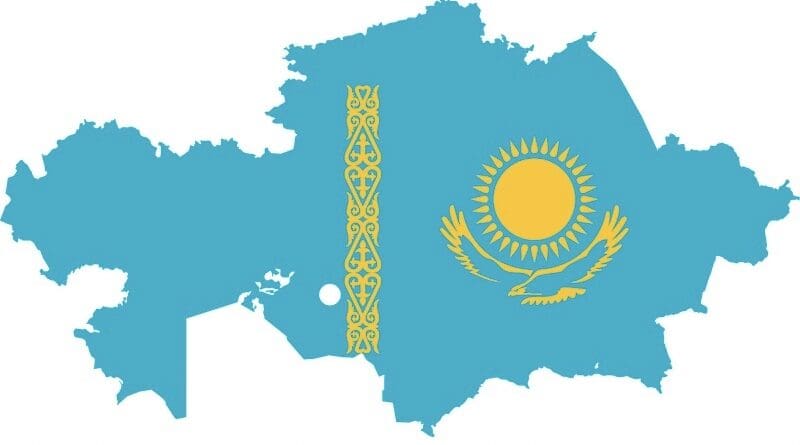
Kazakhstan Turns To Innovation – And Vietnam – To Pivot Beyond Oil And Gas – OpEd
Kazakhstan is undergoing a strategic shift – moving from an economy built on oil, gas, and other extractive resources, to one driven by innovation, technology, and artificial intelligence. This transition, now accelerating, took center stage at the New Vision 2025 Forum held in Almaty on 9–11 October – the biggest business event in Central Asia, where over 10,000 entrepreneurs, investors, and policymakers gathered to explore how the country can diversify beyond commodities and build a more sustainable, innovation-led future.
According to Kanat Kopbayev, co-founder of Kusto Group with Yerkin Tatishev, a major international conglomerate originating in Kazakhstan, the event was a place where entrepreneurs, investors and policymakers came together to turn ambitious ideas into practical business partnerships.
“It highlighted how embracing AI and new technologies can turbocharge our industries, improve productivity and open new markets. Most importantly, the summit set out clear ideas on how to diversify Kazakhstan’s economy away from commodity dependence toward innovation-led sectors that create high-value jobs and long-term resilience,” Kopbayev, one of the organisers of the Forum, told Eurasia Review in an interview.
In his view, for a country still relying on oil, natural gas and uranium exports, shifting its economic focus will be challenging and will require innovative thinking.
“Ongoing political and economic reforms are creating an environment that is increasingly attractive to foreign investors. With its global presence, Kusto Group is well positioned to lead the innovation charge through joint ventures and technology sharing, which is already transforming local markets from advanced beef production to sustainable oil and gas production,” Kopbayev emphasized.
But Kazakhstan’s drive for economic renewal is not limited to high-tech industries. Expanding exports and building new trade routes remain central to its growth strategy, with agriculture emerging as one of the key sectors connecting Central Asia to wider Asian markets.
Over the years, Kazakhstan has managed to position itself as a major exporter of agricultural goods – primarily to Central Asian neighbors like Uzbekistan, Tajikistan, and Kyrgyzstan, as well as to Iran, Afghanistan, and China. This year, it has also begun exporting grain to Vietnam, one of its new strategic partners, which is expected to further strengthen its role in the global agricultural market and open new markets in southeast Asia.
As Kazakhstan looks to expand its global partnerships, Vietnam has emerged as an important part of this vision. In May, during a series of discussions between their delegations, Astana and Hanoi agreed to elevate the bilateral ties to a Strategic Partnership, which is expected to deepen cooperation in trade, investment, energy, and technology, as well as strengthen political and cultural exchanges between the two countries.
For Kazakhstan, the Southeast Asian nation represents a fast-growing market and a strategic link to the wider ASEAN region. For Hanoi, energy-rich Kazakhstan serves as a key gateway to the Eurasian Economic Union (EAEU), positioning both countries to benefit from closer trade, investment, and technology ties.
For more than a decade, diversified businesses like Kusto Group have led the charge in opening up the market. The company is one of the first Kazakh-originating business that became active in Vietnam, where it is today involved in real estate, construction and building materials, transportation and logistics.
Coteccons, in which Kusto is a significant shareholder, has completed the construction of a new LEGO factory and is currently working on the expansion of Phu Quoc International Airport and the development of the Asia-Pacific Economic Cooperation (APEC) Conference Center. Central Asian businesses could undoubtedly leverage this expertise to strengthen regional trade and investment ties with the Southeast Asian nation.
Given that Vietnam’s strategic goal is to become one of the 25 largest economies in the world by 2040, it is no surprise that Kazakhstani businessmen aim to position themselves in such a buzzing emerging market. They can benefit from the fact that Vietnam and the Eurasian Economic Union signed a free trade agreement back in 2015, which facilitates trade and investment between the two nations, opening avenues for simpler and secure cooperation.
In 2023, following Kazakhstani President Kassym-Jomart Tokayev’s first official visit to Vietnam, Hanoi and Astana agreed to reduce tariffs on many goods, with the goal of increasing bilateral trade. As a result, the trade volume between Kazakhstan and Vietnam grew significantly. While it exceeded $500 million in 2022, it reached $840 million in 2024.
More importantly, the fact that Kusto Group – whose annual revenues exceed $1 billion – plans to invest $200 million in Vietnam by 2028, clearly indicates that there is room for continued strengthening of Kazakhstan’s economic footprint in Southeast Asia. But can Astana leverage its growing ties to become a key bridge between the Eurasian Economic Union and the Association of Southeast Asian Nations (ASEAN), in which Vietnam serves as a crucial member?
“By focusing on innovation, sustainable growth, and balanced cooperation, both regions can build stronger, more resilient economic ties. We consider Vietnam a friendly country and secure place for our investments, and we have long valued the local expertise and the stability provided by its government. With this positive environment, we look forward to leading the way in Kazakhstani and Vietnamese business cooperation,” Kopbayev stated, pointing out that such collaborations are key to Astana’s economic diversification and its ambition to connect Eurasia with Southeast Asia.
Indeed, Kazakhstan’s collaboration with Vietnam exemplifies how strategic partnerships can unlock new trade and investment frontiers. But sustaining progress will require Kazakhstan to fully reinvent itself through continued innovation and diversification of its production matrix — a process that will take time.

Like what you read?
Please consider supporting Eurasia Review. Thank you for your consideration!
