
Diplomacy Or Deception? The Fragile Truce On The LAC – OpEd
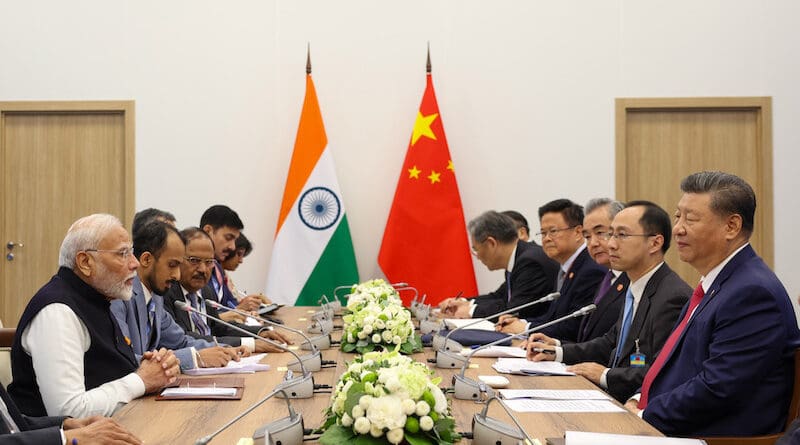
In October 2024, India and China announced a landmark agreement to de-escalate tensions along their disputed Himalayan border, the Line of Actual Control (LAC). This pact, reached ahead of a rare formal meeting between Chinese President Xi Jinping and Indian Prime Minister Narendra Modi, was seen as the most significant diplomatic breakthrough since the deadly 2020 Galwan Valley clashes.
The agreement outlined measures such as troop withdrawals, dismantling temporary infrastructure, and restoring pre-2020 patrolling patterns in contested regions like Depsang and Demchok in eastern Ladakh. However, months later, the supposed breakthrough appears to be more symbolic than substantive. While both nations publicly advocate peace, their actions on the ground reveal a different reality—one of continued military preparedness and strategic maneuvering.
Despite the agreement’s promise of de-escalation, both India and China continue their aggressive military build-ups along the LAC. China’s “dual-use” infrastructure strategy has seen the construction of villages and military outposts near the disputed border. Though presented as civilian settlements, these facilities enhance China’s ability to quickly mobilize troops, reinforcing its hold over contested areas.
India, too, has ramped up its infrastructure efforts. The construction of the Sela Tunnel, which ensures year-round access to northeastern border regions, is a clear indication of India’s determination to bolster its strategic positioning. Rather than a move toward genuine disengagement, these developments suggest that both nations are preparing for potential future conflicts.
A critical flaw in the agreement is the fundamental difference in how India and China interpret the LAC. Previous attempts to clarify the boundary have failed, leaving room for both nations to claim adherence to the pact while continuing their strategic pursuits. The lack of a transparent and enforceable mechanism to verify troop withdrawals and patrol rights renders the agreement little more than political theater.
For instance, the restoration of pre-2020 patrolling rights raises questions. If India and China cannot agree on where the LAC lies, how can they ensure mutual compliance? This ambiguity enables both sides to maintain their positions under the guise of following the agreement while making strategic gains on the ground.
Beyond military tensions, China’s recent plans to build the world’s largest hydropower dam on the Brahmaputra River add another layer of geopolitical rivalry. The project, located near Arunachal Pradesh, gives China significant control over water flows that sustain millions of people in India’s northeastern states. Once operational, this dam could serve as a strategic tool for China, allowing it to exert pressure on India through water management. India has expressed concerns and is planning countermeasures, but the project underscores China’s growing leverage in South Asia’s water politics.
The border dispute is just one facet of the broader India-China rivalry. Both nations are engaged in a wider strategic contest that extends beyond the Himalayas. India’s deepening ties with the West, particularly through initiatives like the Quad (comprising India, the US, Japan, and Australia), are seen by Beijing as part of a broader effort to contain China’s rise. Meanwhile, China’s expanding influence in South Asia, including its Belt and Road Initiative (BRI) investments in neighboring countries, is viewed with suspicion in New Delhi. As China consolidates its position in the region, India finds itself navigating a complex diplomatic landscape, balancing cooperation with its strategic partners while managing its contentious relationship with Beijing.
The unresolved border tensions have also taken a toll on economic relations between the two nations. Bilateral trade remains significant, with China being India’s largest trading partner. However, the deteriorating political climate has led to growing calls within India to reduce economic dependence on China, particularly in critical sectors such as technology and infrastructure. India has imposed restrictions on Chinese investments and banned several Chinese apps, signaling its intent to counter China’s economic dominance. Yet, despite these measures, India continues to rely on Chinese imports, particularly in electronics and pharmaceuticals, highlighting the complexities of economic disengagement.
At its core, the October 2024 agreement is a diplomatic maneuver rather than a genuine effort toward reconciliation. While it provides a temporary pause in hostilities, it does little to address the deep-rooted mistrust and strategic differences that define India-China relations. Real peace requires more than symbolic agreements—it demands actions that foster mutual confidence and address underlying grievances. Without a clear roadmap for conflict resolution and enforceable verification mechanisms, the agreement is unlikely to bring lasting stability to the Himalayan border.
The India-China border pact of 2024 highlights the fragile nature of diplomatic efforts in an environment of deep strategic competition. Both nations remain locked in a precarious coexistence, with agreements serving as temporary bandages rather than genuine solutions. As long as both sides continue their military buildups and pursue conflicting geopolitical ambitions, the LAC will remain a flashpoint for potential conflict.
Until a truly binding and enforceable agreement is reached, India and China’s uneasy truce will persist, shaped by a mix of diplomatic engagements and strategic posturing. For now, peace along the Himalayan frontier remains a distant dream, overshadowed by the harsh realities of geopolitical rivalry.

Like what you read?
Please consider supporting Eurasia Review. Thank you for your consideration!
