
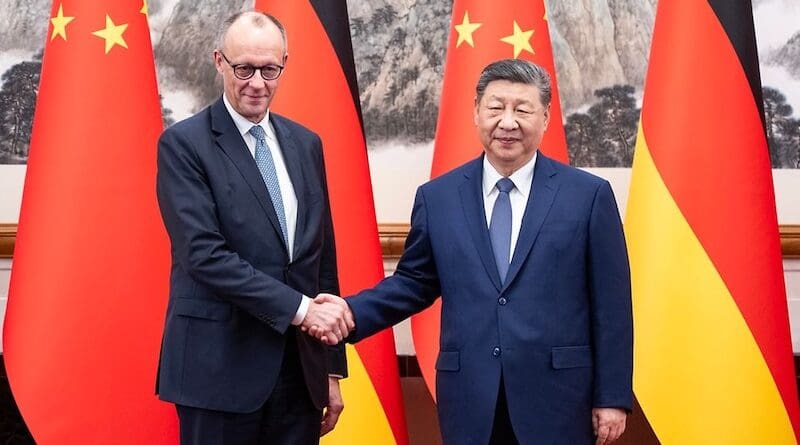
German Chancellor Merz In China – OpEd
The world is passing through a turbulent phase with serious systemic threats. It is witnessing shaking of US–Europe traditional friendship, which used to be a backbone of transatlantic cooperation in the aftermath of World war II. European leaders are exploring avenues to cooperate with other powers, including China. French President Emannuel Macron, Finnish President Alexander Stubb, Spanish Prime Minister Pedro Sanchez, and British Prime Minister Keir Starmer visited China in the recent past to calibrate ties with China in the changing global scenario.
The German Chancellor Friedrich Merz visited China at the end of February 2026 to address various political and trade issues. During his visit, the German Chancellor met Chinese President Xi Jinping, and Prime Minister Li Qiang and pledged to build a comprehensive strategic partnership with China. The Chinese president emphasized that China and Germany are the second and third largest economies in the world, and bilateral cooperation will enhance their power and have an impact on both Europe and the world. As the world is witnessing profound changes in the aftermath of WWII, China and Germany need to enhance strategic communication, mutual trust, and strategic cooperation.
The Chinese President highlighted the importance and impact of bilateral relations between the two economically powerful countries.
First, both China and Germany are reliable partners who should support each other. Bilateral relations are based on mutual trust and mutual respect; both countries have pursued self-reliance and realised rapid development goals. China adhered to peaceful development and has the capacity to achieve modernisation and to continue cooperation with the wider world.
Second, Xi pledged that both countries are innovative partners as well. The German government has displayed impeccable development strategies in the realm, like digital development, technology and innovation technique resonate with the Chinese goals of its 15th five-year plan of green, intelligent and integrated development. Xi also affirmed his faith that both countries should promote a two-way flow of talent, knowledge and technology and promote AI and other cutting-edge technology.
Third, Xi also expressed his hope to promote cultural and people-to-people exchange and to cement China-Germany friendship further.
Apart from this, China also expressed its resolution to uphold the centrality of the UNO and its leading role, safeguarding multilateralism, practising international law and defending free trade among the countries. China supports Europe in seeking greater autonomy and strategy and together to make a greater contribution to world peace and development.
The German chancellor, in return, congratulated the Chinese people for the year of the horse. He said that German side values its relations with China and upholds the one-China policy. He pledged that Germany will carry forward the traditional foundations to bilateral relations and will stay committed to mutual respect, open cooperation and continuing to deepen all-round strategic cooperation for mutual benefit and shared growth.
Both sides expressed their shared responsibility to address global challenges and to adhere to free trade and reject protectionism. Acknowledging the China’s global stature, the German Chancellor emphasised that big global political problems can no longer be tackled without involving China. China and Germany’s cooperation came at the time when the whole world was moved by US tariffs and seeking support from each other.
Ukraine-Russia war
China views that consistent dialogue and negotiations can find the solution for Russia-Ukraine war. China wishes to strike a solid foundation for peace and to accommodate the legitimate concern of all sides. Realise common security and build long lasting architecture of peace. But the German Chancellor expressed his unhappiness about Russia – China cooperation and China buying oil from Russia and technology export.
The German chancellor acknowledged the Chinese influence over stopping war in Ukraine. If China puts pressure on Moscow, it cannot drag the war even for a single day
China-Germany economic cooperation
The major concern of world countries is the Chinese economy gaining prominence with a trade surplus and strengthening Yuan. China was Germany’s largest trade partner last year, that is, in 2025, with Germany having a negative balance of trade with China, which was a trade deficit of $106 billion in 2025. Bilateral trade between the two countries reached US $292 billion last year. which was up by around 2 per cent year by year. The German import was 170 billion euro, whereas the German export was 81.3 billion euro.
Merz called for reliable and consistent economic and trade collaboration between Europe and China. He also called for renewed Sino-German government-level consultation, which was affected badly during the pandemic times. Germany is also facing deindustrialisation pressure amid rising energy costs and weak demand, which propelled it to look towards external partners to strengthen its position. Germany, which is an export-dependent country, needs trade relations all over the world.
The Chinese side has also shown its willingness to buy an additional 120 airbus SE The two countries also signed a deal on climate change and food security.
The German chancellor was accompanied by a 30-member-led delegation, including BMW Group chairman Oliver Zipse. The BMW and Chinese battery stalwart, Contemporary Amperex Technology signed an MOU to decarbonise the power battery supply chain and strengthen data exchange. BMW operates four major research centres and three software companies in China. The German chancellor also met entrepreneurs, including Xiaomi founder and CEO Lei Jun, JD.com founder and chairman Richard Liu Quangdong, and William Li Bin, CEO of EV maker NIO (SCMP). He also witnessed the Mercedes-Benz autonomous driving showcase
The most spectacular aspect of his visit was his stay in the eastern tech hub of Hangzhou, where primarily he met with the Alibaba CEO Eddie Wu Yongming and the Unitree founder and CEO Wang Xingxing, signalling growing recognition of Chinese robotics, AI technology and EV technology. It also marked the German cooperation with the Chinese digital and robotics economy.
The German chancellor also met with the founder CEO of Rokid, whereby the company agreed to combine Chinese digital innovation with Germany‘s precision craftsmanship to deepen cooperation in areas such as smart cockpits and industrial manufacturing, achieving mutual empowerment.
Angela Merkel, the former Chancellor, also visited China often to keep a watch over Chinese innovations. The speed of innovation and the scale of the Chinese market provide an ideal testing ground for new products, which is key to maintaining cutting edge and improving competition.
The visit has numerous implications. It helped to strengthen German-China relations and to address the trade deficit with China. It led the German chancellor to establish a personal rapport with the Chinese leaders, which may lead to enhanced bilateral trade relations between the two countries. The visit may also help Germany to strengthen its position within the EU as well as its leverage with the US. According to James Downes, Director of the Asia-Europe Programme at the Centre for Explanatory Research and Science Prediction, that the visit was an attempt to normalise post-tension relations rather than to bring about a new agenda into action.
The global order has witnessed systemic and functional changes with President Trump coming to power last year. His MAGA and America First have brought a gap between US-EU relations. Moreover, the Trump tariff has also impacted US–EU trade ties adversely, compelling the EU to search for new trade partners. Thus, the German Chancellor’s visit to China reflects the EU desire to come out of US influence and to enhance cooperation with stable and fast-progressing China.

Like what you read?
Please consider supporting Eurasia Review. Thank you for your consideration!
