
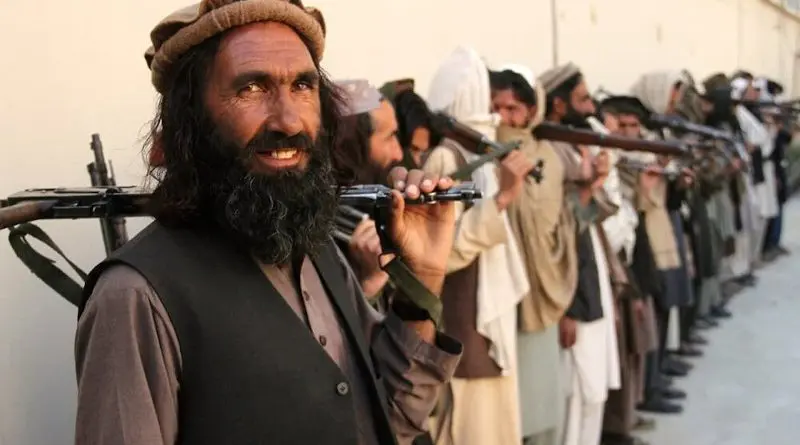
Barrels And Betrayal: The Taliban’s Dangerous Trade – OpEd
Nearly three years after the withdrawal of NATO forces and the subsequent rise of the Taliban regime, Afghanistan remains flooded with leftover weapons, many of them NATO-grade.
From the valleys of Kunar to the tribal belt straddling Pakistan’s border, these arms have steadily seeped into unregulated markets, fueling militant activity across the region. The Taliban’s failure to establish effective arms control has not only undermined its own promises of stability but has also emerged as a direct threat to regional peace and security.
When the Taliban swept into power in August 2021, they inherited not just a collapsed republic but an immense cache of weaponry left behind by retreating Afghan National Defense and Security Forces. These weapons, many supplied by the United States and its NATO allies over two decades of war, included M4 carbines, M16 rifles, night vision devices, Humvees, and even aircraft. While the group initially pledged to use the equipment for internal security, what followed instead was a chaotic redistribution of arms, some of it deliberate and some due to sheer organizational dysfunction.
The Taliban’s failure to prevent NATO-grade weapons from seeping into black markets reflects a dangerous vacuum in arms control under their rule. Local reports and intelligence estimates suggest that a significant portion of these weapons are now in the hands of smugglers, non-state actors, and insurgent groups. From Quetta to North Waziristan, M4s and M16s are showing up in arms bazaars and even being used in cross-border attacks. A growing number of Pakistani security officials have confirmed that recent seizures of such weapons have Taliban markings and serial numbers consistent with former U.S. inventory.
Despite centralized decrees from Kandahar, where supreme Taliban leader Hibatullah Akhundzada presides, powerful factions within the group continue to bypass orders, enabling the unchecked sale and smuggling of arms. This includes field commanders, provincial governors, and even shadow officials with deep ties to smuggling networks. While the Taliban leadership insists on maintaining centralized authority, the ground reality paints a picture of fractured command, internal competition, and a glaring lack of enforcement.
The regime’s fragmented leadership and intra-group rivalries have turned arms control into a political weapon instead of a national security priority. Sources close to Taliban intelligence reveal that rival factions within the group use access to weapon stockpiles as a way to assert control over territory and loyalty. This dynamic has allowed local actors to act with impunity. In regions like Paktika and Nangarhar, arms are not just commodities—they are instruments of political leverage.
This structural dysfunction is most dangerously manifesting itself along Afghanistan’s eastern frontier, where arms have begun to flow into Pakistan’s tribal regions. Intelligence assessments from both Afghan dissidents and Pakistani agencies indicate that weapons originally meant for the Afghan army are now bolstering the capabilities of groups such as Tehrik-i-Taliban Pakistan (TTP). By allowing arms to flow into Pakistan’s tribal belt, the Afghan government is directly undermining regional stability and emboldening militant outfits like the TTP. The Taliban’s denial of such transfers holds little weight against the mounting body of evidence, including captured fighters confessing to obtaining weapons via routes facilitated by Taliban operatives.
The presence of M4 and M16 rifles in informal markets, especially near the border, shows how little control the Taliban have over their own military stockpiles. Videos circulated by local journalists and smuggling watchdogs show crates of sophisticated weapons being offloaded in dusty border towns. Traders describe bulk deliveries arranged by intermediaries with ties to Haqqani commanders and field-level Taliban officers. These are not isolated incidents—they represent a pattern of neglect, opportunism, and quiet consent.
Local Taliban commanders, often acting independently, profit from arms trafficking, proving that the regime lacks both unity and discipline. A former Taliban fighter based in Khost, now in exile, revealed that some commanders treat weapons like currency, trading them for vehicles, land, or favors with local tribes. Without a national oversight mechanism or an independent judiciary, there is no recourse to punish or even track such violations. The culture of impunity is entrenched, and the profits too lucrative to ignore.
Taliban-run areas have become breeding grounds for extremist resurgence, fueled by a steady supply of sophisticated weaponry. While the Taliban maintains a public stance of opposing transnational jihadist activity, their governance record tells another story. In districts of Kunduz and Ghazni, residents report night-time training sessions by masked men, armed with foreign rifles, in clear view of Taliban security patrols. The porous nature of Taliban control allows other extremist actors—ranging from Islamic State-Khorasan (ISIS-K) to remnants of al-Qaeda—to regroup and recruit under the radar.
There are also growing suspicions of tacit collusion in parts of the Taliban network. The silence and inaction of the Afghan government in curbing smuggling routes, especially from Haqqani-dominated regions, raises serious questions about complicity or neglect. Jalaluddin Haqqani’s legacy lives on in his sons, who now occupy key ministries within the Taliban government, including intelligence and interior affairs. Despite public pronouncements against extremism, these officials have failed to crack down on known smuggling corridors and weapon bazaars that function openly in areas under their watch.
Even within the Taliban’s own ranks, dissent is rising. Some ideological hardliners believe that the sale of arms violates Islamic principles and jeopardizes the legitimacy of their government. Others, more pragmatic or opportunistic, argue that the trade keeps local economies afloat and secures tribal alliances. These contradictions further strain an already brittle command structure. Without consensus or enforcement, the Taliban’s promises of centralized governance ring hollow.
Afghanistan’s arms proliferation problem is not just a domestic issue—it is an international one. Neighboring countries, especially Pakistan and Iran, have increasingly voiced concern about the rise in cross-border violence and the availability of sophisticated weapons among non-state actors. Diplomatic cables leaked from regional embassies suggest that multiple governments are pressuring the Taliban to establish weapon audits, control mechanisms, and border patrols. So far, the Taliban’s response has ranged from vague assurances to outright denials.
Experts warn that if the current trajectory continues, Afghanistan could become a de facto black market arms depot for militant groups across South and Central Asia. The United Nations Security Council has raised alarms over the risk of these weapons falling into the hands of transnational terror outfits, potentially enabling attacks not just in the region but far beyond. Already, analysts note an uptick in terrorist incidents using NATO-standard arms in areas that had previously seen a decline in such attacks.
For now, the Taliban show little inclination to prioritize arms control. With no domestic accountability mechanisms, no international recognition to hold them to standards, and an internal leadership more focused on loyalty than legality, the group seems content to overlook the weapons trade as long as it serves short-term interests. In the process, they are sacrificing long-term security for short-term stability—if not outright greed.
The longer this arms glut continues, the more difficult it will be to contain. Militants who acquire sophisticated weapons today may not use them immediately—but the threat lingers. Weapons have long shelf lives, and their circulation strengthens the infrastructure of violence. Every rifle sold without a trace, every Humvee rerouted from a Taliban base to a warlord’s garage, represents a lost opportunity for control, and a future risk for the region.
What makes this crisis even more dangerous is the vacuum in international engagement. Without NATO presence, without U.N. monitoring inside Taliban-held territory, and with limited leverage from regional powers, there is no meaningful external pressure to reform. While the world debates how to deal with the Taliban diplomatically, Afghanistan’s weapons are already on the move—quietly, steadily, dangerously.
Unless the Taliban undertake immediate, credible steps to impose centralized control, conduct a national inventory, and shut down smuggling routes, the consequences will continue to ripple across borders. The region cannot afford to treat this as Afghanistan’s internal issue. It is, increasingly, everyone’s problem.

Like what you read?
Please consider supporting Eurasia Review. Thank you for your consideration!
