
Pak-Saudi Economic Surge: Sealing The $2.2B Future – OpEd
The recent signing of 27 Memorandums of Understanding (MoUs) between Pakistan and Saudi Arabia marks a major milestone in the deepening of their economic partnership, setting the stage for transformative cooperation in various sectors.
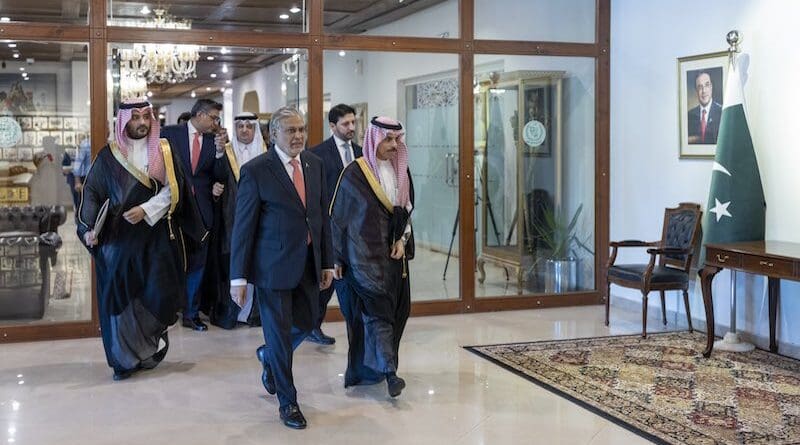
The agreements, valued at $2.2 billion, span vital industries including agriculture, health, energy, information technology (IT), and petroleum, signaling the beginning of a new phase in bilateral relations. This event, hailed as a reflection of Saudi Crown Prince Mohammed bin Salman’s (MBS) vision for greater regional cooperation, was conducted during a high-profile visit by the Saudi delegation, led by Minister for Investment Sheikh Khalid Bin Abdul Aziz Al Faleh.
Prime Minister Shehbaz Sharif, alongside Chief of Army Staff (COAS) General Asim Munir, received the delegation in Islamabad during their three-day visit. The MoUs were not just agreements on paper, but signaled a genuine intention to turn these commitments into full-scale collaborations across diverse sectors. The sectors targeted, ranging from mining and food to IT and education, align with both Pakistan’s and Saudi Arabia’s ambitions for economic diversification and sustainability.
In his address during the MoU ceremony, Prime Minister Shehbaz Sharif hailed the visit as a manifestation of the “great sincerity and affection” shared between Pakistan and Saudi Arabia, especially from the leadership of Saudi Crown Prince Mohammed bin Salman. The Prime Minister expressed his government’s unwavering commitment to executing these MoUs without any unnecessary delays or bureaucratic red tape, ensuring the deals turn into practical, actionable results that benefit both nations. The assurance to transform MoUs into real economic opportunities was also echoed by COAS General Asim Munir, who assured the Saudi delegation of Pakistan’s full commitment to fast-tracking all business and investment operations.
Sharif also used the opportunity to highlight recent improvements in Pakistan’s economic outlook, bolstered by the country’s recent International Monetary Fund (IMF) agreement. Inflation has fallen from 32% to 6.9%, policy rates have decreased from 23% to 17.5%, and exports are witnessing steady growth. The Premier attributed much of this progress to the strategic support received from Saudi Arabia, particularly in securing the IMF programme. This strategic alignment was a major theme during the talks, with both parties keen to leverage each other’s strengths to achieve mutually beneficial outcomes.
Saudi Minister for Investment Sheikh Khalid Al Faleh echoed these sentiments, stating that the agreements were just the beginning of limitless possibilities for Pakistan-Saudi Arabia economic cooperation. He noted that the potential for joint ventures in key sectors, including mining, renewable energy, and IT, is immense. This relationship, he said, is driven by Saudi Arabia’s Vision 2030, which aims to diversify the Kingdom’s economy away from oil dependency by investing in sectors such as technology, infrastructure, and energy—areas where Pakistan can offer strong partnership.
Al Faleh also appreciated Pakistan’s recent strides in economic reform, applauding the efforts made over the last two years, which he termed as “quite impressive.” He pointed to Pakistan’s strategic geographic location and the scope for expansion of Saudi investments into Central Asia through Pakistan’s Arabian Sea connectivity.
In a significant gesture, COAS Munir assured the Saudi delegation that all bureaucratic hurdles, often referred to as “red tape,” would be replaced with “red carpet” treatment for Saudi investors. This includes a streamlined process under the Special Investment Facilitation Council (SIFC), a body created to ease foreign investment flows into Pakistan. These efforts aim to make Pakistan a hub for international investments, facilitating foreign ventures with more speed and efficiency than before.
The signing of these MoUs also serves as a testament to Saudi Arabia’s recognition of Pakistan’s potential in becoming an economic hub in South Asia. The two countries already enjoy robust bilateral trade, which has grown from $3 billion in 2019 to $5.4 billion in 2024—a staggering 80% increase. Al Faleh emphasized that the $2.2 billion package is just the “tip of the iceberg,” signaling that more investments could follow if the current agreements prove successful.
In conclusion, the strategic partnership between Pakistan and Saudi Arabia has entered a new chapter, underpinned by shared economic ambitions, mutual respect, and strategic cooperation. The $2.2 billion in MoUs signed is not just a number; it represents the potential for far-reaching economic transformations for both nations. The Saudi delegation’s visit serves as a reminder that with the right partnerships, Pakistan can position itself as a pivotal player in the regional and global economic arena, while Saudi Arabia can strengthen its footprint beyond oil in the emerging economies of South Asia.

Like what you read?
Please consider supporting Eurasia Review. Thank you for your consideration!
