
Why Control Is No Longer The Only Way To Shape Chokepoints – OpEd
Access, Not Occupation: Rethinking Power at Maritime Chokepoints
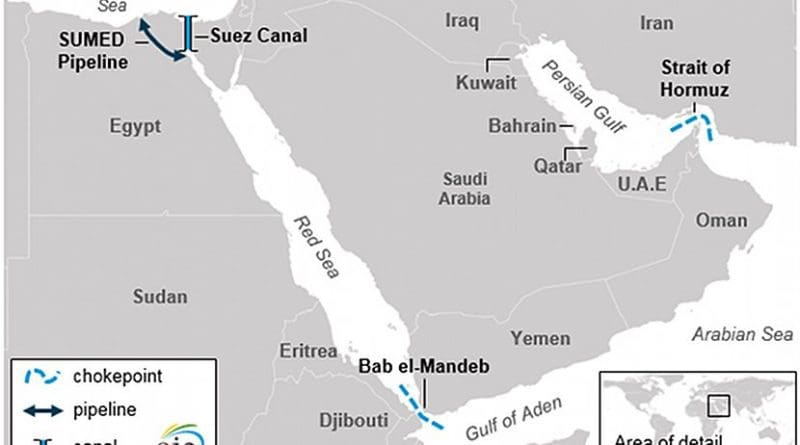
Strategic chokepoints are often discussed in terms of control and closure. Yet recent maritime behavior suggests a subtler shift is underway: waterways can remain open while access becomes uneven. India’s actions in the Bab-el-Mandeb–Aden corridor illustrate how chokepoints are increasingly shaped through differentiated access rather than territorial dominance.
In the Bab-el-Mandeb–Aden corridor, India did not hold the chokepoint or operate under a unified command, yet it was able to sustain viable flows for partners while others rerouted, producing differentiated access in formally open waters. No passage was declared closed, no territorial authority changed hands, and freedom of navigation formally remained intact. Yet behaviour at the chokepoint shifted: some vessels continued transit with relative confidence, while others diverted or delayed. The waterway stayed open, but it did not function evenly.
What is evolving is how chokepoints are being shaped in practice.
Geopolitics still tends to equate chokepoint power with patrols, bases, and command authority. But these measures alone no longer explain why access now diverges without any change in territorial control. In this case, India did not try to dominate the waterway. Instead, it relied on selective deployments and predictable response, drawing on shared maritime awareness to intervene where risk was highest. This made it possible to protect some traffic without declaring exclusive zones or maintaining permanent presence.
The result was not control of the chokepoint, but reliability of access. Vessels that could reasonably expect timely response continued transit under stress, while others rerouted in anticipation of higher risk. The chokepoint did not close; it differentiated.
This distinction matters because control alone cannot explain outcomes where no space is owned yet behaviour shifts. Chokepoints have traditionally been treated as sites to be held or denied. Increasingly, however, they are becoming spaces where access is filtered rather than blocked. Power manifests not through exclusion, but through shaping which actors can continue to operate when conditions deteriorate.
At work here is a mechanism of predictability rather than occupation. Selective deployment allows a state to signal availability without declaring exclusivity. Consistent response reduces uncertainty for some actors while leaving others exposed to ambient risk. Over time, this produces behavioural sorting: shipping decisions adjust not to who controls the waterway, but to who can be relied upon when disruption occurs.
This pattern is not confined to the Bab-el-Mandeb. Similar dynamics are visible at other strategic passages. In the Malacca Strait, routing and risk assessments already differentiate between vessels based on escort availability and response assurance rather than geography alone. In the Strait of Hormuz, shipping behaviour often adjusts less to formal control than to expectations of protection, retaliation, or tolerable delay. Across chokepoints, access is being shaped without overt occupation.
The significance of this evolution lies in how maritime power is exercised. As traffic density increases, threats become more asymmetric, and the political costs of overt control rise, shaping access becomes as consequential as holding space. Influence increasingly operates through reliability rather than dominance, and through differentiation rather than denial.
India’s role in this shift is illustrative rather than exceptional. It is not attempting to replace existing maritime powers or assert exclusive authority. Instead, it demonstrates how a state can affect chokepoint outcomes by remaining operationally present without becoming territorially committed. This posture allows influence to scale without escalation and engagement to persist without ownership.
As chokepoints become sites of continual friction rather than decisive confrontation, power is exercised less through occupation and more through the quiet governance of access. The waterway stays open—but not for everyone in the same way.

Like what you read?
Please consider supporting Eurasia Review. Thank you for your consideration!
