
Kharan Siege Marks A Dangerous Phase Of BLF Operations – OpEd
Balochistan emerged in 2025 as Pakistan’s most volatile internal security frontier, and the January 15 attack in Kharan city underscores a worrying new phase in the province’s insurgency. While militant activity has risen nationwide, Balochistan’s trajectory is distinct: attacks are sustained, geographically wider, increasingly coordinated, and target not just remote outposts but also urban and semi-urban centers. The Kharan operation, claimed by the Balochistan Liberation Front (BLF), highlights both the tactical evolution of the organization and the growing gap between official accounts and local realities.
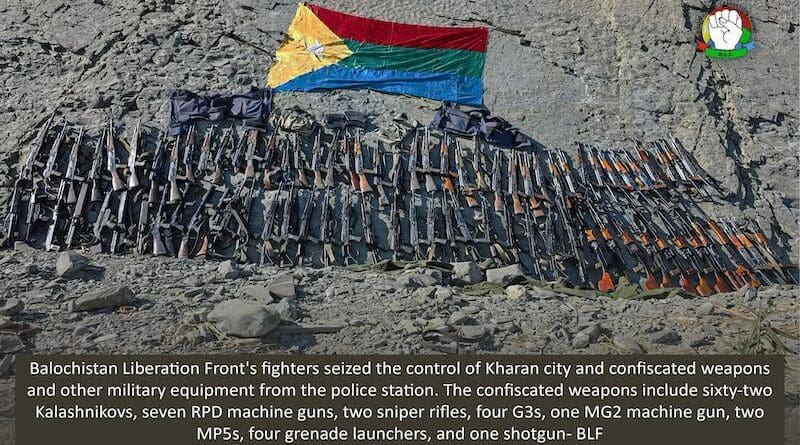
According to the BLF, its fighters entered Kharan city around 2:30 pm, quickly establishing control over key points in the city for nearly nine hours. The organization claimed to have seized the city police station, capturing officials, confiscating weapons and military equipment, and freeing dozens of detainees. Another BLF unit reportedly moved into Kharan’s central bazaar, targeting the National Bank, Meezan Bank, Habib Bank, and other government financial infrastructure. According to the BLF, a bank security guard was killed while resisting the attack, and members of local death squads were wounded in the clashes.
To protect their operation and fighters, the BLF said its “Qurban Unit” was stationed at the Red Zone in Kharan, where it ambushed a military convoy, killing 15 soldiers and destroying all three armored vehicles. When another force attempted to recover the bodies, a three-hour firefight ensued, leaving 27 additional Pakistani soldiers dead and many wounded, with two more armored vehicles destroyed. Later in the evening, in the Kulan area of Kharan, a large military convoy including SSG commandos was attacked by another BLF team, resulting in three armored vehicles destroyed and dozens of troops killed or wounded, including eight SSG commandos.
Another BLF unit, the “Sniper Tactical Squad,” targeted advancing forces, reportedly killing a military sniper and downing eight drones. The fighters successfully withdrew after nine hours of controlling the city, sustaining four casualties, three of which resulted from follow-up drone and air strikes. Senior Military officers, including Colonel Wadan and Major Asim, were among the wounded. Overall, the BLF claimed that more than 50 Pakistani security personnel were killed, including Naib Subedar Shafqat, a figure that stands in stark contrast to the state’s official reports.
Official accounts, however, framed the events differently. Pakistan’s ISPR described the incident as a terrorist attempt to loot banks, asserting that 12 militants were killed and that security forces successfully prevented a hostage situation at the police station. Chief Minister Mir Sarfraz Bugti confirmed this account, emphasizing that the attackers intended to steal money from public banks and that swift security action neutralized the threat. While he confirmed injuries to Colonel Wadan and Major Asim, no casualties among Pakistani security personnel were reported.
Independent reporting and eyewitness accounts paint a more complex picture. BBC Urdu and local sources confirmed that dozens of armed men entered the city on motorcycles and vehicles, attacked police stations and banks, and fired across multiple neighborhoods. Residents reported heavy aerial activity and troop movements, prolonged gunfire, and a curfew-like environment as authorities sealed markets and restricted movement. Local accounts also describe the population expressing visible excitement and support for the BLF fighters during the city’s nine-hour takeover, highlighting a sharp contrast with the official narrative.
The strategic significance of Kharan extends beyond casualties or destruction. Located roughly 270–300 kilometers west of Quetta and near the Iran–Pakistan border, Kharan serves as a regional hub for administration and security installations. While Baloch armed organizations have historically operated in mountainous peripheries, sustained operations inside an urban center like Kharan, particularly those targeting police and military installations, represent both a symbolic and operational escalation. The attack signals the BLF’s growing capacity to challenge the state in high-profile, high-visibility environments.
Kharan also fits into a broader pattern of BLF escalation. In its 2025 annual report, the BLF claimed responsibility for 581 armed operations across Balochistan, resulting in 929 casualties among Pakistani security forces and allied networks, including 647 deaths. The group lost 42 fighters, including six fidayeen (self-sacrificers) in the November Nokundi operation, which targeted the Frontier Corps brigade headquarters in Chagai District.
That 36-hour assault in Nokundi marked the BLF’s first use of self-sacrificing tactics, targeting high-security compounds linked to major economic projects such as the Reko Diq and Saindak mining sites. The operation involved female fidayee and underscored the BLF’s willingness to absorb losses for both symbolic and strategic impact. Together, the Nokundi and Kharan operations illustrate a shift toward urban engagement, prolonged confrontations, and coordinated multi-unit attacks, which represents a more sophisticated approach than BLF’S previous armed activities.
The BLF, being the largest armed Baloch organization with the widest manpower base, asserts that its campaign is a fight against Pakistan’s “illegal occupation” of Balochistan. Its statements suggest that 2026 is being positioned as a new operational phase, with the early month marking intensified activity. Analysts note that the organization is not merely escalating its attacks but is also consolidating its political and military relevance, demonstrating its continued centrality within Balochistan’s armed movement.
For the Pakistani state, the Kharan attack exposes critical vulnerabilities. Official narratives that reduce a nine-hour urban operation to a simple “bank robbery” fail to match local perceptions and eyewitness accounts. Across Balochistan, many see such operations as a demonstration of Baloch armed organization’s capability, while state responses, including lockdowns, cordon-and-search operations, market closures, and reports of enforced disappearances, often deepen grievances. This disconnect between official accounts and on-the-ground realities risks further alienating communities and entrenching cycles of violence.
Although Pakistan retains overwhelming military resources, the Kharan attack shows that the BLF is adapting, accelerating, and significantly expanding its operational reach. The organization has demonstrated the ability to seize urban centers and engage multiple high-value targets simultaneously. Its tactical skill, coordination, and visibility on the ground suggest that similar high-impact operations are likely in the coming months, marking a lethal phase of sustained armed activity in Balochistan.
As 2026 unfolds, Pakistan faces a stark choice: continue relying primarily on kinetic responses and official messaging, or address the deeper political, social, and economic grievances that fuel the insurgency. Without tackling these underlying issues, Kharan attack may prove less a one-off event and more a harbinger of a more intense, entrenched phase of conflict in Balochistan.

Like what you read?
Please consider supporting Eurasia Review. Thank you for your consideration!
