
Modi At 75: The Statesman, The Swayamsevak, And The Question Of Succession – OpEd
On his 75th birthday, Narendra Modi is celebrated by millions not only as a Prime Minister but as a phenomenon: a man who rose from the ranks of the swayamsevaks to become the architect of India’s modern resurgence. Streets have echoed with his name, temples have offered special prayers, and citizens across the country have marked the day as if it were a festival. For many, he is not merely a leader but an embodiment of India’s civilisational confidence. Yet, even as his admirers lionise him, whispers of transition and succession refuse to die down.
As someone who has tracked Indian politics for more than three decades, I have seen few leaders who could command such devotion at home and such attention abroad. On this day, when millions are celebrating him, I too have watched the phenomenon with a mixture of journalistic scrutiny and personal awe. Modi is not merely observed — he is felt, in the chants, in the banners, in the sheer emotion that his presence evokes across the country.
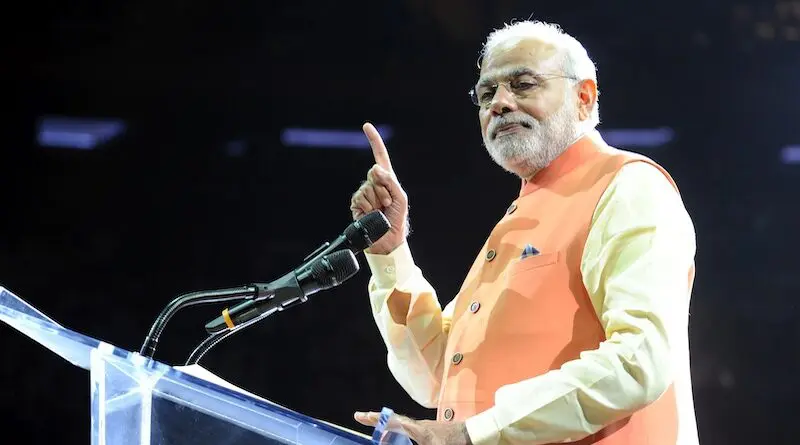
Modi became more than a politician — he became a brand unto himself: from his signature kurtas and jackets, to the youth imitating his swept-back hair and silver-white beard, to the dazzling array of colourful, exotic Indian attire that turned him into a walking emblem of civilisational pride.
A leader of striking presence — charming and handsome — Modi today commands a nation of nearly 1.4 billion souls, a country once dismissed as impoverished but now resurgent, striding with renewed confidence on the global stage.
A Journey Without Precedent
Narendra Modi’s rise is a saga that defies precedent. From his modest beginnings as a swayamsevak in the Rashtriya Swayamsevak Sangh, he became the first Prime Minister since Nehru to secure a third consecutive term in office. He is not a dynast, not an inheritor, but a man who forged his ascent through sheer tenacity and political acumen.
Across these eleven years, Modi has transformed the grammar of Indian politics. He has married Hindu civilisational nationalism with the language of modern governance, made infrastructure a theatre of mass politics, and carried India’s voice from Davos to Washington as a confident global power. From roads to temples, from digital payments to diplomatic breakthroughs, the Modi imprint is indelible.
The “Rule of 75”: Modi’s Own Doctrine
There was never an RSS or BJP norm about retiring at 75. That principle was Modi’s own innovation. In 2014, fresh from his overwhelming mandate, he moved swiftly to clear space for his leadership. Stalwarts like L. K. Advani and Murli Manohar Joshi — both RSS hardliners of unimpeachable loyalty — were pushed into the newly-created Margdarshak Mandal, a council of mentors. In reality, it was a gilded cage. Power had shifted irrevocably from the old guard to Modi and his man Friday Amit Shah.
It was Modi, not the RSS, who institutionalised the “75” principle as a line of generational change. He used it to sideline those who had once been mentors to him. Now, the irony: the same principle is being invoked in whispers about him.
The RSS Factor: From Distance to Embrace
For much of his first two terms, Modi kept a calculated distance from the Sangh’s shadow. He had the numbers, he had the charisma, he had the state machinery. The RSS, though the ideological parent, was kept respectfully at arm’s length.
But in his third term, the balance has shifted. In 2024, the BJP lost its solitary majority, dropping from the commanding 303 seats of 2019 to 240. Power had to be stitched with allies — Nitish Kumar (Bihar), Chandrababu Naidu (Andhra Pradesh), and others. For the first time since 2014, Modi was no longer the unchallenged sovereign.
On 15 August 2025, from the ramparts of the Red Fort, he did something he had studiously avoided for eleven years: he praised the RSS in his Independence Day address. He called it the “world’s largest NGO” and saluted its century of service. This, coupled with his first visit in over a decade to the RSS headquarters in Nagpur, signalled not just courtesy but necessity.
Murmurs of Succession
-For the Prime Ministerial succession, the field is even more charged. Alongside Road and Transport Minister Nitin Gadkari, long admired for his delivery record and technocratic credibility, stand other formidable figures: Home Minister Amit Shah, Modi’s closest lieutenant and strategist-in-chief; Defence Minister Rajnath Singh, respected for his experience and acceptability across factions; and Uttar Pradesh Chief Minister Yogi Adityanath, adored by grassroots cadres though less embraced abroad.
For the BJP presidency, sources in the BJP and RSS understand that senior leadership who have experience and are loyalists with wide mass appeal must be considered. Among the names in circulation are Shivraj Singh Chouhan, the seasoned former Madhya Pradesh Chief Minister; Sanjay Joshi, the old organisational hand and once Modi’s rival in Gujarat; and Vasundhara Raje, the former Rajasthan Chief Minister with deep mass appeal. Each brings a distinctive political legacy, and their possible elevation reflects the Sangh’s desire to broaden the party’s centre of gravity beyond Modi’s chosen circle
These names are not idle gossip but the architecture of a transition narrative — one where the RSS seeks to remind Modi that its reservoir of leadership extends beyond any single individual.
Modi at His Zenith, Facing the Future
Why, then, do whispers of quitting persist? The answer lies not in weakness but in strategy.
A leader who rose by enforcing the “75” rule may prefer to bow out on his own terms rather than be gradually edged out. Stepping aside at his zenith could enshrine him as the leader who knew when to let go, sparing himself the humiliation of slow marginalisation. By leaving at the peak, he would define the succession rather than suffer it.
The Celebrations — and the Crossroads
On his 75th birthday, India erupted in jubilation. From the sanctity of temples where special aartis were sung, to city streets festooned with banners, to party offices resounding with chants, the day took on the fervour of a national festival. It was not merely a celebration of a man, but of an idea — the idea of a resurgent Bharat that Modi has come to symbolise.
Global Leaders Extend Greetings
Modi’s 75th birthday was not only a domestic celebration but a moment acknowledged across the globe. From US President Donald Trump extending his personal congratulations, to Pope Leo XIV offering a special blessing for Modi’s health and long life, the tributes poured in. Messages also came from world leaders in Europe, Asia, and Africa — a testament to the stature he has carved as a global statesman. For his admirers, such greetings underscore that Modi is not merely an Indian leader but a figure whose influence reverberates internationally.
Conclusion : The Tribute & The Test
At seventy-five, Narendra Modi is both swayamsevak and statesman; both king and, perhaps, king-maker. His story is already etched into the annals of India. The question is no longer what he has achieved — it is what he chooses to do next.
If he bows out, it will not be as a man defeated but as one who shaped his own departure. If he stays, it will be as a leader tested by coalition constraints, internal murmurs, and the inexorable march of time.
For now, let us salute him: the man who reformed India, the leader who made Bharat speak with unflinching confidence, the Prime Minister who carried Ma Bharati’s soul onto the world stage.
Happy 75th, Narendra Modi ji. The final act of your political journey may yet be the most decisive of all.

Like what you read?
Please consider supporting Eurasia Review. Thank you for your consideration!
