
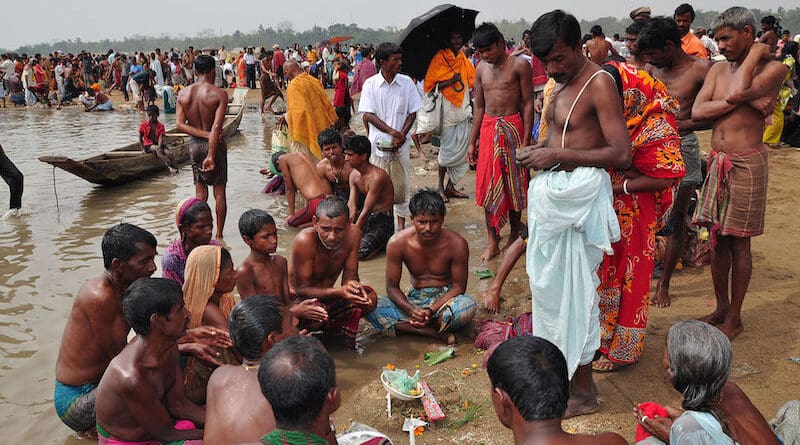
Beyond Borders: The Global Implications Of Religious Persecution In Bangladesh – OpEd
In the heart of South Asia, Bangladesh is quietly unravelling under the weight of sectarian violence, political decay, and rising geopolitical intrigues. For its beleaguered Hindu minority, the nation’s escalating turmoil has become synonymous with persecution: temples desecrated, women brutalized, and communities driven to despair.
The recent arrest and denial of bail to revered Hindu spiritual leader Krishna Chandra Das, followed by violent attacks on his advocates, has become more than a grim episode—it is a microcosm of Bangladesh’s alarming descent into chaos under President Mohammad Yunus.
Yet, as this unfolds, the silence from India, the United States, and global bodies like the United Nations remains deafening. The deliberate indifference of these global actors suggests either a myopic geopolitical calculation or a tacit complicity that emboldens extremist forces. Meanwhile, as Hindu deities are desecrated and minorities lynched with impunity, a greater storm is brewing: a dangerous alliance of China, Pakistan, and Bangladesh, allegedly poised to provoke India into a limited-time war.
The situation cannot be viewed in isolation. It is not merely a humanitarian crisis—it is an accelerant of a larger, more dangerous geopolitical design.
Bangladesh: A Nation Under Siege
The repression of Hindu minorities in Bangladesh is not a new phenomenon, but its current manifestations are particularly egregious. Krishna Chandra Das, a prominent Hindu spiritual leader, was arrested on charges widely viewed as fabricated. His detention—denying him bail and unleashing mob violence against his legal defenders—signals a broader cultural purge under Yunus’s administration. With the rise of Jamaat-e-Islami and its ideological partner, the BNP, Bangladesh’s political culture has surrendered to extremist forces.
Religious intolerance has become both a weapon and a distraction. The desecration of Hindu temples, the lynching of devotees, and the systematic violence against Hindu women expose a targeted effort to erase Bangladesh’s religious plurality. These acts are not spontaneous outbursts of mob fury—they are orchestrated provocations aimed at terrorizing a community into submission while signalling the state’s ideological alignment with Islamist extremism.
For President Yunus, a leader whose legitimacy remains contested, appeasing these radical forces appears to be part of his survival strategy. The delay in holding elections until the end of 2025, as announced, is not just a bureaucratic timeline—it is a calculated move to consolidate power while weakening opposition forces and silencing dissent.
India’s Mystifying Silence: Strategic Patience or Eerie Complacency?
India, as the region’s dominant power and natural defender of Hindu interests, has maintained an unsettling silence. For a nation that considers itself the protector of its diasporic communities and a pillar of regional stability, its response to Bangladesh’s Hindu persecution is both confounding and disquieting.
The silence raises questions. Is New Delhi’s strategic patience a signal of behind-the-scenes diplomacy, or is it a calculated avoidance of confrontation for fear of geopolitical backlash? The alleged provocations—that Bangladesh, with support from its allies, could seize India’s strategically vital “chicken neck” corridor, splitting the nation into two—are too serious to dismiss as mere bluster. The Siliguri Corridor, India’s vulnerable strip of land connecting the northeast to the rest of the country, has long been eyed as a weak point in India’s territorial integrity. If such a claim even partially holds water, India has legitimate cause for concern.
Furthermore, Bangladesh’s aggression seems emboldened by China’s silent backing. Beijing’s well-documented interests in South Asia, from its Belt and Road Initiative to its alliances with Pakistan and Myanmar, form a triangular nexus that aims to contain India. The Yunus regime’s calculated provocations—both cultural and geopolitical—may be part of a larger playbook orchestrated with China in the background.
The Geopolitical Triangle: China, Pakistan, and Bangladesh
The convergence of China, Pakistan, and Bangladesh in their posture towards India cannot be ignored. Pakistan’s long-standing hostility toward its eastern neighbour and its tacit alignment with Islamist forces makes it a natural ally to Bangladesh’s ruling regime. China, meanwhile, has emerged as the shadow actor in this equation. With its economic and strategic foothold in Bangladesh, Beijing has quietly deepened its influence in Dhaka, ensuring that Bangladesh remains both indebted and beholden to its interests.
If China’s support enables Bangladesh to take a more provocative stance toward India, it also serves a dual purpose: it opens another front for India to defend while complicating its partnerships with Russia and other allies. There are allegations, albeit speculative, that Bangladesh could be leveraged as a proxy to challenge Indian sovereignty, destabilizing its domestic and regional focus. The triangle’s unspoken objective is not just containment—it is the gradual fracturing of India’s geopolitical ambitions.
In this context, President Yunus’s rise to power warrants scrutiny. The circumstances surrounding Yunus’s ascension—his sudden return from the United States and his swift installation as head of state—raise uncomfortable questions about Washington’s role in this unfolding drama. Is Yunus’s presidency an independent development, or is it part of a broader Western strategy to destabilize South Asia and disrupt India’s deepening ties with Russia?
The United States and UN: Complicity in Silence
The United States and international bodies like the UN have been conspicuously silent on Bangladesh’s human rights violations. The violence against Hindus—the lynchings, the assaults on women, the destruction of temples—has elicited little more than muted statements. This is not a failure of awareness; it is a conscious geopolitical calculus.
For Washington, Bangladesh represents a strategic foothold in South Asia, a buffer against China’s influence and a counterweight to India’s rising assertiveness. By maintaining a pliant regime in Dhaka, the United States secures its influence in the region, even if that comes at the cost of Bangladesh’s secularism and minority rights. The mystic silence surrounding Krishna Chandra Das’s imprisonment and the unchecked mob violence reveals a troubling hypocrisy: human rights are championed when convenient but ignored when they conflict with geopolitical interests.
The United Nations, for its part, has become a spectator to the slow disintegration of Bangladesh’s pluralism. Its inability to intervene—beyond perfunctory condemnations—reinforces the perception that international bodies are powerless in the face of political realities shaped by great powers.
Human Rights and the Global Indifference
The persecution of Hindus in Bangladesh must also be viewed as a gross violation of human rights. Beyond the immediate acts of violence, the systemic suppression of a minority group reflects a failure of Bangladesh to adhere to international conventions. The lack of judicial recourse for victims, the targeting of women and children, and the destruction of cultural symbols are violations of basic human dignity and international law.
Global actors have a moral and legal obligation to respond to these atrocities. However, their silence speaks volumes. While countries like the United States and China are preoccupied with their strategic interests, the international human rights framework is being undermined. Without accountability, the message to authoritarian regimes worldwide is clear: human rights abuses will be tolerated if they align with global power dynamics.
Cultural Devolution and the Decline of Secularism
At the heart of Bangladesh’s turmoil is the erosion of its secular identity. The country that fought for independence in 1971 on the ideals of Bengali nationalism—a nationalism that transcended religious divisions—has now succumbed to the forces of sectarianism. Jamaat-e-Islami, once marginalized, has returned as a potent ideological force, dictating the state’s cultural and political trajectory.
For Bangladesh’s Hindu minority, this cultural devolution is existential. The attacks on their temples and the assault on their women are not random acts; they are symbolic erasures of a history and heritage that challenge the majoritarian narrative. The Yunus regime’s failure—or refusal—to protect its minorities reflects a broader moral collapse within the state apparatus.
A Fragile Future: The Road Ahead
The future of Bangladesh is precariously balanced on the edge of sectarian strife and geopolitical gamesmanship. For India, the provocations from Bangladesh and the looming threat of territorial aggression demand a decisive response. Strategic silence may no longer be a viable option when the nation’s sovereignty and regional stability are at stake.
Equally, the international community—particularly the United States—must confront its role in enabling Bangladesh’s descent. If Yunus’s regime continues its trajectory unchecked, Bangladesh risks becoming not only a failed state but a geopolitical flashpoint. The silence of giants like India and the US, and the passivity of global institutions, may one day be viewed as complicity in a tragedy foretold.
Bangladesh’s Hindu persecution is more than a domestic crisis; it is a bellwether of South Asia’s future. If the world continues to look away, the cost will be borne not just by the Hindus of Bangladesh but by an entire region caught in the crossfire of extremism and power politics.

Like what you read?
Please consider supporting Eurasia Review. Thank you for your consideration!

Dear Debashis Chakrabarti,
Thank you for your interesting article.
It would be very helpful if you provided us with details on dates, locations and number of casualties related to the “violence against Hindus—the lynchings, the assaults on women, the destruction of temples” that you refer to.
Greetings,
Dirk
I have not yet seen any of the facts and figures I requested from Mr Debashis Chakrabarti.
What I did find today is this article in the New York Times. In summary, the article states “Hindu residents confirmed episodes of vandalism and mob violence, particularly after the arrest of a Hindu monk in November and the death of a Muslim lawyer during a protest by the monk’s supporters. But they also said that the cases of forged or exaggerated information had muddied the real threat to them.”
For the whole article see https://www.nytimes.com/2024/12/24/world/asia/bangladesh-hindus.html?unlocked_article_code=1.j04.brUP.agUKsL-i_X6o&smid=url-share