
Kolams Of Resistance: Tamil Nadu’s Artistic Protest Against Linguistic Homogenisation – OpEd
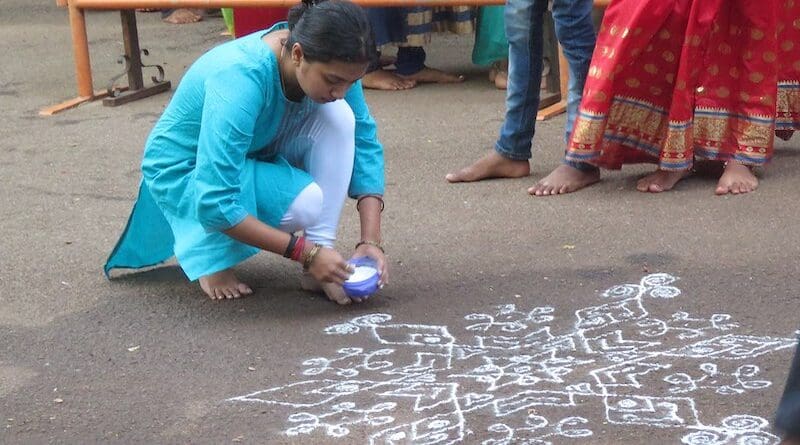
In the quiet streets of Ayapakkam Housing Board, Tiruvallur District, Tamil Nadu, a vibrant form of dissent recently unfolded. Residents transformed their thresholds into political statements, crafting kolams—traditional rice flour rangoli—inscribed with messages like “Welcome Tamil Language” and “Stop Hindi Imposition.”
This protest, organised by the INDIA bloc parties, including the DMK and its allies, is not merely a local act of defiance but a microcosm of Tamil Nadu’s decades-long struggle to preserve its linguistic identity. The protest, following Deputy Chief Minister Udhayanidhi Stalin’s warning that Hindi threatens Tamil, underscores a persistent tension in India’s linguistic federalism.
This article critically examines the historical roots of such protests, the political motivations behind them, and the broader implications for India’s multicultural fabric.
Tamil Nadu’s resistance to Hindi imposition dates to the 1930s, culminating in the violent 1965 anti-Hindi agitations that forced the Central government to retain English as an official language.
The Dravidian movement, spearheaded by parties like the DMK, framed Hindi as a tool of North Indian hegemony, arguing that its imposition marginalised Tamil speakers in education, employment, and governance.
Today’s protests, though non-violent, revive this historical narrative. The kolam, a daily ritual symbolising prosperity, now doubles as a medium of dissent, blending cultural pride with political messaging. This duality reflects Tamil Nadu’s unique strategy of embedding resistance within tradition, ensuring accessibility and emotional resonance.
Kolams, typically ephemeral designs welcoming deities and guests, were repurposed to challenge the Central government’s language policies. This choice is strategic. Unlike rallies or strikes, kolams are non-confrontational yet highly visible, leveraging domestic spaces for public discourse. They symbolise grassroots participation, as households—often women—voice collective dissent.
However, critics argue that such protests risk reducing complex policy debates to slogans. Phrases like “Stop Hindi Imposition” simplify nuanced issues: What constitutes “imposition”? Is the state conflating promotion with enforcement? The protest’s artistic form, while powerful, may lack the nuance needed to address these questions.
The protest’s organisation by the INDIA bloc—a coalition including the DMK, Left parties, and regional groups—reveals its political dimensions. The DMK, inheritor of the Dravidian movement, has long weaponised linguistic identity to consolidate power.
Udhayanidhi Stalin’s recent remarks framing Hindi as an existential threat to Tamil mirror this legacy. While such rhetoric energies the base, it also risks alienating non-Tamil speakers and fostering linguistic paranoia. The bloc’s involvement raises questions: Is this a genuine defence of Tamil, or a calculated move to counter the BJP’s nationalist narrative? Conversely, could such protests inadvertently reinforce the BJP’s portrayal of southern states as “anti-national”?
The term “Hindi imposition” refers to policies perceived as prioritising Hindi over regional languages. Recent flashpoints include the National Education Policy (NEP) 2020, which advocates a three-language formula, and the Central government’s preference for Hindi in social media communication and official events.
Tamil Nadu, which follows a two-language (Tamil and English) policy, views this as coercive. However, the Central government denies enforcement, emphasising Hindi’s role as a “link language.”
Critics of the protest argue that Tamil faces no realistic threat—Tamil Nadu’s educational institutions and administration remain Tamil-dominated, and the state’s economic clout ensures its linguistic relevance. They contend that the DMK exaggerates the issue to deflect from governance failures.
Proponents of Hindi argue that it offers economic opportunities and national integration. Yet, Tamil Nadu’s resistance highlights a valid concern: India’s linguistic federalism hinges on voluntary multilingualism, not top-down homogenisation.
States like Kerala and Karnataka teach Hindi without backlash, but Tamil Nadu’s historical trauma—rooted in colonial-era linguistic hierarchies—makes it uniquely sensitive. The protest’s message, “Welcome Tamil Language,” seeks not isolation but equality, demanding that the Centre recognise Tamil as a classical language and a pillar of India’s diversity.
The Ayapakkam protest transcends Tamil Nadu, touching on India’s struggle to balance unity and diversity. The Constitution designates 22 official languages, yet Hindi dominates Parliament, bureaucracy, and popular culture.
The protest challenges this asymmetry, advocating for a pluralistic model where regional languages thrive alongside Hindi and English. However, the risk lies in conflating resistance with exclusion. Tamil Nadu’s stance, while protective, must avoid mirroring the majoritarianism it opposes.
The kolam protest is a poetic assertion of Tamil identity, but lasting solutions require dialogue. The Centre must address perceptions of imposition through inclusive policies, perhaps expanding the official language roster or decentralising cultural governance.
Simultaneously, Tamil Nadu’s leaders must move beyond symbolic gestures, investing in Tamil’s modernisation and global reach.
India’s strength lies in its diversity; preserving it demands recognising that no single language—whether Hindi, Tamil, or English—can encapsulate the nation’s soul. As the kolams of Ayapakkam fade, they leave behind a question: Can India craft a linguistic harmony that respects all voices? The answer will define its democratic ethos.

Like what you read?
Please consider supporting Eurasia Review. Thank you for your consideration!
