
COP29 Summit And Pakistan’s Serious Climate Change Woes – OpEd
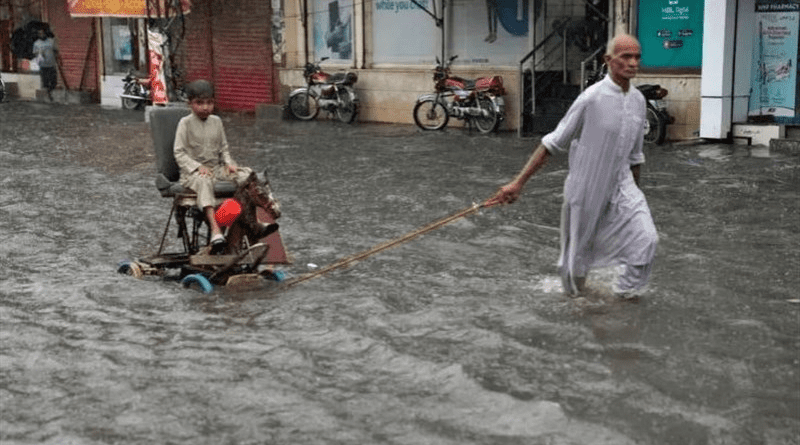
The adverse effects of Climatic Change are well recognized and visible all over the globe. In Pakistan, severity of these adverse effects (heat wave, rains and floods, drought etc) caused by global warming, deforestation, urbanization and host of other contributors; has posed serious challenges for an economically struggling country.
In this retrospect, the Pakistani Prime Minister put across his country’s case at the COP29 summit, highlighting climate change challenges faced by Pakistan and the country’s efforts to handle the environmental issues. He further stressed upon the establishment of a new ‘damage and loss fund’ for the vulnerable countries as was announced in COP27 in 2022. (1)
Despite being a negligible contributor to global warming (0.9 %), (2) the costs of climate change faced by Pakistan are substantial and continuously increasing. Pakistan is among the ten most vulnerable countries to climate change. (3) Due to climate change, Pakistan’s annual economic loss is assessed at $26 billion (9.1% of GDP), as per UN-ESCAP Report–2022. (4) Pakistan faced devastating floods which huge material and economic losses in 2022.
As per the World Bank assessment, the total economic cost faced by Pakistan amounted to a whopping $15.2 billion. (5) In the aftermath of 2022 floods, an International Conference on Climate Resilient Pakistan, co-hosted by Pakistan and UNDP in Geneva on 9 January 2023, the international donors pledged around $10 billion for flood damages. However, very less of those pledges have been materialized. The same was lamented by Pakistan’s Prime Minister at COP29. He further emphasized that “make this understanding loud and clear that we will have to fulfil those financial pledges”, (6) while referring to the commitments made at COP27 and COP28.
The Pakistani government has taken several steps in line with the Paris accord to tackle the climate change issue and mitigate the risks. These steps include the ‘Nationally determined contribution (PAK-NDC)’, the ‘National Adaptation Plan’ and several other initiatives like Ten Billion Tree Tsunami Programme (TBTTP), Protected Areas Initiative, Billion Tree Honey Initiative, Reversing Deforestation and Forest Degradation, etc. However, its true implementation can only materialize through consistent global support in terms enhancing climate change awareness, scientific research development, technology provision and financial assistance.
Climate Change with its devastating effects make the people of Pakistan extremely vulnerable. To tackle this menace and mitigate the risks to people, a holistic domestic effort and requisite assistance by the global community is urgently needed. This assumes much importance when the crisis is not of its own making being a negligible contributor to global warming and climate change.
Endnotes:
- https://unfccc.int/news/cop27-reaches-breakthrough-agreement-on-new-loss-and-damage-fund-for-vulnerable-countries
- https://unfccc.int/sites/default/files/NDC/2022-06/Pakistan%20Updated%20NDC%202021.pdf
- https://www.germanwatch.org/en/19777
- https://www.dawn.com/news/1697439
- https://www.worldbank.org/en/news/press-release/2022/10/28/pakistan-flood-damages-and-economic-losses-over-usd-30-billion-and-reconstruction-needs-over-usd-16-billion-new-assessme
- https://www.dawn.com/news/1872112/pm-shehbaz-presents-pakistans-case-at-cop29

Like what you read?
Please consider supporting Eurasia Review. Thank you for your consideration!
