
UN Chief Guterres Changes Goalposts In Bangladesh – OpEd
“I want to reaffirm my support for all journalists who fight to inform the public. Shedding light on the truth is an essential combat. There is no democracy without press freedom.”, are the words asserted by UN secretary general António Guterres during his visit to headquarters of Reporters Without Borders (RSF) in February. These words are reassuring for any journalist, leading one to consider the UN chief as being open and conducive to ensure flow of information for the sake of accountability.1
But it took less than a month for the UN supremo himself to flaunt his tall claims and commitments on ensuring journalists the freedom to ask questions as he colluded with the interim regime in justifying deprivation of rights to information for journalists during his visit to the youngest nation in South Asia.
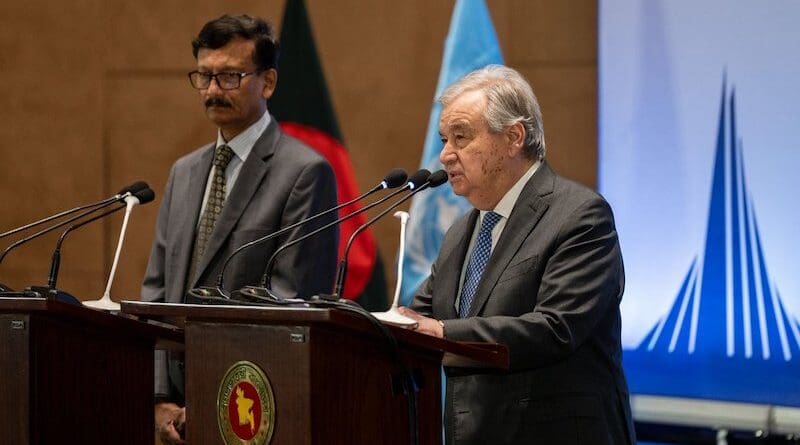
“Due to scarcity of time, we have to limit the number of questions to four”, was how the moderator announced a curb on journalists in presence of UN Secretary General before the question and answer session over his three day official visit on Bangladesh.
On March 15, soon after the UN chief ended his speech at the gathering of journalists, the coordinator was prompt to make the announcement and Guterres was seen visibly irritated with the restriction imposed on journalists, exposing Guteress’s endorsement for blocking journalists from asking questions that may deem uncomfortable by top officials but important to masses. During the briefing, Md. Towhid Hossain the foreign advisor appointed by Yunus regime was standing right next to Guterres. A breakdown of the press conference revealed, the total duration of the event lasted for 21 minutes 17 seconds while the major part (around first 12 minutes captured one sided speech delivery from UN chief), leaving only around 10 minutes space for the journalists to ask questions.2
Senior journalists in Bangladesh decried the move as a disgraceful and shocking exercise approved by Guterres himself to avoid uncomfortable questions over substantive erosion and breach of UN charter by very officials from the global body with regards to Bangladesh, putting the spotlight on the lack of accountability of UN officials amid silence from member states.
“The UN chief managed to spend three days in Bangladesh but it is ironic that the chief did not allow at least 20 minutes for journalists to ask questions that are of great public interest, given the country has been beset with a plethora of challenges,” added a private television channel journalist, reminding the danger of total impunity for UN officials.
While the restriction on asking questions became visible due to live telecast, a deeper investigation revealed a more sinister plot to deny access to journalists to cover the event that holds such high import.
A number of senior journalists working with television and newspapers revealed, invitations sent by chief advisor’s office and UN local office to media outlets to cover this event violated the past norm as only a select group of journalists were invited, denying others to cover the event.
In 2018, when Guterres made a visit to Bangladesh, a press conference was held on July 2 in Dhaka following his return from Rohingya camp, where invitations sent to journalists were much more holistic manner allowing more journalists to attend the press conference and the scope for asking questions to the UN chief was much more wide open, revealed several senior journalists who watched both press conference live on television.
Guterees himself made headlines for embracing Myanmar military informants in Rohingya camps during his visit to Coxsbazar but no explanation has been issued from him and the local UN office. Photos have emerged showing top smugglers enjoying privileged access during the ifter event graced by Guterres.3
No breakthrough in ensuring safe return for Rohingays in Myanmar for so many years is another abject failure on part of UN team and the much application of pressure on BD army to ensure regime change by UN rights chief are some questions journalists would have asked him. But to avoid embarrassment, UN chief endorsed the state managed publicity stunt, added another senior journalist.
On political front, UN chief also received drawbacks after BNP secretary general mirza fakhrul Alamgir publicly slammed a move by Guterres over holding a political dialogue with a select group of political parties.
BNP Secretary General Mirza Fakhrul Islam Alamgir has said he failed to understand the purpose of the roundtable meeting with United Nations Secretary-General António Guterres, who is currently visiting Bangladesh.
After the meeting at the InterContinental Dhaka hotel on Saturday afternoon, he said: “Actually, I didn’t quite understand what this roundtable was about.”4
Rights groups have raised questions over the outright backing to reform process by Guteress citing out the total lawlessness and rights abuses including communal violence, assault on freedom of press, targeted killing, custodial deaths alongside free reign for militants and terrorist, while consistent failure of UN in ensuring return of Rohingays to Myanmer. On the other hand, UN rights body chief Vulker Turk has also come under scanner following his recent admission of interference to expedite regime change with threats of withdrawal of BD troops from UN peacekeeping mission.
Links:
- 1 https://rsf.org/en/un-leader-ant%C3%B3nio-guterres-visits-rsf-headquarters-reaffirms-commitment-press-freedom-and-reliable
- 2 https://youtu.be/yRY0KxCN6js?si=YHyNz92pTCRf-vi7
- 3 https://www.rohingyarefugee.news/p/un-chief-iftar-rohingya-armed-groups?utm_medium=ios
- 4 https://bdnews24.com/bangladesh/7fcc97fe7bec

Like what you read?
Please consider supporting Eurasia Review. Thank you for your consideration!
