
Why Geography Still Traps Russia In Ukraine – OpEd
Russia’s continued attacks on Ukraine, combined with cross-border drone provocations against Poland. These escalations send a clear message: the war is now as much about Europe’s security psychology as it is about territory.
The strikes drew global attention, prompting reactions from world leaders. EU leaders rushed to discuss a 19th package of sanctions against Russia and new ways to channel frozen Russian assets into Ukraine’s war effort. Global leaders offered condolences and urged a ceasefire through diplomacy, emphasizing that peace and stability are vital for 21st-century growth. Yet, peace remains elusive, as Russia shows little interest in halting the conflict.
Russia’s Geography and Invasions
To understand why Russia resists a ceasefire, one must look beyond today’s battlefield into its history—where repeated invasions shaped a foreign policy built on insecurity and expansion.
In the mid-13th century, the Mongol Empire invaded Kievan Rus’, sacking major cities like Kiev and Chernigov. This devastation set the stage for centuries of cultural and economic decline. It took more than 100 years for Russian cities to recover from the invasion of Batu Khan and its consequences.
The accepted impact of the invasion: (1) the Mongol invasion “destroyed” Kievan culture, (2) the Tatar period was one of “stultification” and “isolation from the West,” and (3) “Russian” culture was deeply influenced by Golden Horde culture.
In 1812, Napoleon’s Grande Armée marched almost unhindered across the flat Russian plains and reached Moscow. Over a century later, Hitler’s blitzkrieg repeated the story, driving to Moscow’s gates. In both cases, Russia’s lack of natural barriers—mountains or oceans—left it fatally exposed. Though winter and scorched-earth tactics eventually saved it, the invasions engraved a lasting lesson: (1) without buffer territories, any great power could penetrate straight into Russia’s heartland, (2) expansion is necessary, or others will invade and capture the territory, and (3) survival requires territorial depth, which was reinforced by later invasions, that still shapes its expansionist instincts today.
In this calculus, the USSR (Union of Soviet Socialist Republic), centered on Russia, used its vast territory to maintain buffers against Europe in the west and Central Asia in the south. After its 1991 collapse, Russia formed the CSTO, a military alliance with Soviet states: Russia, Armenia, Kazakhstan, Kyrgyzstan, Tajikistan, and Belarus, to secure its southern flank. Meanwhile, Ukraine emerged as a critical neutral buffer against the West.
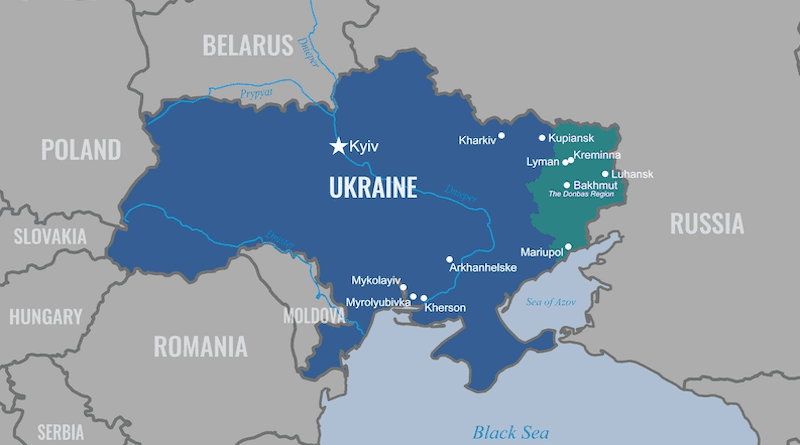
This alliance secures the southern border of Russia, while Ukraine was considered the buffer zone (shock absorber) for Russia—a neutral neighbor. Realists argue that if a state cannot fully control its neighbor, it will at least seize its most strategic regions. For Russia, that has meant annexing Crimea for Black Sea access and seeking control of Donbas for industrial and strategic depth. These regions can become a fortified outpost for Russia.
Europe’s Security Lens
The equations for Europe and especially Ukraine are different. Europe’s security order builds on the Westphalian balance of power, preventing any single hegemon from dominating, as seen in Britain’s offshore balancing or coalitions against Louis XIV. Today, the EU’s response to Russia’s invasion of Ukraine echoes this logic collective containment strategy. However, unlike the power calculus, today’s balancing is equally shaped by values (sovereignty, rule of law, democracy, and territorial integrity), institutional mechanisms (EU and NATO), and transatlantic cooperation (EU-US), making it both a continuity and an evolution of the European security order.
For Europe, supporting Ukraine is not just a choice—it is a question of credibility and the very survival of its security order. NATO, on the other hand, once derided as “obsolete,” has regained centrality. NATO’s door remains ‘theoretically open’ to avoid appeasing Moscow, even as EU membership is unlikely in the near term due to security liabilities–the EU’s Article 42.7, i.e., the equivalent of NATO’s Article 5, states that an attack on one is an attack on all, to which all have to retaliate in sync.
Ukraine’s (buffer state for Russia) membership in the EU or NATO is a hanging sword for Europe—militarily costly and strategically risky. European leaders know this, but capability gaps and internal divisions force them to lean on the US security safeguards—evident from the recent EU-US trade deal on 27th August. Europe is set to import $750 billion worth of US gas over the next three years, deepening dependency. Additionally, the European and U.S. firms position themselves for Ukraine’s post-war reconstruction.
The Stalemate
The existing condition depicts ‘stalemate’; none of them is winning—one side is Russia backed by China, North Korea (troop support), and Iran. While Ukraine, backed by the US, Europe, Canada, Japan, etc. Each supporter from both sides has their own reasons for prolonging the conflict. The West is not dragging the war because it seeks Ukraine’s NATO membership tomorrow, but because prolongation weakens Russia and prevents a quick Russian diplomatic victory, as ‘wars are won as much by timing and exhaustion of the enemy as by the bullets’.
But post Kyiv strikes, neither side can afford visible retreat. This stalemate favored a coerced armistice–neutrality by time-lock, iron-clad monitoring, sequenced sanctions relief, and non-NATO security guarantees–rather than a clean diplomatic peace.
The Way Forward
The first and foremost priority is a ‘ceasefire’ through a non-partisan mediator. The recent American push for negotiation seems to be failing; that’s obvious since Russia doesn’t trust the USA and Ukraine doesn’t want to compromise its sovereignty. In this scenario, the middle ground may come through India’s mediation or a reluctant UN compromise, while Turkey or China can play a supporting role in this process.
Peace comes with the intent to negotiate, west must understand that sanctions and isolations don’t bring nations to the table—they push them further towards hard power, escalating conflicts instead of resolving them. Either way, the war is unlikely to end with victory parades—only with exhausted negotiations. For Europe, Russia, and the world, the lesson is the same: geography, history, and security psychology still decide wars in the 21st century. Stability in Europe will shape not just energy and defense, but the Indo-Pacific’s growth too.

Like what you read?
Please consider supporting Eurasia Review. Thank you for your consideration!
