
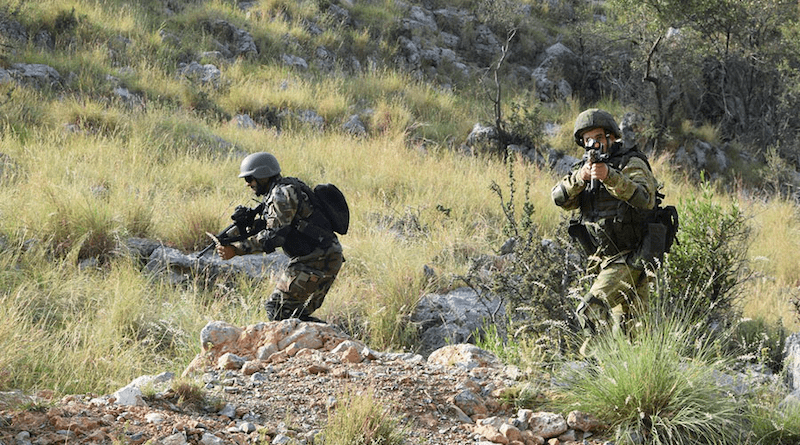
Why Counterterrorism Operations Are Necessary For Pakistan – OpEd
Over the past twenty years, Pakistan has been on an unremitting war against terrorism that has challenged its will, its structures, and its citizens. In the war against the terrorist and extremist networks which targeted civilians, state institutions and their national cohesion, the country has lost the lives of more than 94,000 people and incurred more than $150 billion in economic losses. This is but, a war of survival and not a war of choice. This does not only persist due to its internal nature, as the Taliban takeover of Afghanistan in 2021 has shown that the threat is regional in nature and requires an uncompromising and immediate response.
The terror threat that Pakistan is facing is complex and well-rooted. Groups such as the Tehrik-e-Taliban Pakistan, ISIS-Khorasan, and the Baloch Liberation Army continue to execute attacks aimed at destabilizing the country. These terrorists act mostly in the Afghan ground by exploiting weak governance and allied networks in the Afghan Taliban. The TTP leadership has used the Afghan soil on numerous occasions to organize and direct attacks within Pakistan mostly to the civilians, schools, mosques, and markets. These groups also use civilians as shields on purpose, sewing into tribal communities so that they cannot be hunted down by the military. Such tactics reveal their utter disregard for human life and expose the moral bankruptcy of their cause.
The recent counterterrorism operations carried by Pakistan are hence not offensive but rather self-defense operations. Any sovereign country is morally and legally justified in defending its people against organized violence. These actions of Pakistan are in line with Article 51 of the United Nations Charter which recognizes the right of self-defense due to external aggression. These are intelligence-led operations, precision-based operations, and meticulously carried out to avoid civilian casualties. However, anti-state propagandists and politically-minded actors still make them look violent or unselective. The fact is that the activities of Pakistan are one of the most measured and humane counterterrorism in the region, which deals only with those who have adopted arms against the state and its citizens.
The scale of the terrorist threat in 2025 alone illustrates why these operations are essential. Hundreds of Pakistani security personnel have been martyred this year in ambushes, suicide bombings, and cross-border assaults orchestrated from Afghan sanctuaries. The TTP and its affiliates have repeatedly demonstrated the capacity to strike deep inside Pakistani territory, attacking not only military installations but also civilians in markets, schools, and places of worship. The inability to react to such aggression would be equivalent to handing over the national sovereignty. The counterterror efforts of Pakistan have helped it thwart many large-scale attacks, destroy commanders of major terrorist groups, and dismantle operational abilities of groups which tried to reorganize themselves within the territory of Afghanistan.
Afghanistan’s current rulers, the Taliban, have either failed or refused to restrain the TTP. The TTP operates freely in Afghanistan yet despite several pledges by the Doha Agreement to ensure the country is not used to launch terrorist attacks, it remains to this day without any restrictions. Internal divisions in the Taliban government, especially the marginalization of Sirajuddin Haqqani and the rising of Hibatullah Akhundzada have further undermined their capability or the desire to take action against these terrorists. Some sects of the Afghan Taliban have instead offered them safe havens and logistical assistance instead of curbing the TTP. Pakistan has been restrained and engaged in diplomacy yet when it encounters attacks, it is forced to employ defensive action as an inevitable measure.
The drawback was that after several warnings and diplomatic talks did not give any results, Pakistan had to do a very specific defensive action. On October 8, 2025, the intelligence-led airstrikes were made by the security forces of Pakistan on confirmed TTP hideouts, safe havens within the territory of Afghanistan. Such attacks were directed at the same compounds on which cross-border attacks were being directed against Pakistani civilians and security personnel. The strikes by Pakistan were surgical and civilian deaths were avoided; they also targeted only infrastructures of the terrorists that was used to orchestrate the fatal attacks within Pakistan. The allegations made by Kabul of killing its civilians were established to be unfounded and according to independent monitoring the targeting of Pakistan was true. These raids acted as a strong indication that Pakistan won’t tolerate cross-border terrorism and that it has the right to protect its citizens at all cost.
External interference is another layer that must remain important in this dynamic. The security agents of Pakistan have also accused India severally of destabilizing the country through its intelligence agency Research and Analysis Wing (R&AW) which has extended financial, intelligence and material assistance to the terrorist organizations like the TTP and BLA. The fact that the Afghan foreign minister visited India during the counterterrorism campaign in Pakistan in October 2025 on its own brought up valid issues of increasing coordination between anti-Pakistan elements in Afghanistan and the intelligence apparatus of India. These developments pose a threat to the internal security of Pakistan as well as to the overall stability of the South and Central Asia.
Those critics who doubt the counterterrorism actions of Pakistan tend to overlook the human cost of terrorism itself. Each bombing, each assassination, each ambush kills families and communities. This conflict has fallen on the Pakistani military, police, and intelligence services on which civilians stand against the terrorists who aim at unleashing havoc on the country. Counterterrorism operations are not a choice between peace and war; they are the price of peace. Pakistan would experience a continuous anarchy in the absence of them.
There is also the need to discuss the internal propaganda war which is fought by anarchist and opportunistic forces like the PTM. PTM has always preferred to use and exploit legitimate local grievances to propagate an anti-state agenda with counterterrorism operations being perceived as ethnic persecution. By so doing, they intentionally turn a blind eye to the reality that it is the Pashtun communities that have been the greatest victims of terrorism. The TTP has been killing thousands of tribal elders, teachers and religious leaders who have been supporting Pakistan and opposed extremism. The presence of the military in such places is a protection to such communities and not a force against them. Pakistan remains focused on rehabilitation and reconstruction efforts in hit regions, infrastructure investments, resettlement and livelihood of the displaced families. This war is expensive to the state, but the state also knows that not doing it would cost a lot of lives as well as generations of uncertainty.
The outcomes of Pakistan’s counterterrorism initiatives are self-evident. Large-scale operations like Zarb-e-Azb, Rah-e-Nijat, and Radd-ul-Fasad were successful in destroying terrorist infrastructure and bringing peace back to areas that had previously been anarchic. This legacy is being carried on by the current campaign, which has eliminated dozens of high-value targets through sophisticated surveillance, airpower, and intelligence coordination. Pakistan’s border management and fencing projects have further limited infiltration routes, reducing the ability of terrorists to exploit unmonitored crossings. Each of these actions, which are justified by necessity and carried out responsibly, represent national defense rather than aggression.
Pakistan’s counterterrorism strategy must continue to be all-encompassing going forward, integrating development in formerly impacted areas, ideological counter-radicalization, education reform, and targeted military operations. Although regional cooperation is crucial, Pakistan cannot rely solely on outside assistance to protect its borders and its people. Pakistan will take strong action to protect its sovereignty and its citizens if Afghanistan keeps providing safe havens for terrorists.
In the end, Pakistan’s counterterrorism efforts are a national necessity rather than a choice in policy. One principle unites the state’s constitutional obligation, strategic necessity, and moral obligation, no compromise with terrorism. Those who misrepresent these operations disregard reality as well as history. Pakistan fights terrorism against an ideology of death and destruction that rejects civilization itself, not against a particular ethnic group or geographical area. With determination, accuracy, and selflessness, Pakistan remains a bulwark against chaos, guaranteeing that peace, not terror, will shape its people’s future.

Like what you read?
Please consider supporting Eurasia Review. Thank you for your consideration!
