
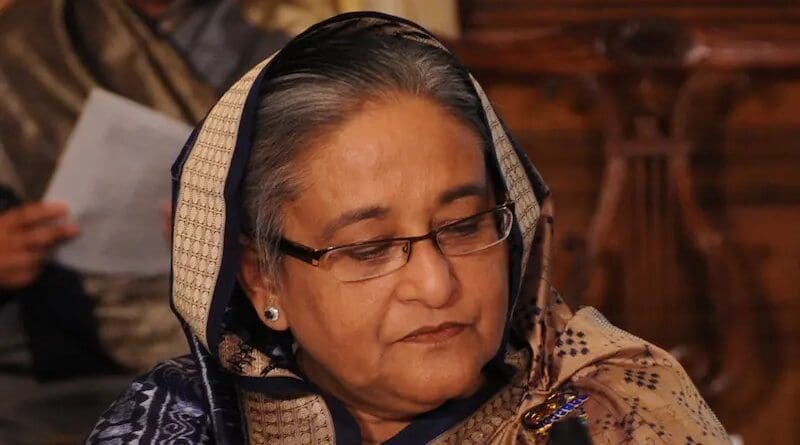
Death Sentence To Hasina: Politicization Of Judiciary In Bangladesh Reiterates – OpEd
By sentencing former Prime Minister Sheikh Hasina to death, the judicial system in Bangladesh has exposed its long-standing vulnerability to practices of political targeting and recrimination.
The International Crimes Tribunal-Bangladesh (ICT-BD) in its indictment of Hasina, revealed her direct involvement in the brutal suppression of student protests in the Summer of 2024. The chief judge highlighted Hasina’s orders to deploy helicopters, drones, and lethal weapons against unarmed civilians, as evidenced by her conversation with the South Dhaka Municipal Corporation mayor and the authenticity of the recording confirmed by forensic analysis as a justification for the imposition of the death sentence. As per the report released by the UN Office of the High Commissioner for Human Rights (OHCHR), around 1,400 people lost their lives in the students’ protest spanning over a period of 46-days in the Summer of 2024.
However, there are ample reasons to believe that the judicial proceedings and judgments have been politically motivated and evidences have been selectively chosen to magnify the gravity of the crime and intensify the degree of punishment on Hasina and a few others of her aides whereas many crimes committed by the perpetrators from the other side of the political spectrum have been deliberately kept outside the definition of crimes against humanity. The judicial structure underpinning the ICT since its inception in 1973 as well as during the reactivation in 2009 has been deliberately designed to be politically vulnerable.
Although originally instituted in 1973 to deliver justice to the victims of the horrendous conflict between the West and East Pakistan (Bangladesh) that resulted in a humanitarian disaster by its sheer statistics – two lakh and four lakh women and children being raped leading to an estimated 25,000 war babies being born and approximately, three million people lost their lives, thirty million people were displaced and ten million people were forced to migrate from the country according to credible estimates was a right step in a right direction but the entire process was marred by imputations of political motives and political hijacking of judicial architecture, proceedings and judgements.
The Tribunal deliberately ignored the crimes committed against the collaborators siding with the authorities of West Pakistan. For instance, it failed to charge the Bangladeshis who indiscriminately executed East Pakistani Biharis. It focussed primarily on the collaborators who assisted and sided with the West Pakistan and committed crimes against humanity according to its vague definition.
The factors that undergirded reactivation of the Tribunal which remained defunct for so many years in 2009 by the Awami League government carried political undertones that they were geared more to subdue the political opponents and dissenters than deliver justice in the true sense of the term and hence remained subjected to political headwinds.
ICT: An Extended Branch of Executive
Bangladesh government instituted the ICT through a domestic act, appointing its own judges and following its own judicial procedures and criminal laws. Because of its domestic nature, the judicial architecture provided by the ICT became politically more vulnerable and it operated without international oversight. The weaknesses and flaws of the Tribunal represented the institutional and systemic weaknesses of the larger political system. However, many international crimes tribunals instituted globally including for Kosovo, Bosnia and Herzegovina, East Timor, Sierra Leone, Cambodia, and Lebanon to hold the perpetrators of such crimes against humanity and their collaborators accountable represented international judicial luminaries as mandated by the UN apart from the local judges and followed international customary laws. Unlike other Tribunals functioning under international supervision, the ICT of Bangladesh has been viewed sceptically for its imposition of death sentences, trials in absentia, cases of victimhood to double jeopardy, manufactured evidences, vague definitions of crimes and skirting of due process of law. For example, the ICT Statute chose to selectively define crimes against humanity that excluded from its purview “widespread or systematic attack against a civilian population”, which is not only part of the widely accepted definition but a significant element of the crimes against humanity under the traditional interpretation of international law. These deliberate omissions and deviations from widely-acclaimed definition were intended to allow the Tribunal overblown authority to flexibly and politically decide the nature of crimes.
The Tribunal’s glaring bias towards targeting opposition leaders since its inception raised serious concerns regarding its independence and neutrality. Furthermore, the Tribunal’s egregious refusal to grant defendants fundamental rights, such as access to their counsel, material evidence, and timely notice of charges, gravely undermined the very fabric of due process, rendering the proceedings a hollow mockery of justice. Many defendants became victims of double jeopardy being tried twice for the same charges.
Beyond the veil of ICT’s ostensibly impartial facade, a disturbing narrative emerged, as chronicled by numerous news agencies and human rights organizations. These accounts revealed a troubling landscape of witness intimidation, impermissible collusion between the Tribunal’s justices and prosecutors, and a disquieting sense of preordained outcomes, all of which have sullied the integrity of the ICT’s proceedings. Contesting the judgements of the ICT was not allowed and the tribunal included the provision of death sentence under political pressure.
Former Prime Minister Hasina, the very architect of the ICT reactivating it in 2009, now finds herself ensnared in its web of justice. The irony is palpable, with Jamaat-e-Islami, a party often at odds with Hasina, now advocating for the ICT’s verdict to be carried out.
A disturbing echo of the past reverberates through the proceedings of the ICT, as credible reports allege that the trial of Hasina was marred by a litany of constitutional transgressions. The appointment of judges, it is claimed, was shrouded in controversy, while prosecutorial zeal seemed to overshadow impartiality. The defence, it is alleged, was shackled by restrictive rights, as the tribunal rushed to judgement, bogged down by a staggering caseload of politically-charged cases.
The trial, meant to be a beacon of justice, was instead reduced to a mere formality, its legitimacy undermined by an atmosphere antithetical to fairness and due process. The spectre of a kangaroo court looms large, casting a shadow of doubt over the verdict, and threatening to undermine the very fabric of Bangladesh’s nascent democracy.

Like what you read?
Please consider supporting Eurasia Review. Thank you for your consideration!
