
When Attention Thins, Responsibility Shifts: India’s Quiet Rise In The Indian Ocean – OpEd
Global attention today gravitates toward the most visible theatres of competition. Strategic focus, diplomatic energy, and military resources are no longer spread evenly across regions. Instead, they are concentrating where tension is persistent and management is continuous. This clustering of attention shapes not only where power is exercised, but also how other regions are treated when they no longer sit at the centre of daily oversight.
Two theatres now dominate this global focus. The South China Sea has become a space of constant attention. Naval deployments are sustained, signalling is routine, and crisis management is ongoing rather than occasional. What was once episodic tension has hardened into a permanent condition that demands continuous presence. At the same time, the Arctic has moved decisively from the margins to the core of strategic planning. As ice recedes, sea routes open, and infrastructure activity grows, military and political attention has followed. Accessibility has turned the Arctic into a long-term commitment rather than a seasonal concern.
These developments have consequences. Attention is not infinite. Assets tied down in one theatre cannot be casually reassigned elsewhere. As naval forces, planners, and political bandwidth are drawn into these high-pressure regions, fewer resources remain available for routine oversight in areas long assumed to be stable. The shift is gradual, but real. It does not announce itself as withdrawal. It appears instead as thinning.
The Indian Ocean sits squarely within this shift. It remains central to global trade and energy flows, yet it increasingly operates outside the spotlight of sustained external attention. It is not abandoned, but it is managed with assumption rather than focus. Day-to-day responsibility, however, becomes less visible.
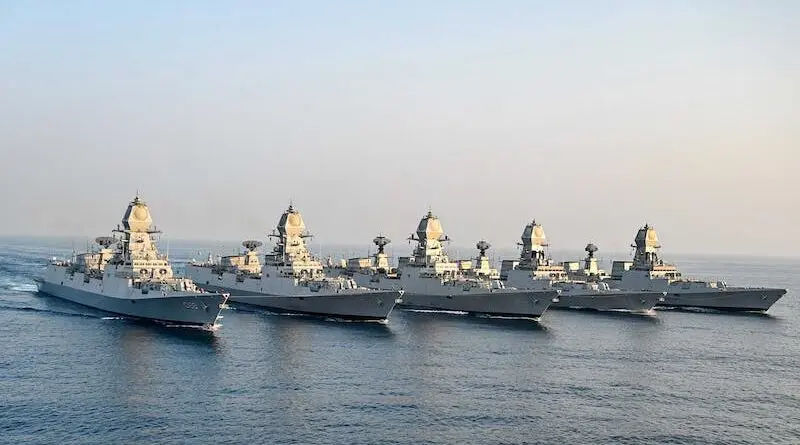
It is in this space that India’s role has accelerated. As attention elsewhere concentrated, New Delhi did not wait for formal handovers or new labels. It moved through practice. Indian naval deployments became more regular. Commercial shipping received sustained escort during periods of risk. Coordination with regional partners deepened quietly. These actions were not framed as strategic announcements. They were responses to a simple reality: stability in the Indian Ocean depends on routine effort.
What has unfolded is not accidental. Sea lanes do not secure themselves. Coordination does not persist without constant work. As global focus narrowed, the cost of neglecting everyday maritime management rose. India responded by remaining present. In doing so, it reduced uncertainty for regional states and commercial actors alike. Reliability began to replace assumption. Continuity replaced episodic reassurance.
This growing role has been shaped by how India has chosen to operate. MAHASAGAR (Maritime Heads for Active Security and Growth for All in the Region) reflects this approach. It is not a declaration of leadership, but a method of engagement. Through Mahasagar, India works with Indian Ocean countries on maritime safety, coordination, and shared responsibility. It places structure around practices already visible at sea. Cooperation is routine. Presence is steady. Stability is treated as a shared task rather than a headline claim.
What distinguishes this shift is persistence. Maritime stability is rarely produced by dramatic intervention. It is built through repetition. Showing up matters. Being present before disruption turns into crisis matters more. In the Indian Ocean, India has increasingly provided that continuity. Over time, presence becomes familiar. Coordination hardens into habit. Trust forms through follow-through. The question quietly changes from who might respond to who is already there.
As global attention remains absorbed by sharper contests elsewhere, influence in the Indian Ocean is consolidating around those willing to shoulder everyday responsibility. India’s role has expanded through accumulation rather than declaration. Deployments feel normal rather than exceptional. Engagement deepens without spectacle. In a region where stability depends on routine function, this kind of presence carries weight.
This quiet shift also changes how risk is managed. When stability is sustained through steady presence, problems are addressed earlier. Shipping routes remain predictable. Disruptions are contained before they escalate. Influence is exercised less through reaction and more through prevention. The absence of crisis becomes the signal of effectiveness.
The broader lesson extends beyond India alone. As global attention concentrates on a limited number of intense theatres, regions that underpin global stability increasingly depend on actors willing to sustain routine order. These efforts rarely draw attention precisely because they work. The Indian Ocean shows how influence today is consolidated not only where competition is loudest, but where attention has narrowed—and responsibility is taken up.

Like what you read?
Please consider supporting Eurasia Review. Thank you for your consideration!
