
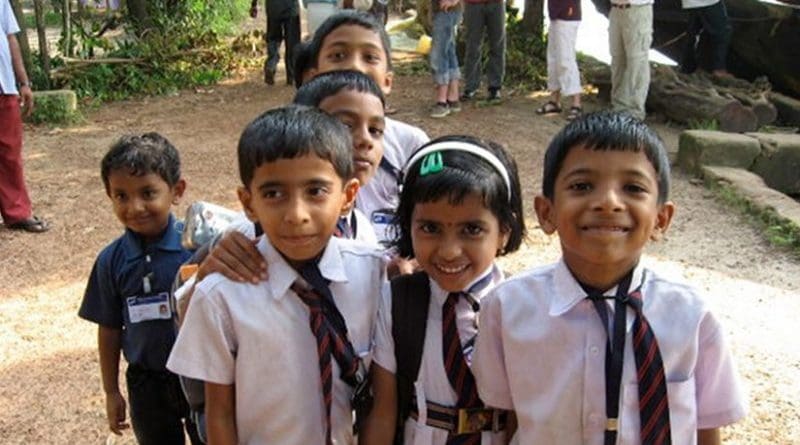
The Learning Paradox: Securing India’s Demographic Future – Analysis
As India marks more than seven decades of independence, its educational transformation ranks among the most remarkable stories of post-colonial state-building. From a literacy rate of barely 12 percent in 1947, the country has moved to near-universal enrollment at the primary level. Today, India educates close to 260 million students, from pre-primary to higher secondary education—making it the largest schooling system in human history.
Yet, beneath this impressive scale lies a paradox that threatens to undermine India’s long-term economic and social aspirations. While access to education has expanded dramatically, learning outcomes have not kept pace. For a country frequently described as the world’s back office and an emerging manufacturing hub, the challenge is no longer one of enrollment, but of capability.
If India is to convert its youthful population into a true demographic dividend, it must move decisively from a system that measures success by attendance and examination scores to one that prioritizes actual learning, skills, and adaptability.
The Narrow Funnel After School
The contradiction becomes stark at the transition from school to higher education. Each year, more than 15 million students complete higher secondary education (Class 12). Almost overnight, this massive cohort enters an intensely competitive race for undergraduate admissions—engineering, medicine, law, management, and other professional streams.
While India’s Gross Enrolment Ratio in higher education has risen steadily to nearly 30 percent, access to institutions of consistent quality remains sharply constrained. The combined annual intake of elite public engineering institutions—Indian Institutes of Technology, National Institutes of Technology, Indian Institutes of Information Technology, and other centrally funded technical institutes—is only around 60,000 to 65,000 seats. In medical education, despite recent expansion, total MBBS seats number about 118,000, with government colleges accounting for a smaller and far more competitive share.
Put differently, well under one percent of India’s annual school-leaving cohort secures admission to the country’s most sought-after public institutions. The rest—over 90 percent—must pursue higher education in a sprawling ecosystem of regional colleges and private institutions, many of which struggle with inadequate infrastructure, outdated curricula, and weak links to the labour market.
This narrow funnel ensures that talent alone rarely determines outcomes. Family income, location, language, early schooling quality, and access to coaching play decisive roles. The result is not merely inequality of opportunity, but inequality of preparedness.
Early Advantage and Its Limits
These disparities are seeded much earlier than the Class 12 examination. India does possess pockets of high-quality public schooling, most notably the centrally administered Kendriya Vidyalayas and Jawahar Navodaya Vidyalayas. These schools are widely regarded for better governance, teacher availability, and learning outcomes.
Yet their scale reveals the limits of elite models. Kendriya Vidyalayas enroll about 1.35 million students, while Jawahar Navodaya Vidyalayas—selective, fully residential schools largely serving rural talent—educate roughly 300,000 students. Together, they account for less than one percent of India’s total school-going population.
Demand for entry into these institutions far exceeds supply, underscoring a central tension: India has demonstrated that quality public schooling is achievable, but such quality currently reaches only the margins of the system. For the overwhelming majority of children, especially in rural and economically weaker regions, early learning outcomes remain fragile—creating cumulative disadvantages that surface later as poor employability.
From Education as Access to Education as a Right
India’s policy response has evolved in stages. Early national education policies focused on access and infrastructure. The most transformative shift came with the Right of Children to Free and Compulsory Education Act of 2009, which made elementary education a legal right.
This legislation succeeded in pushing enrollment and retention to historic highs. But it also produced unintended consequences. Emphasis on universal schooling, combined with practices such as automatic grade promotion, often allowed students to progress without mastering foundational literacy and numeracy. Learning deficits accumulated quietly, becoming visible only at the point of high-stakes examinations.
The system, in effect, optimized for schooling rather than learning.
The Rise of Shadow Education
For millions who fall outside elite pathways, higher education frequently delivers credentials without competence. General degrees in arts, science, or commerce often remain poorly aligned with the demands of a rapidly changing economy.
This gap has fueled the explosive growth of a vast shadow education industry. Coaching centres now function as parallel institutions, training students to crack entrance examinations rather than to understand concepts. From early adolescence, learning is increasingly reduced to test optimization. Creativity, curiosity, and critical thinking—skills essential for innovation—are crowded out by rote preparation.
The social costs are significant: prolonged stress, delayed entry into productive work, and a workforce trained to follow patterns rather than solve problems.
Digital Access, Unequal Learning
The COVID-19 pandemic exposed another layer of inequality. While smartphone access is now widespread, effective digital learning remains uneven. Devices are shared, internet connectivity is unreliable, and quiet study spaces are scarce for millions of households.
For a student in an urban private school, digital platforms open access to global knowledge repositories. For a student in a remote village, the same technology may offer only sporadic access to recorded lectures. Unless addressed deliberately, the digital divide risks solidifying into a cognitive divide, reinforcing inequality rather than mitigating it.
From Vision to Scale
India’s National Education Policy of 2020 represents an important conceptual shift, emphasizing foundational learning, flexibility, and skills. The challenge now lies in implementation at scale. Five priorities stand out.
First, foundational literacy and numeracy must be treated as a national emergency. No education system can succeed if students cannot read fluently or perform basic arithmetic by the early grades.
Second, India must leverage its best public institutions through cluster-based mentorship, where high-performing schools mentor groups of neighbouring government schools, sharing pedagogical practices and teacher training.
Third, vocational education must be integrated early and without stigma. Exposure to modern trades from middle school onward can widen pathways to dignified livelihoods and reduce the excessive premium placed on a narrow set of degrees.
Fourth, employers—particularly in the public sector—must begin decoupling degrees from jobs, shifting toward skill-based hiring for entry-level roles.
Finally, community digital learning centres, anchored at the local level and equipped with reliable connectivity, can democratize access to high-quality educational resources.
From Schooling to Learning
India’s demographic window is expected to peak around 2041. By 2047, the country aims to become a developed economy. Whether this ambition is realized will depend less on the number of graduates produced and more on what those graduates can actually do.
Treating education not merely as a service but as a right to learn would be the most fitting tribute to the architects of independent India. The country has already proven its capacity to build educational infrastructure at an unprecedented scale. The next frontier lies in strengthening the human mind.
If India can repair the learning leak at the foundation and broaden pathways to success beyond a narrow set of elite institutions, it will not merely supply labour to the global economy—it will cultivate thinkers, innovators, and leaders for the century ahead.

Like what you read?
Please consider supporting Eurasia Review. Thank you for your consideration!

Eye opener