
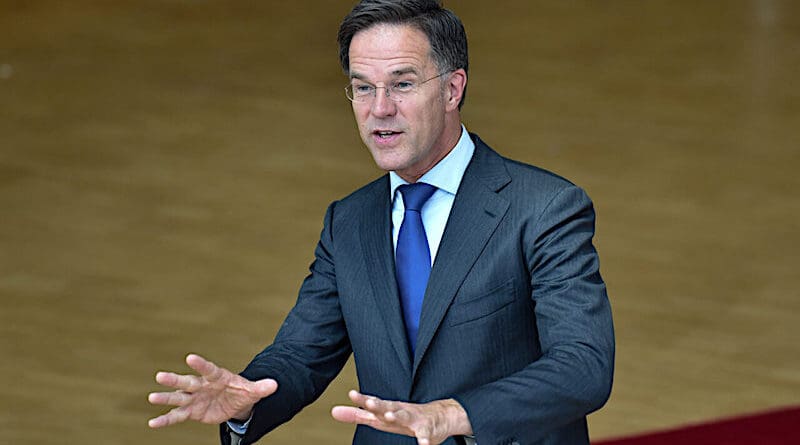
NATO Chief Threatens Countries Trading With Russia – OpEd
“Economic Warfare as the New Frontline in the West Vs Rest”
On 14th July in Washington, NATO Secretary-General Mark Rutte made unusually blunt remarks that signaled a hardening of the Western position towards countries continuing commercial ties with Russia. Addressing primarily BRICS nations—India, Brazil, and China—he warned that they could face “100 per cent secondary sanctions” from the US if they continued trading with Russia, particularly in the energy sector.
NATO Chief urged these countries to “Call Putin” and persuade him to “get serious about peace,” implying that failure to pressure Russia could lead to economic retaliation. His comments echoed those of US President Donald Trump, who earlier this month issued a parallel threat—10 per cent additional tariffs and reciprocal duties for BRICS nations seen as aligning with “Anti-American” economic policies. This is no longer traditional diplomacy—it’s coercive economic diplomacy, bordering on what many critics would term geo-economic intimidation.
In What Capacity Is NATO Chief Involved?
While NATO is primarily a military and security alliance, it is increasingly inserting itself into economic and strategic policy spheres, especially where the West’s leverage is economic rather than military. Rutte’s comments suggest that NATO is now positioning itself as a Geo-Economic Enforcement Arm of the transatlantic alliance, closely aligned with US Trump’s pressure tactics.
This marks a significant shift in NATO’s role—from collective defense to collective coercion—using trade, sanctions, and market access as levers to force global alignment with Western interests. Rutte, a European liberal formerly known for moderation, is now embracing a tone and strategy reminiscent of Trump’s transactional “America First” doctrine. This reflects a transatlantic policy convergence, where economic coercion is normalized as part of international diplomacy.
India’s Response
India, which has continued purchasing oil from Russia post-Ukraine invasion, responded firmly. Foreign ministry spokesperson Randhir Jaiswal defended India’s energy policy, stating: “Securing the country’s energy needs remains an overriding priority… guided by national interest and prevailing market conditions.” He added that India would “particularly caution against any double standards,” an indirect but sharp rebuke to the West, highlighting the hypocrisy of expecting developing nations to bear the cost of a war they had no part in.
This statement reflects India’s strategic autonomy, a long-held foreign policy doctrine that allows it to act in accordance with its own national interests—neither fully aligned with the West nor the Russia-China axis.
Implications
West vs Rest: A Growing Fracture Line. Rutte’s warning reinforces the emerging ideological and economic split between the “West” (NATO/EU/US) and the “Rest” (BRICS, Global South, OPEC+).
Instead of promoting diplomacy, such ultimatums push neutral powers like India, Brazil, Saudi Arabia, and South Africa closer toward strategic cooperation with Russia and China, who offer an alternative.
Alienation of Key Global Powers. Forcing countries to choose between cheap Russian energy and access to Western markets is a dangerous gamble. Countries like India, already building self-reliance in critical sectors, may accelerate their decoupling from Western economic dependence.
Weaponization of Trade and Market Access. Sanctions have moved from being punitive to preventive weapons in shaping global behavior—what was once Trump’s hallmark strategy is now becoming NATO’s standard toolkit. This represents a transformation of economic interdependence into strategic vulnerability.
Likely Future Consequences for the West. The more aggressively sanctions and threats are used, the greater the incentive for the Global South to build alternative financial and trade systems, e.g., using non-dollar trade, local currencies, BRICS Bank, or even commodity-backed exchanges. Over time, this could weaken the dollar’s global dominance and diminish Western soft power.
Short-term Intimidation, Long-term Isolation?
The parroting of Trump tactics by NATO’s Chief signals a convergence of military alliances and economic coercion, where alliances like NATO now aim to enforce compliance not just on the battlefield but in boardrooms and oil contracts.
In trying to isolate Russia, the West may be isolating itself from emerging powers. While it may yield temporary diplomatic wins, the long-term effect could be the birth of a new multipolar order, where BRICS and the Global South carve out economic and political autonomy, away from Western tutelage.
Mark Rutte’s words were not just a warning to BRICS—they were a harbinger of how economic war is replacing cold war ideologies, and how diplomacy is now increasingly dictated by who controls the markets, not just the missiles.
NATO Chief’s warning to BRICS nations marks a dangerous shift in global diplomacy. Once a military alliance, NATO is now venturing into geo-economic policing, parroting the hardline tactics of Donald Trump’s “America First.”
The West must ask itself: can a stable world be built by threats and transactional diplomacy? Or is it time to engage the Global South as equal partners rather than subordinates?
“If NATO continues down this path, it may win the moment— But lose the future.”

Like what you read?
Please consider supporting Eurasia Review. Thank you for your consideration!

Threats Continue:
Speaking on Fox News, US Senator Lindsey Graham Warns India, China, Brazil Over ‘Cheap’ Russian Oil; Graham said, “If you keep buying cheap Russian oil, to allow this war to continue, we will tariff the hell out of you,” ___ “And we’re going to crush your economy, because what you are doing is blood money” . Is this how a senator should speak and threaten?
The tone and language used by the US Senator is highly aggressive and undiplomatic. Such rhetoric is inflammatory, coercive, and undermines the norms of international dialogue — especially when directed at sovereign nations like India, Brazil, and China the important global players. The US-NATO allies are understandably frustrated that countries continue buying Russian oil, which potentially funds Russia’s war effort. However, accusing countries of trading in “Blood Money” is accusatory and moralistic, with a very narrow lens, ignoring the energy security needs and economic realities of Global South nations.
Hypocrisy and Double Standards: The US has historically traded with questionable regimes when it suits its interests. How about supplying weapons to Ukraine through NATO? Is it Not “Blood Money” contributing to American Economy ?