
India’s Shipbuilding Moment Is About Capability, Not Just Capacity – Analysis
India’s defence shipbuilding sector is often discussed in terms of scale, vessel numbers, capital outlays, or headline procurement figures. Yet the more consequential shift underway is quieter and structural: the steady maturation of institutional capability across the maritime industrial base.
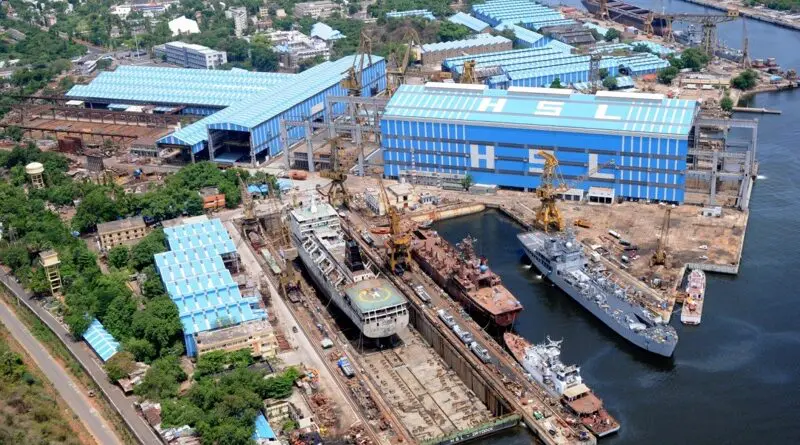
Recent developments at Visakhapatnam offer a revealing lens into this transition. India’s oldest shipyard, the state-owned Mini-Ratna public sector undertaking Hindustan Shipyard Limited, recently laid the keel for a high-bollard-pull harbour tug and concluded a follow-on contract for a second vessel for the Visakhapatnam Port Authority. Taken together, these milestones illustrate how India’s shipbuilding ecosystem is evolving towards sustained, reliable execution—moving away from episodic project cycles to a more continuous and dependable operating model.
From episodic output to dependable execution
For much of the past three decades, uneven utilisation has marked India’s shipbuilding industry—particularly in the defence segment. Intense naval procurement cycles alternated with lulls, eroding workforce continuity and vendor confidence. Now, this pattern is changing.
Industry research from late 2025 indicates that the naval shipbuilding sector is executing or advancing projects worth over ₹2.3 trillion. Shipbuilders are currently constructing more than 60 naval platforms and planning another 70–80. As important as these numbers are, the nature of the pipeline is equally important: organisations stagger, diversify, and extend projects over multiple years and across multiple platform types, including auxiliary and support vessels.
This diversification is not accidental; deliberate naval modernisation drives it. The navy now extends its focus beyond frontline combatants and actively includes the enabling layer—dockyards, support ships, harbour craft, and repair infrastructure—without which operational readiness cannot be sustained. Shipyards that reliably execute tasks across this spectrum are becoming strategic assets in their own right.
Why auxiliary platforms carry strategic weight
Harbour tugs and support vessels rarely feature in discussions of maritime power, yet their absence is felt immediately. Ports handling larger commercial and naval vessels require high-capacity support assets to ensure safe manoeuvring, quick turnaround, and resilience during congestion or adverse weather.
The 60-ton bollard-pull tug under construction in Visakhapatnam is emblematic of this logic. Designed for demanding port operations, such vessels strengthen the connective tissue between commercial logistics and naval mobility. For ports that serve both civilian trade and defence logistics, this dual utility carries strategic implications.
From an industrial perspective, auxiliary platforms serve another vital function: they sustain execution discipline. Unlike when shipyards build one-off, highly complex capital ships, auxiliary projects reinforce repeatability—design integration, vendor coordination, and schedule management—capabilities that translate directly into better outcomes on larger naval projects.
Policy intent and industrial signalling
India’s policy architecture increasingly recognises this linkage. For instance, the ₹697-billion Shipbuilding and Maritime Development Package announced in 2025—the largest maritime stimulus in the country’s history—reflects a shift from aspirational targets to structural enablement. Financial assistance, interest subventions, and the development of coastal shipbuilding clusters are intended to address long-standing cost and infrastructure disadvantages relative to East Asian yards.
These measures sit within Maritime India Vision 2030, which explicitly links shipbuilding to port modernisation, logistics efficiency, and maritime security. Crucially, the policy emphasis is not limited to headline platforms but extends to the industrial processes that sustain them.
In this context, teams that execute projects quietly and on schedule send a signal more powerful than promotional narratives. They demonstrate institutional reliability—an attribute that both naval planners and commercial port operators value highly.
Strategic continuity and the export horizon
India’s growing defence exports further reinforce this trajectory. Naval and maritime platforms are increasingly seen as scalable export offerings, particularly for partners in the Indian Ocean Region. Beyond transactions, these exports embed long-term relationships through training, maintenance, and lifecycle support.
Shipyards that demonstrate consistency across domestic programmes are better positioned to support this outward-facing role. Continuity of execution, rather than headline scale, becomes the foundation for credibility.
Reading the signals correctly
India currently ranks outside the top tier of global commercial shipbuilding by tonnage, and East Asian leaders maintain a substantial lead. Yet, focusing solely on rankings risks missing the underlying shift. India’s shipbuilding ecosystem now prizes reliability, integration, and sustained output.
Seen through this lens, stakeholders recognise incremental milestones—such as auxiliary vessels entering construction or follow-on contracts being signed—as strategically significant. These achievements reflect a system that learns to function without disruption, preserving skills, vendors, and institutional memory.
For India’s maritime ambitions, the development of quiet, reliable competence across the shipbuilding ecosystem—not just headline achievements—forms the true foundation for sustainable maritime power. This capability-driven approach may ultimately be the decisive element in achieving long-term strategic goals.

Like what you read?
Please consider supporting Eurasia Review. Thank you for your consideration!
