
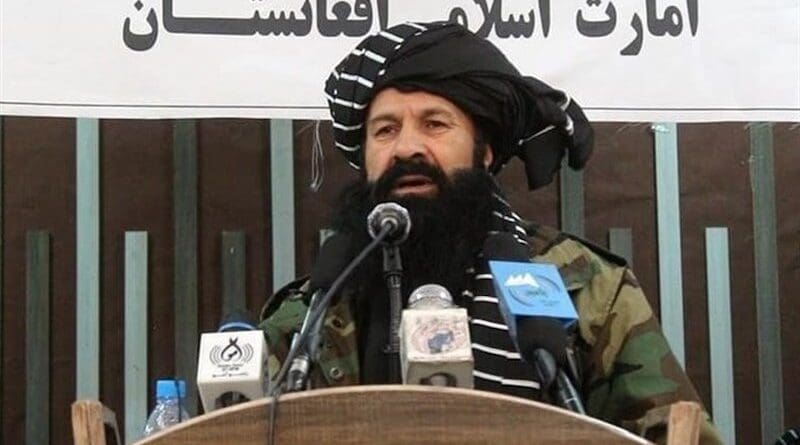
Rethinking The Khalil-Ur-Rahman Haqqani Killing – OpEd
On the anniversary of Khalil-ur-Rahman Haqqani’s death, the Taliban-aligned outlet Al-Mirsaad has once again attempted to shape the narrative around one of the most sensitive killings within Afghanistan’s post-2021 political order. According to its latest claims, the suicide attack that killed Rahman Haqqani was planned and directed by Islamic State Khorasan Province (ISKP) operatives operating from Pakistan. At first glance, this version appears designed to fit a familiar storyline: external enemies destabilizing Afghanistan. Yet information emerging from within the Taliban’s own circles paints a far more troubling picture—one that points inward, not outward.
Al-Mirsaad’s sudden burst of activity follows a well-established pattern. Time and again, it has pushed dramatic but unverified claims precisely when international scrutiny of the Taliban intensifies. Today, that scrutiny is growing. UN bodies, regional governments, and security analysts are increasingly vocal about the resurgence of terrorist activity within Afghanistan and the Taliban’s failure to consolidate stable governance. In this context, blaming a foreign-based ISKP network looks less like a credible intelligence assessment and more like a strategic diversion.
The central weakness of Al-Mirsaad’s narrative is the complete absence of evidence. No documentation, no independently verifiable intelligence, and no corroboration from regional or international counterterrorism bodies have been presented to support the claim that ISKP planned the attack from Pakistan. The Taliban authorities themselves have not shared any credible proof with neighboring states, the United Nations, or other international stakeholders. In an era where terrorism allegations carry serious diplomatic and security consequences, assertions without evidence only deepen mistrust.
More importantly, accounts from within the Taliban’s own intelligence wing directly contradict the official public line. According to these internal findings, the operation that killed Khalil-ur-Rahman Haqqani was planned inside Afghanistan, particularly in the eastern regions. Even more damning is the reported involvement of Taliban personnel themselves. Two officials posted at the Ministry of Refugee Affairs allegedly facilitated the bomber’s access to Khalil, granting him proximity that would have been nearly impossible without inside help. This alone undermines the notion of a distant, foreign-directed plot.
The implications go further. Multiple sources suggest that senior Taliban figures, including Mullah Yaqoob and Sirajuddin Haqqani, were involved in authorizing—or at the very least approving—the operation. If true, this reframes the killing not as an act of external terrorism but as a manifestation of deep internal power struggles. Competition over influence, control, and ultimately the prime minister’s seat appears to have created an environment where political rivalry trumped organizational unity. The killing of a prominent figure like Khalil-ur-Rahman Haqqani thus becomes a symptom of factional conflict rather thansacrather than a straightforward security breach.
Recent UN Security Council briefings add further weight to this interpretation. Statements from countries such as Russia and Denmark emphasize rising terrorist threats emanating from within Afghanistan itself. These assessments do not support the Taliban’s claim that instability is being exported into Afghanistan from abroad. Instead, they highlight concerns that Afghanistan is once again becoming a hub for militant activity, with potential spillover into the wider region. This directly challenges the diversionary narrative promoted by Al-Mirsaad.
UN findings also reflect a broader international fear: that after more than two years of Taliban rule, internal mismanagement, lack of accountability, and unresolved factional rivalries are eroding whatever internal security gains were initially claimed. The killing of Khalil-ur-Rahman Haqqani by elements operating from within the Taliban system starkly illustrates this failure. It signals that even high-ranking insiders are not immune from internal violence, raising serious questions about command, control, and cohesion.
For Pakistan and other regional states, these developments reinforce long-standing concerns. Cross-border terrorism is not primarily the result of external conspiracies but of instability inside Afghanistan itself. When Afghan authorities deflect blame rather than confront internal fractures, they make genuine regional cooperation more difficult. Security cannot be achieved through denial or propaganda; it requires transparency and credible action.
By continuing to ignore internal realities and projecting blame outward, Al-Mirsaad also disregards repeated UN assessments showing that ISKP’s main base of activity remains inside Afghanistan. Portraying ISKP as a foreign-directed force conveniently absolves those in power of responsibility, but it does nothing to address the conditions that allow such groups—or internal rivals—to operate.
As global concern grows over terrorism emanating from Afghan soil, partisan outlets cannot substitute for accountability. Efforts to rewrite the circumstances of Khalil-ur-Rahman Haqqani’s death, echoed by aligned platforms such as TOLO News, raise serious questions about political motives and information control. Ultimately, stability will not come from deflection. It will come only when Afghanistan’s rulers acknowledge internal divisions, hold perpetrators accountable, and engage honestly with regional and international partners. Until then, narratives blaming others will remain unconvincing—and the cycle of violence will continue.

Like what you read?
Please consider supporting Eurasia Review. Thank you for your consideration!
