
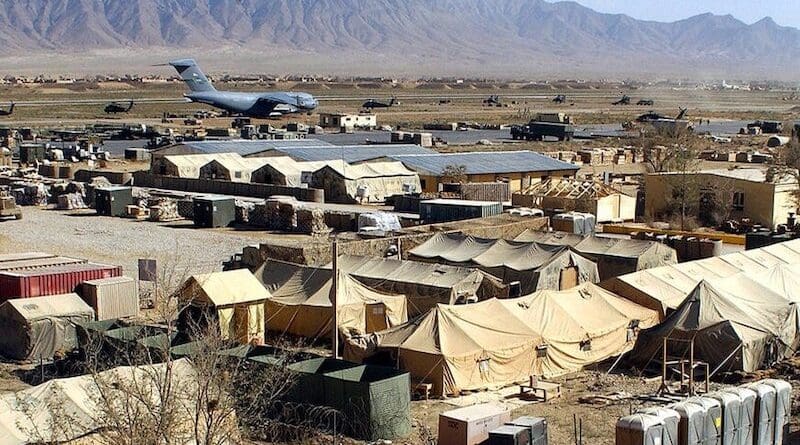
Bagram After America: Why Trump Still Sees A Strategic Mistake In Afghanistan – OpEd
This is not the first time that U.S. President Donald Trump has described the abandonment of Afghanistan’s Bagram Air Base, located near Kabul, as a mistake. On several occasions, he has even hinted at the idea of retaking the base. He again “criticized Afghanistan exit, says leaving Bagram was a mistake.”
Trump, in the past, has strongly criticized the U.S. withdrawal from Afghanistan and has blamed former President Joe Biden for the way it was carried out and described it “most embarrassing moment” in U.S. history. According to Trump, had he remained in office, the Bagram Air Base would not have been abandoned.
In 2021, during Biden’s presidency, U.S. forces withdrew from Afghanistan. However, the withdrawal process was accompanied by chaos, including a deadly attack at Kabul airport that killed thirteen American soldiers along with dozens of Afghan civilians. Trump’s anger toward Biden is also rooted in what he describes as the disorderly and humiliating manner of the U.S. military withdrawal from Afghanistan.
The Strategic Importance of Bagram Air Base
Bagram Air Base played a crucial role during both the Soviet invasion of Afghanistan and the later U.S.-led NATO intervention. In both periods, the base was used as a central hub for military operations across the country.
During the U.S. military presence, Bagram underwent significant expansion. At its peak, thousands of American troops were stationed there. The base included markets, accommodation facilities, and extensive logistical infrastructure.
Bagram’s location made it possible to reach almost all parts of Afghanistan with relative ease. It played a vital role in the war, serving as the primary launch point for U.S. military operations nationwide. The base was also central to supplying, equipping, and sustaining American forces throughout the conflict.
Beyond Afghanistan, Bagram occupies a highly strategic geographic position. It is located close to key U.S. regional rivals, including China, Russia, and Iran. Trump has repeatedly emphasized this point, arguing that Bagram could be used to monitor sensitive Chinese regions. He has even claimed that the base is “one hour away” to China’s nuclear facilities.
For this reason, Trump views Bagram as strategically indispensable. He believes that regaining control of the base would allow the United States to reestablish a strong intelligence presence in the region and protect its broader security interests through Afghanistan.
Originally built by the Soviet Union in the 1950s, Bagram Air Base was heavily damaged during Afghanistan’s civil wars. Following the U.S. invasion, the base was extensively rebuilt and expanded, including the construction of a modern runway.
During the U.S. presence, Bagram was also used to detain high-profile prisoners. Reports of harsh interrogation methods and abuse made the base infamous among Afghans, who came to refer to it as the “Guantanamo of Afghanistan.”
When the United States invaded Afghanistan in 2001, it received support not only from Russia but also from Iran, despite Tehran being a long-standing opponent of Washington. At that time, regional conditions were largely favorable to U.S. objectives.
Over time, however, opposition to the U.S. presence in Afghanistan increased. Many regional countries grew increasingly critical of American policies and openly opposed Washington’s continued military presence in Afghanistan.
Under the Doha Agreement with the Taliban, U.S. forces eventually withdrew from Bagram. However, any attempt to return or retake the base would now be far more difficult for Trump or any future U.S. administration.
Why Trump Cannot Retake Bagram
Although there are no clear signs that Trump has a concrete plan to retake Bagram, he has expressed the desire to do so. If such an attempt were made, it would likely face serious obstacles.
Several factors would make any effort to reclaim Bagram extremely difficult. First and foremost is strong regional opposition. This is no longer 2001, when regional powers supported the U.S. intervention in Afghanistan. Today, many countries openly challenge U.S. unilateralism and oppose its policies.
China, Russia, India, Iran, and others would not support a renewed U.S. military presence in Afghanistan. They are well aware that Washington’s return would serve broader strategic goals and would directly threaten their own regional interests.
Another major obstacle is the firm opposition of the Taliban government. Afghan authorities have repeatedly rejected any suggestion of handing over Bagram. Foreign Minister Mawlawi Amir Khan Muttaqi has stated that Afghanistan would not give up even one inch of its territory to the United States, not even in exchange for the reconstruction of the entire country.
If Trump harbors ambitions toward Afghanistan similar to his controversial remarks about acquiring Greenland from Denmark, he would face fierce resistance. Such a move would encounter strong opposition from the Taliban, the Afghan population as a whole, and regional states alike.
Historically, Afghans have rejected the presence of foreign armies on their soil. In the nineteenth and twentieth centuries, they fought prolonged wars against the British Empire and the Soviet Union. They have resisted numerous invaders throughout history, earning Afghanistan the reputation of being the “graveyard of empires.”
Conclusion
The U.S. decision to abandon Bagram Air Base was driven by necessity. The costs of the war had become unsustainable, and the strategic objectives the United States sought in Afghanistan were not fully achieved.
Trump is not entirely wrong to describe the abandonment of Bagram under the Biden administration as a mistake. However, any attempt by Trump to return to Afghanistan or retake Bagram would likely prove to be an even greater mistake—one that could surpass the very error he criticizes.

Like what you read?
Please consider supporting Eurasia Review. Thank you for your consideration!
