
How A Multi-Functional Bridge Unlocks China’s Development Approach – OpEd
In today’s world, the so-called “slash youth” refuse to be defined by a single job title, but enjoy the self fulfillment through embracing multiple roles—singer/fashion designer/writer etc. But what if infrastructure could also embrace this multiplicity? In China, a new generation of bridges do exactly that, serving as the transit corridor, tourist attraction, sports venue, and economic driver.
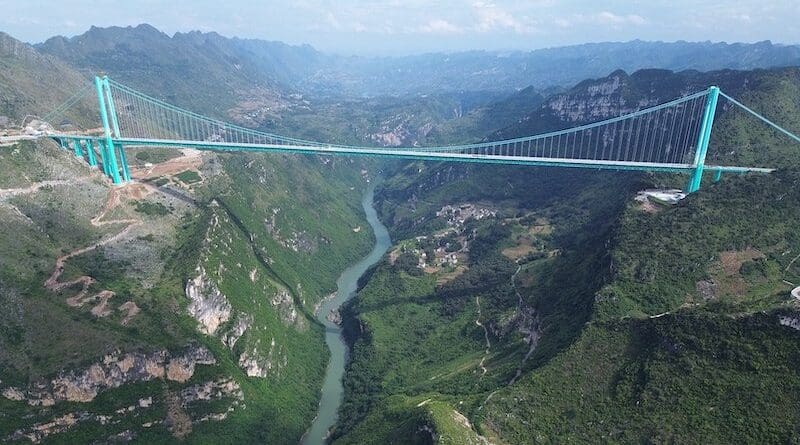
The recently opened Huajiang Canyon Bridge in Guizhou Province is now the world’s highest and also longest-span steel truss girder suspension bridge in mountainous terrain, with its deck 625 meters above the river and a main span of 1,420 meters. More than just a feat of engineering, it draws visitors to experience a high-speed glass elevator leading to a café 2600 feet above the river, stunning views on a glass walkway, and a record-breaking bungee jump. It redefines bridges not merely as transportation links, but as multifunctional hubs of economic, technological, and social activity.
Technology as Backbone
This multi-functionality was only made possible with advanced technology. Smart cables act as a “nervous system,” monitoring structural health in real time. The construction overcame challenges in wind resistance and high-altitude engineering, while a light-water curtain show blends infrastructure with nature.
The bridge exemplifies China’s commitment to technology self-reliance and innovation, a strategic priority in its 14th Five-Year Plan. To “achieve greater self-reliance and strength in science and technology and steer the development of new quality productive forces” is among a few major objectives in the CPPCC’s recommendations for formulating the 15th Five-Year Plan.
This consistent focus on original innovation is reflected in over 3.6 trillion yuan of R&D investment in 2024. China recently ranks among the top 10 in the 2025 Global Innovation Index. It has been one of the fastest-improving economies in innovation capacity over the past decade. Major achievements include the Fujian aircraft carrier and the Chinese space station, alongside breakthroughs in artificial intelligence and quantum communication.
Tangible Public Benefits
In China, technology quickly moves from concept to public benefit. Advances are designed to improve daily life. Generative AI, for example, had 515 million users by June 2025 and is widely used in content creation, office tools, and smart devices. Its applications are expanding into agriculture, manufacturing, and scientific research, according to the 2025 China Internet Infrastructure Resources Conference.
The Huajiang Canyon Bridge also embodies this people-oriented approach. It cuts travel time across the canyon from two hours to two minutes and is expected to lower logistics costs for local agricultural products by 40%. More importantly, it serves as a bridge of hope for rural revitalization, linking remote communities to tourist sites like Huangguoshu Waterfall. Villagers can now access tourism-driven jobs and income without leaving home. Tangible benefits for local people come first in the pursuit of high-quality development.
Integrated Development Model
It has been a common pursuit to merge world-class infrastructure with cultural, economic, and symbolic roles. France’s Millau Viaduct combines transport with tourism through an observation deck. The UK’s Gateshead Millennium Bridge tilts to accommodate cyclists, pedestrians, and boats, while also serving as a dynamic public art piece.
In China’s Guizhou Province, the rapid growth of bridges, from around 2,900 bridges in the 1980s to over 32,000 today, reflects an integrated strategy for infrastructure building and poverty alleviation. This integrated model also reflects the Chinese principle of “killing three birds with one stone.” For example, the Balinghe Bridge opened in 2009 was designed for international sports like bungee jumping and skydiving. It also features a bridge technology museum and supports educational tourism, turning an engineering landmark into a cultural-tourism IP. This “bridge-tourism integration” model explores how a mega-bridges can be more than transit routes—they can drive local economic and cultural growth, and deliver tangible benefits to improve the quality of life.

Like what you read?
Please consider supporting Eurasia Review. Thank you for your consideration!
