
She Was Only Three – OpEd
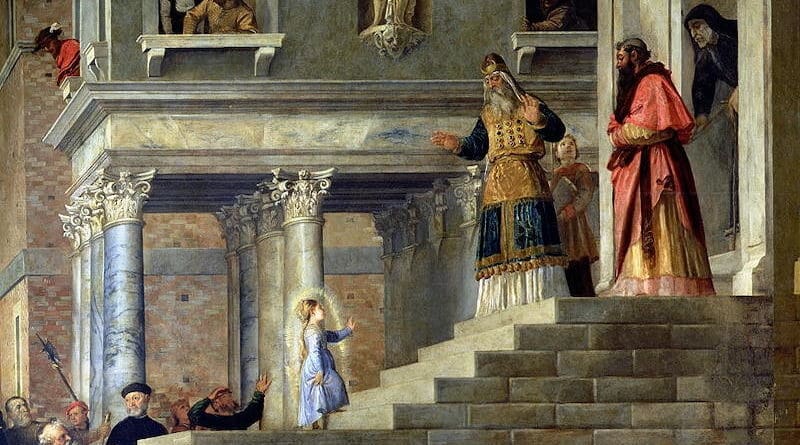
The little girl stood at the bottom of the temple steps, clutching her mother’s hand. The stones were cold under her bare feet. Somewhere above, the priests were chanting. Her father, Joachim, knelt and kissed her forehead one last time. Anne’s eyes were already red. No one spoke the obvious: they would not carry her home again tonight. Mary looked up, those enormous child-eyes that somehow already held tomorrow, and said simply, “I want to stay with God.” Then she let go of her mother’s fingers and began to climb. One step. Two. Fifteen steps without looking back. Tradition says the child who would one day carry the Saviour was herself carried by angels that day so her feet would not stumble.
Every November 21, the Church remembers that climb. We call it the Presentation of the Blessed Virgin Mary.
I used to think the story was sweet the way old paintings are sweet, distant, gold-framed, a little too perfect.
Scripture never mentions this event directly. The Protoevangelium of James, written around AD 150, is our earliest witness, but the feast itself flows from a deeper place in the heart of the Church. It flows from the same impulse that made the early Christians linger over every possible detail of Mary’s life. If she was going to be the living Ark, the spotless dwelling place of the Word, then every moment of her existence must have been radiant with purpose, even when she was too small to understand the words of the psalm being sung around her.
Luke gives us the only biblical glimpse we have of Mary as a young girl, and it comes much later. Twelve years after the Presentation, maybe more, she is in the temple again. This time she is the one who is lost, and her parents are the ones climbing steps in panic. “Son, why have you treated us like this?” Mary asks Jesus when they finally find Him. The question is so human, so parental. Yet the girl who once walked away from Anne and Joachim without tears now stands in the same courts and hears her Son answer, “Did you not know that I must be in my Father’s house?” Something closes like a circle. The child who gave herself entirely to the temple has raised a child who knows the temple is His true home. The Presentation was not a single day. It was the first note of a lifetime spent saying yes.
We modern people struggle with this feast because we hate goodbyes. We prolong adolescence, soften every transition, pad every corner. We want our children forever within arm’s reach. And here is the Church holding up a three-year-old who wakes before dawn, kisses her parents, and walks into a life of silence, prayer, and hiddenness because she has already heard Love calling her name.
But the Presentation is not finally a story about loss. It is a story about belonging. Mary did not cease to be Anne’s daughter that day. She became more truly everyone’s mother. The temple was not the end of home. It was the widening of home until it stretched to hold the entire world. That is why the feast matters in 2025, in our noisy, wounded, distracted century. We need to remember that the most important journeys begin with a single, courageous letting-go.
I think of the teenager who finally walks into the confessional after years away. Of the wife who stays when leaving would be easier. Of the young man who puts on the uniform or the habit or the collar because something deeper than ambition is tugging at his heart. Of the mother who hands her sick child to the surgeons and whispers, “She was Yours before she was mine.” Every real yes echoes that little girl on the temple steps.
Presenting ourselves to God is rarely dramatic. Most days it looks like getting out of bed when we do not feel like it. Like speaking kindly when we are exhausted. Like forgiving again. Like staying faithful in the small, unglamorous duties no one applauds. Mary’s Presentation was not a spectacular exception. It was the pure form of what we are all invited to do, day after ordinary day.
She was only three. And she walked straight into the heart of God without looking back, because even then she somehow knew: the safest place, the truest home, the widest love, is always wherever the Father is waiting.
May we, too, have the courage to climb.

Like what you read?
Please consider supporting Eurasia Review. Thank you for your consideration!
