
Yet Another Lackluster COP, With Little Progress On The Ground – OpEd
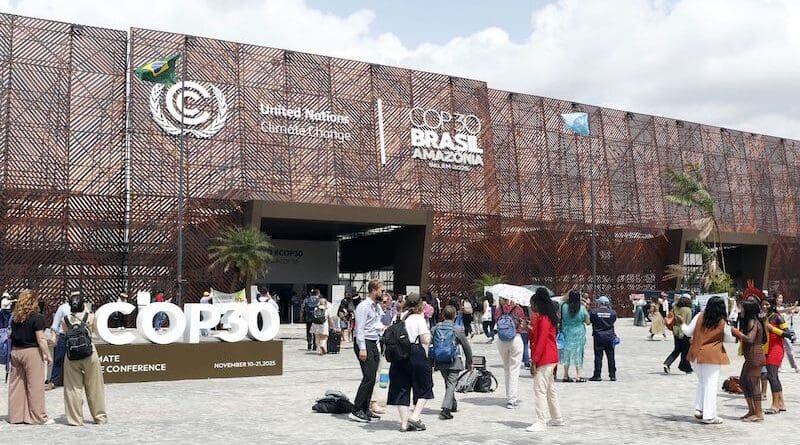
Almost similar to the 29 earlier COP (Conference of the Parties) that were organised in different venues around the world each year, COP 30 at Belem in Brazil also started with high expectations and hopes about finding solution to the global climate crisis and ended as a damp squib.
As number of countries, have different background, economic status, priorities and compulsions, often views are expressed during the deliberations by the participating countries, which highlight the sharp difference in the strategies to be adopted to overcome the climate crisis. This is so, in spite of the fact that every country is committed to manage the climate challenges in the best manner possible.
COP in the earlier years have struggled to arrive at a resolution that would reflect the views of each country to the extent possible and finally they end up as a compromise resolution. Such compromise resolution do not reflect the ideal solution, keeping the ground realities in view and they take the battle against climate change nowhere. This is what has happened in COP 30 also.
Global warming and emissions
The grim nature of the global climate issue is well reflected by the steady increase in the global temperature. The rising temperature trend continues unabated, with the 2023–2025 three-year period projected to be the first time the average exceeds 1.5 degree centigrade temperature. The adverse Impact of rise in global temperature is already clearly evident, with seasonal changes, flood and drought taking place in different countries in an unexpected manner, sea level rising and melting of ice. Both Arctic and Antarctic ice are melting due to climate change, primarily driven by warming air and ocean temperatures. In the Arctic, this warming is amplified, causing a faster rate of ice loss than in Antarctica, though both ice sheets are losing mass overall. This melting leads to global sea-level rise and disrupts weather patterns worldwide.
There is no difference of view among the countries participating in COP and among the technologists, that the change in the global temperature is caused by unchecked emission of noxious gases such as carbon dioxide, sulphur dioxide ,nitrous oxide and methane. Such emissions take place due to use of fossil fuel such as coal, crude oil and natural gas. Obviously, the primary requisite to stop the emission of such global warming noxious gases is to completely eliminate the use of fossil fuel.
Tall targets and little action
During the much publicised COP in Paris and Glasgow earlier, a number of countries including USA and China promised that they would completely eliminate the emission of noxious gas by a targeted timeline. While China said that it would emerge emission free by the year 2050, India announced that it would become emission free by the year 2070. However, claims on emission free timeline by such countries appear to be now far fetched, as the steps initiated to get emission free status by these countries are minimal or much less than the steps required.
While coal as an energy source is considered as one of the major “culprits” causing climate crisis, China, India, Australia, South Africa, Indonesia continue to open new coal mines and are targeting to increase the production and use of coal. Global coal production has reached an all-time high in recent years, driven by production increases by major producers like China, India, and Indonesia, which boosted overall output in 2024 to a record 9.15 billion tonnes. Such a trend is likely to continue.
Production of crude oil, (use of which as energy source is a major contributor to emissions) by crude oil rich countries such as Russia, Saudi Arabia, Qatar, Venezeula, Nigeria and USA are steadily increasing and are being exported around the world. Global crude oil production is projected to increase in 2025, with a 3.1 million barrel per day rise expected due to contributions from both OPEC+ and non-OPEC+ nations.
Methane is another deadly global warming gas. Methane emissions originate from both natural and human sources, with the largest human-caused sources being agriculture especially from livestock and rice cultivation. Production and transport of fossil fuel such a s crude oil, natural gas, and coal and waste landfills also cause large scale methane emissions. Global methane emissions are currently still rising and the world is far from meeting the goal of a30% reduction in methane emissions from2020 levels by 2030.
Discussion in vacuum
With such global emissions continuing and concerned countries not reducing production of fossil fuel and consuming countries of fossil fuel not reducing consumption level, any discussion on tackling climate change in COP is bound to be in vacuum.
Alternate energy source
It appears that the solution to find alternate eco friendly fuel for energy source at affordable cost and at an adequate level will not happen anytime soon.
While power from wind and solar as renewable energy is increasingly focused, however, given the limiting factors such as seasonal variations, renewable energy source can never be a substitute for fossil fuel fully.
Hydrogen energy source is another targeted research and development programme but the technology is still revolving and production cost of hydrogen to generate energy is unlikely to match the production cost of energy from fossil fuel anytime soon. One has to keep the fingers crossed at this stage as to how far use of hydrogen can reduce the global emissions, given the issues faced in the production cost and transportation of hydrogen gas.
Emissions caused by war
While COP discuss about global warming issues, conflict and war frequently take place between the participating countries in COP, with use of drone and missiles to drop bombs, which cause fire hazards and huge emissions of noxious gas.
It is surprising that this aspect has not been discussed in the COP 30
Lacklustre COP
The focus of views expressed in COP 30 is that there should be no uniform regulation for reduction in emission by all countries.
The developing countries have opposed the suggestion to commit countries to timeline to eliminate use of fossil fuel.
Further, developed countries have insisted that specifying such a path is critical to keep the planet from over heating beyond 1.5 degree Celsius.
There is also disagreement by developed countries about the quantum of financial assistance that they should provide to the developing countries to combat climate change.
The net result is that there is no clear agreement between the countries about facing the climate issue challenge and it appears that every country would go in its own way to manage its economy and its development plans, irrespective of the impact on the global climate.
Under the circumstances, it is no surprise that COP 30 has ended as a lacklustre exercise.

Like what you read?
Please consider supporting Eurasia Review. Thank you for your consideration!

True.However,the exercise should continue.Regards,
Dr G.Sundaram.
Dear NSV
I have been advocating demo plants and small scale units using NNR or NMR concept and also for using abandoned deep mines and abandoned oil wells for further deepening and tapping Geothermal energy. We can do an organic rankine cycle demo unit in Kolar mines which has gone almost 4 km deep. Some of the abandoned oil drilling holes have gone to 4 km as well.
The use of GYRATRON to drill faster and deeper has to be seriously pursued.
If G20 can pursue these ideas and India puts in some money and carries out R&D in SMRs and NNRs and Geothermal field with non steam and steam based power cycles, it will definitely help us in reducing coal and petroleum.
Where there is a will there is a way. Love and regards. great writing. Thank you. PONNANI